

Pakistan says an estimated 500,000 children missed vaccinations in recent anti-polio drive

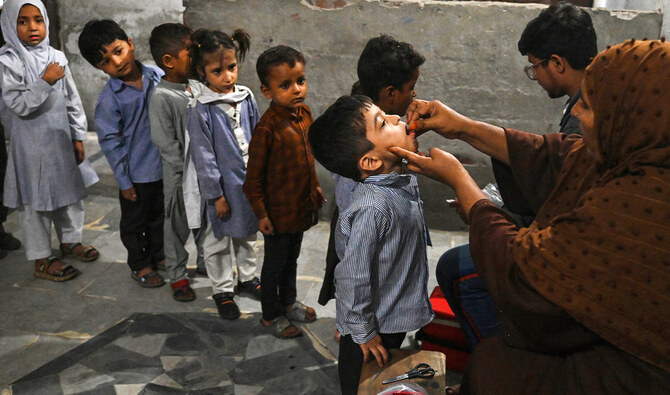
Health workers administer polio drops to children at a school during a vaccination campaign in Lahore, Pakistan, on October 28, 2024. (AFP/File)
Short Url
Updated 10 November 2024
Follow

Pakistan says an estimated 500,000 children missed vaccinations in recent anti-polio drive

  • PM’s coordinator on health says refusals, unavailability of people caused children to miss vaccinations in November
  • Says unvaccinated Afghan refugees traveled to other parts of Pakistan to escape deportation, leading to spread of polio 

ISLAMABAD: An estimated 500,000 Pakistani children missed polio vaccinations during this month’s countrywide inoculation drive, the country’s chief health official confirmed this week, attributing it mostly to people refusing vaccines or being unavailable due to traveling when the campaign was launched. 

Pakistan has reported 48 polio cases this year, with 23 of those reported from the country’s southwestern Balochistan province, 13 from Sindh, ten from Khyber Pakhtunkhwa (KP) and one each from Punjab and Islamabad.

The alarming surge in cases prompted Pakistan to conduct a countrywide anti-polio vaccination drive from Oct. 28 to Nov. 3, aiming to inoculate over 45 million children against the infection.

Pakistan remains one of only two countries worldwide where polio remains endemic. Misinformation about vaccinations and attacks by religiously motivated militants on polio teams have been major impediments to immunization campaigns.

“This year I don’t have the exact figure but we are expecting around 500,000 refusals, unavailability [of people for vaccinations],” Malik Mukhtar Ahmed Bharath, coordinator to the prime minister on national health services, told Arab News in an exclusive interview. 

“But we are not going to leave them [children] we are going to chase them, we are going to track them, trace them and we are going to get them vaccinated for this polio.”

Since late 2018, Pakistan has seen a resurgence of poliovirus cases, highlighting the fragility of gains achieved in the preceding years when cases dropped in 2023 to six, 20 in 2022 and just one in 2022.

Attacks on polio vaccinators and security teams deployed to protect them have also increased. 

Seven people, including five children, were killed when a bomb targeted police traveling to guard vaccine workers this month. Days earlier, two police escorts were gunned down by militants.

The official regretted that over 90 polio vaccinators have been killed in the country since 2012. 

“[Overall] more than 90 have been martyred just because they are serving the nation and I do not think so anywhere in the world this happens,” Bharath said. 

Speaking on the recent surge in polio cases, Bharath said there was nothing wrong with Pakistan’s polio program, adding that the country has one of the best surveillance systems to monitor the disease. 

He said one of the major causes of the surge in polio cases this year was due to a repatriation drive launched in 2023 by Pakistan against “illegal immigrants,” causing many Afghan refugees who were not vaccinated against polio to travel to other parts of the country and spread the infection. 

“The major factor is the Afghan refugees’ repatriation program started [last year],” Bharath said. “Because they were unvaccinated, they just traveled from south Khyber Pakhtunkhwa KP to all over Pakistan to just escape from that repatriation, and that is one of the biggest causes of this spread of poliovirus across Pakistan.”

He said another reason for polio spreading countrywide was because of vaccine refusals in some tribal areas of the country, where the polio teams could not administer drops and due to the deteriorating security situation which made some areas inaccessible for volunteers.

Bharat said the prime minister’s focal person on polio, the country’s polio team and the Ministry of Health developed a strategy in July and August to target previously inaccessible areas with vaccination drives. 

These were the Karachi, Quetta and south KP divisions, the official said.

“The main areas of concern were the Quetta block, that is Quetta, Chaman, Killa Saifullah, Killa Abdullah and adjoining areas,” he said.

Bharath said 64 union councils in Pakistan’s largest city Karachi, seven districts in southern KP were some areas where the government had been unable to eliminate polio for a very long time.

“To deal with the situation, we are working on a different plan for each area,” Bharath said. “In South Punjab, there is a different plan and If we are going in south KP, there is a different plan,” he added. 

He said authorities were determining which programs, influencers or Islamic scholars should be involved in each area to achieve better results.

“There is a segregated campaign for south KP from 11th or 12th [November] which they are going to start in five or four districts,” he informed. 

Bharath said synchronized campaigns with Afghanistan to target polio were “crucial” to eliminate the disease.

“We are going to hold a dialogue in the first week of December in Doha, Qatar, along with WHO and we are going to discuss how we are going to have synchronized campaigns,” he said. 


Islamabad puts drivers on notice as smog crisis worsens

Updated 12 sec ago
Follow

Islamabad puts drivers on notice as smog crisis worsens

  • Police checkpoints have issued over 300 fines and impounded 80 vehicles as Islamabad rolls out roadside emissions checks
  • Transport accounts for over half of the capital’s toxic PM2.5, with air quality this month repeatedly breaching WHO safety limits

ISLAMABAD: Truck driver Muhammad Afzal was not expecting to be stopped by police, let alone fined, as he drove into Islamabad this week because of the thick diesel fumes emanating from his exhaust pipe.

“This is unfair,” he said after being told to pay 1,000 rupees ($3.60), with the threat of having his truck impounded if he did not “fix” the problem.

“I was coming from Lahore after getting my vehicle repaired. They pressed the accelerator to make it release smoke. It’s an injustice,” he told AFP.

This picture taken on December 10, 2025, shows residents examining their cars at an emission testing point in Islamabad. (AFP)

Checkpoints set up this month are part of a crackdown by authorities to combat the city’s soaring smog levels, with winter months the worst due to atmospheric inversions that trap pollutants at ground level.

“We have already warned the owners of stern action, and we will stop their entry into the city if they don’t comply with the orders,” said Dr. Zaigham Abbas of Pakistan’s Environmental Protection Agency (EPA), as he surveyed the checkpoint at the southeast edge of the capital.

For Waleed Ahmed, a technician inspecting the vehicles at the site, “just like a human being, a vehicle has a life cycle. Those that cross it release smoke that is dangerous to human health.”

This picture taken on December 10, 2025, shows technician Waleed Ahmed examining a vehicle to test its emissions on road, on the outskirts of Islamabad. (AFP)

‘SELF-INFLICTED CRISIS’

While not yet at the extreme winter levels of Lahore or the megacity Karachi, where heavy industry and brick kilns spew tons of pollutants each year, Islamabad is steadily closing the gap.

So far in December it has already registered seven “very unhealthy” days for PM2.5 particulates of more than 150 micrograms per cubic meter, according to the Swiss-based monitoring firm IQAir.

Intraday PM2.5 levels in Islamabad often exceed those in Karachi and Lahore, and in 2024 the city’s average PM2.5 reading for the year was 52.3 micrograms — surpassing the 46.2 for Lahore.

Those annual readings are far beyond the safe level of five micrograms recommended by the World Health Organization.

An aerial picture shows dense smog in Islamabad on December 12, 2025. (AFP)

Built from scratch as Pakistan’s capital in the 1960s, the city was envisioned as an urban model for the rapidly growing nation, with wide avenues and ample green spaces abutting the Himalayan foothills.

But the expansive layout discourages walking and public transport remains limited, meaning cars — mostly older models — are essential for residents to get around.

“The capital region is choked overwhelmingly by its transport sector,” which produces 53 percent of its toxic PM2.5 particles, the Pakistan Air Quality Initiative, a research group, said in a recent report.

“The haze over Islamabad... is not the smoke of industry, but the exhaust of a million private journeys — a self-inflicted crisis,” it said.

‘HER BASIC RIGHT’

Announcing the crackdown on December 7, EPA chief Nazia Zaib Ali said over 300 fines were issued at checkpoints in the first week, with 80 vehicles impounded.

“We cannot allow non-compliant vehicles at any cost to poison the city’s air and endanger public health,” she said in a statement.

This picture taken on December 10, 2025, shows a technician pasting a certified sticker on a car after it cleared an emission test in Islamabad. (AFP)

The city has also begun setting up stations where drivers can have their emissions inspected, with those passing receiving a green sticker on their windshield.

“We were worried for Lahore, but now it’s Islamabad. And that’s all because of vehicles emitting pollution,” said Iftikhar Sarwar, 51, as he had his car checked on a busy road near an Islamabad park.

“I never needed medicine before but now I get allergies if I don’t take a tablet in the morning. The same is happening with my family,” he added.

Other residents say they worry the government’s measures will not be enough to counter the worsening winter smog.

“This is not the Islamabad I came to 20 years ago,” said Sulaman Ijaz, an anthropologist.

“I feel uneasy when I think about what I will say if my daughter asks for clean air — that is her basic right.”