

The hardest job in Washington? A look at those who have served as chief of staff for Trump

Former US President and Republican presidential candidate Donald Trump greets his campaign manager Susie Wiles (L) during an election night event at the West Palm Beach Convention Center in West Palm Beach, Florida, on November 6, 2024. (AFP)
Short Url
Updated 10 November 2024
Follow

The hardest job in Washington? A look at those who have served as chief of staff for Trump

WASHINGTON: Susie Wiles will be the latest occupant of the hottest hot seat in Washington — Donald Trump’s chief of staff.
It’s a tough job under the best of circumstances, responsible for networking with lawmakers, administration officials and outside groups while also keeping the White House running smoothly.
But it’s been particularly challenging under Trump, who has a history of resenting anyone who tries to impose order on his chaotic management style. Four people served as chief of staff during his first term, and sometimes things ended on acrimonious terms.
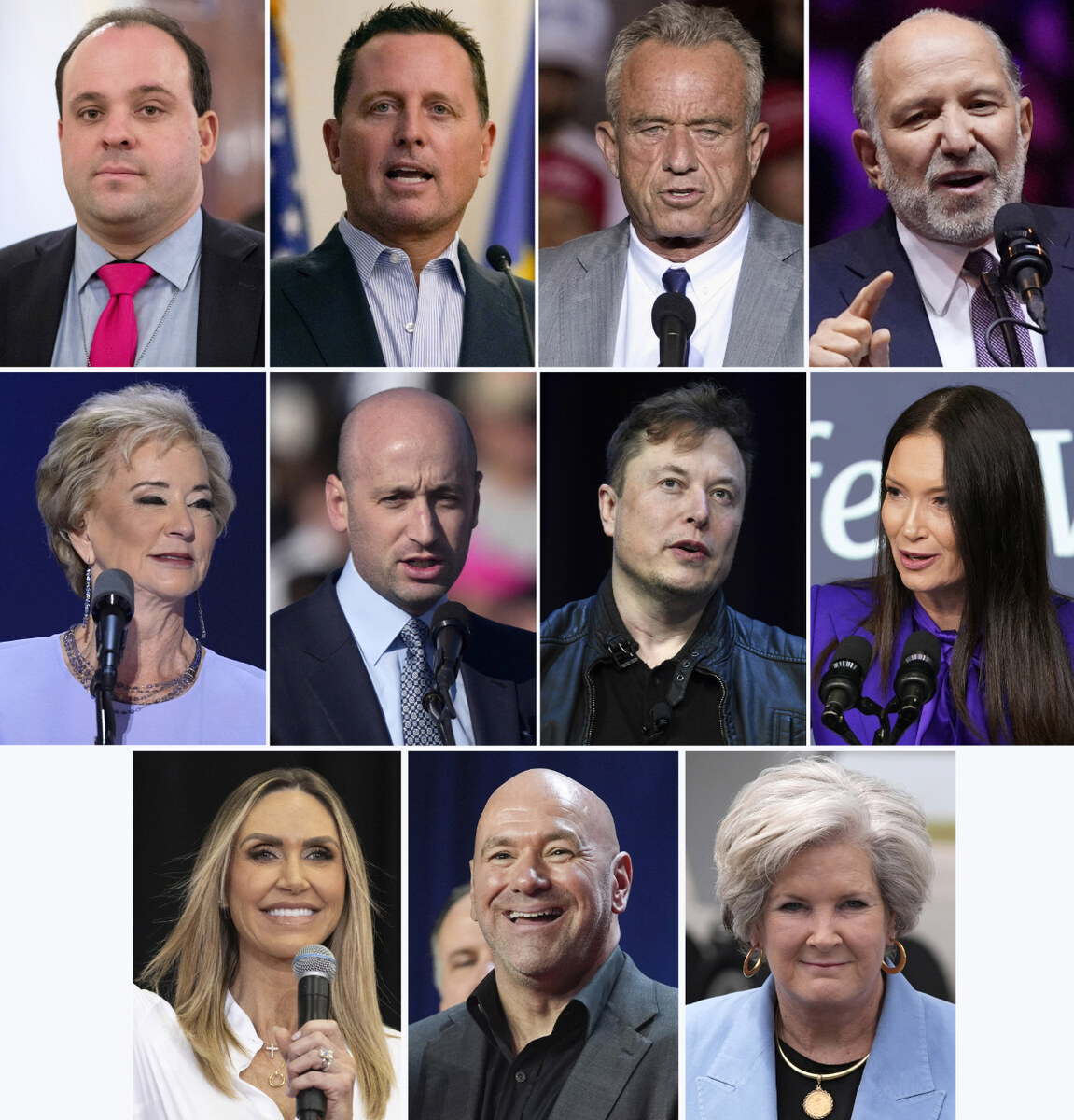


This combination photo of President-elect Donald Trump's longtime friends, aides and allies shows Boris Epshteyn, from top row left, Richard Grenell, Robert F. Kennedy Jr., Howard Lutnick, from center row left, Linda McMahon, Stephen Miller, Elon Musk, Brooke Rollins and from bottom row left Lara Trump, Dana White and Susie Wiles. (AP)

Will past be prologue? It’s impossible to know. So far, Wiles has fared better than most in Trump’s orbit, and she just steered his presidential campaign to victory.
Here’s a look at who came before her.
Reince Priebus
Priebus chaired the Republican National Committee while Trump ran for president in 2016, and he became Trump’s first chief of staff in the White House. Priebus was symbolic of the awkward alliance between the party establishment and Trump’s insurgency, and he struggled to balance the two.
The White House was plagued by infighting and failed to advance legislative goals such as repealing the Affordable Care Act. Priebus was sometimes viewed as untrustworthy by various factions vying for Trump’s favor. Anthony Scaramucci, who memorably but briefly served as Trump’s communications director, profanely attacked him for allegedly leaking information to the media.
Six months into his first term, Trump pushed out Priebus on July 28, 2017. The decision was announced on Twitter, which was par for the course in those tumultuous years.
John Kelly
Next up was Kelly, who had been Trump’s first Homeland Security secretary. Trump liked the way that Kelly, a former four-star Marine general who had served in Iraq, led his immigration crackdown.
But he soon became frustrated by Kelly’s attempts to impose military-style order on the chaotic White House. Kelly clashed with the president and some of his allies, ultimately becoming more isolated and less influential.
Trump appeared so eager to get rid of Kelly, he announced his departure on Dec. 8, 2018, without having a replacement lined up.
While Kelly served longer in the role than anyone else, his break with Trump was ultimately the most acrimonious. He described his former boss in acidic terms last month, saying Trump met the definition of a fascist and once praised Adolf Hitler as having done “some good things.”
Mick Mulvaney
It took days for Trump to settle on a replacement for Kelly, an unusual delay for a such a critical role. He chose Mulvaney, a former South Carolina congressman who was running the White House budget office at the time.
The decision came with an asterisk — Trump called Mulvaney his “acting” chief of staff, suggesting the position would be temporary.
Mulvaney abandoned Kelly’s strict management approach and decided to “let Trump be Trump.” Instead of managing the seemingly unmanageable president, Mulvaney focused on overseeing the staff and working with lawmakers.
He held the job for a little more than a year, departing on March 6, 2020, after Trump was acquitted in his first impeachment trial.
Mark Meadows
Trump turned to Meadows, a North Carolina congressman and leader of the right-wing House Freedom Caucus, to serve as his fourth chief of staff. It was a challenging time, with the coronavirus spreading in the United States and around the globe.
Long viewed as one of the roadblocks to congressional deal-making, Meadows played a leading role in negotiating pandemic relief legislation. He also proved himself as a loyalist as Trump was running for reelection against Joe Biden. Meadows oversaw a White House awash in conspiracy theories about voter fraud as Trump tried to overturn his defeat.
A former aide said Meadows frequently burned papers in his office fireplace during this time. Meadows refused to cooperate with a House committee investigating the Jan. 6 attack on the US Capitol, and he was indicted in election-related cases in Georgia and Arizona. He’s pleaded not guilty.


Afghanistan says it thwarted Pakistani airstrike on Bagram Air Base as fighting enters fourth day

Updated 01 March 2026
Follow

Afghanistan says it thwarted Pakistani airstrike on Bagram Air Base as fighting enters fourth day

  • The fighting has been the most severe between the neighbors for years
  • Pakistan accuses Taliban government of harboring militant groups that stage attacks against it

KABUL: Afghanistan thwarted attempted airstrikes on Bagram Air Base, the former US military base north of Kabul, authorities said Sunday, while cross-border fighting between Pakistan and Afghanistan stretched into a fourth day.
The fighting has been the most severe between the neighbors for years, with Pakistan declaring that it’s in “open war” with Afghanistan.
The conflict has alarmed the international community, particularly as the area is one where other militant organizations, including Al-Qaeda and the Daesh group, still have a presence and have been trying to resurface.
Pakistan accuses Afghanistan’s Taliban government of harboring militant groups that stage attacks against it and also of allying with its archrival India.
Border clashes in October killed dozens of soldiers, civilians and suspected militants until a Qatari-mediated ceasefire ended the intense fighting. But several rounds of peace talks in Turkiye in November failed to produce a lasting agreement, and the two sides have occasionally traded fire since then.
On Sunday, the police headquarters of Parwan province, where Bagram is located, said in a statement that several Pakistani military jets had entered Afghan airspace “and attempted to bomb Bagram Air Base” at around 5 a.m.
The statement said Afghan forces responded with “anti-aircraft and missile defense systems” and had managed to thwart the attack.
There was no immediate response from Pakistan’s military or government regarding Kabul’s claim of attempted airstrikes on Bagram or the ongoing fighting.
Bagram was the United States’ largest military base in Afghanistan. It was taken over by the Taliban as they swept across the country and took control in the wake of the chaotic US withdrawal from the country in 2021. Last year, US President Donald Trump suggested he wanted to reestablish a US presence at the base.
The current fighting began when Afghanistan launched a broad cross-border attack on Thursday night, saying it was in retaliation for Pakistani airstrikes the previous Sunday.
Pakistan had said its airstrike had targeted the outlawed Pakistani Taliban, also known as Tehreek-e-Taliban Pakistan, or TTP. Afghanistan had said only civilians were killed.
The TTP militant group, which is separate but closely allied with Afghanistan’s ruling Taliban, operates inside Pakistan, where it has been blamed for hundreds of deaths in bombings and other attacks over the years.
Pakistan accuses Afghanistan’s Taliban government of providing a safe haven within Afghanistan for the TTP, an accusation that Afghanistan denies.
After Thursday’s Afghan attack, Pakistani Defense Minister Khawaja Mohammad Asif declared that “our patience has now run out. Now it is open war between us.”
In the ongoing fighting, each side claims to have killed hundreds of the other side’s forces — and both governments put their own casualties at drastically lower numbers.
Two Pakistani security officials said that Pakistani ground forces were still in control on Sunday of a key Afghan post and a 32-square-kilometer area in the southern Zhob sector near Kandahar province, after having seized it during fighting Friday. The captured post and surrounding area remain under Pakistani control, they added. The officials spoke on condition of anonymity, because they weren’t authorized to speak publicly.
In Kabul, the Afghan government rejected Pakistan’s claims. Deputy government spokesman Hamdullah Fitrat called the reports “baseless.”
Afghan officials said that fighting had continued overnight and into Sunday in the border areas.
The police command spokesman for Nangarhar province, Said Tayyeb Hammad, said that anti-aircraft missiles were used from the provincial capital, Jalalabad, and surrounding areas on Pakistani fighter jets flying overhead Sunday morning.
Defense Ministry spokesman Enayatulah Khowarazmi said that Afghan forces had launched counterattacks with snipers across the border from Nangarhar, Paktia, Khost and Kandahar provinces overnight. He said that two Pakistani drones had been shot down and dozens of Pakistani soldiers had been killed.
Fitrat said that Pakistani drone attacks hit civilian homes in Nangarhar province late Saturday, killing a woman and a child, while mortar fire killed another civilian when it hit a home in Paktia province.
There was no immediate response to the claims from Pakistani officials.