At least 64 attacks against schools reported in Gaza last month, says UNICEF

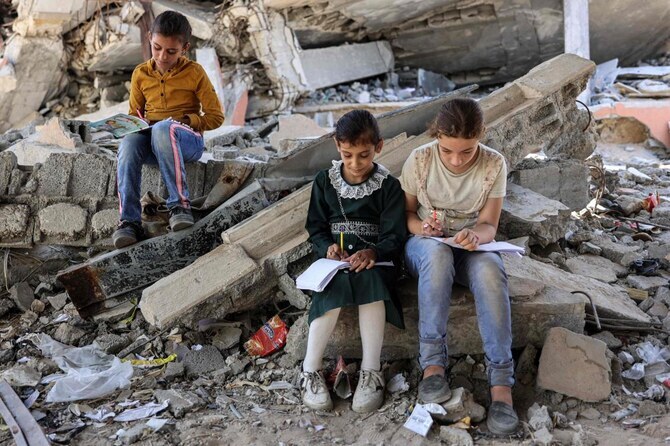
At least 64 attacks targeting schools were reported in the Gaza Strip last month, averaging nearly two incidents per day, according to data from UNICEF. (AFP/File Photo)
Short Url
Updated 10 November 2024
Follow

At least 64 attacks against schools reported in Gaza last month, says UNICEF

  • Strikes in October led to estimated 128 deaths, many children, said UN body

LONDON: At least 64 attacks targeting schools were reported in the Gaza Strip last month, averaging nearly two incidents per day, according to data from UNICEF and its partners released on Saturday.

The strikes in October led to an estimated 128 deaths, many of whom were children, the report added.

These schools, which often double as shelters for displaced families and children fleeing violence, have seen 226 attacks since the conflict began on Oct. 7 last year. Over 1 million children have been displaced in the past 14 months, facing unimaginable hardship and trauma, UNICEF said.

“Schools should never be on the frontlines of war, and children should never be indiscriminately attacked while seeking shelter,” said UNICEF Executive Director Catherine Russell.

“The horrors we are seeing in Gaza are setting a dark precedent for humanity, one where children are hit with bombs at record numbers while looking for safety inside classrooms. Trauma and loss have become their daily norm.”

Nearly half of the attacks in October — 25 in total — were concentrated in northern Gaza, an area experiencing relentless bombardment, widespread displacement, and limited humanitarian aid.

Many of these schools also serve as critical malnutrition treatment points, providing essential services to those in need.

International humanitarian law designates schools as protected spaces. However, since the renewed hostilities in October 2023, more than 95 percent of Gaza’s schools have been partially or completely destroyed. UNICEF reports that 87 percent will need extensive reconstruction before they can be used again.

The plight of children in Gaza underscores the urgent need for adherence to international laws protecting civilians and civilian infrastructure, particularly in conflict zones where the most vulnerable bear the brunt of violence and devastation, UNICEF added.


Syrian Democratic ​Forces withdraws from east of Aleppo

Updated 17 January 2026
Follow

Syrian Democratic ​Forces withdraws from east of Aleppo

RIYADH: Syrian Democratic ​Forces have withdrawn from positions east of Aleppo, according to SDF head Mazloum Abdi.
He announced Friday that SDF will withdraw from east ⁠of ‌Aleppo at ‍7 ‍AM ‍local time on Saturday and redeploy ​them to areas ⁠east of the Euphrates, citing calls from friendly countries and ‌mediators.
Hours earlier, a U.S. military designation had visited Deir Hafer and met with SDF officials in an apparent attempt to tamp down tensions.
The U.S. has good relations with both sides and has urged calm. A spokesperson for the U.S. military did not immediately respond to a request for comment.
Shortly before Abdi’s announcement, interim President Ahmad al-Sharaa had announced issuance of a decree strengthening Kurdish rights.
A wave of displacement
Earlier in the day, hundreds of people carrying their belongings arrived in government-held areas in northern Syria ahead of the anticipated offensive by Syrian troops on territory held by Kurdish-led fighters.
Many of the civilians who fled were seen using side roads to reach government-held areas because the main highway was blocked at a checkpoint in the town of Deir Hafer controlled by the SDF.
The Syrian army said late Wednesday that civilians would be able to evacuate through the “humanitarian corridor” from 9 a.m. to 5 p.m. Thursday and then extended the evacuation period another day, saying the SDF had stopped civilians from leaving.
There had been limited exchanges of fire between the two sides in the area before that.
Men, women and children arrived on the government side of the line in cars and pickup trucks that were packed with bags of clothes, mattresses and other belongings. They were met by local officials who directed them to shelters.

* with input from Reuters, AP