

Suffering in Gaza ‘almost unparalleled’: Humanitarian chief

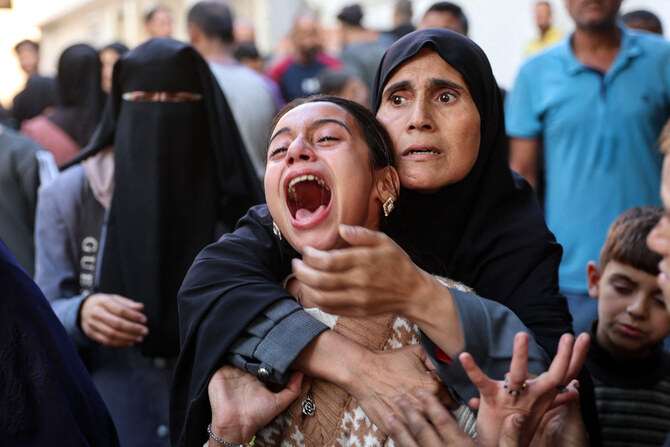
Young Palestinian girl reacts in the courtyard of the al-Shifa hospital in Gaza City after the bodies of victims were transported there, following an Israeli strike that hit a school-turned-shelter in the Al-Shati refugee camp amid the ongoing war between Israel and the Hamas militant group. (File/AFP)
Short Url
Updated 08 November 2024
Follow

Suffering in Gaza ‘almost unparalleled’: Humanitarian chief

  • Norwegian Refugee Council secretary-general: Palestinians pushed ‘beyond breaking point’
  • Jan Egeland: Gaza rendered ‘uninhabitable’ due Israel’s policies

LONDON: Palestinians in the Gaza Strip are experiencing “almost unparalleled” suffering, one of the world’s foremost humanitarian officials has warned following a visit to the enclave, The Guardian reported on Friday.

Jan Egeland, secretary-general of the Norwegian Refugee Council, traveled to Gaza this week, reporting that families, widows and children have been pushed “beyond breaking point” by Israel’s year-long war.

He witnessed “scene after scene of absolute despair” as Palestinian families had been torn apart by attacks, with survivors unable to bury their dead relatives.

Gaza has been rendered “uninhabitable” as a result of Israel’s policies, supported by Western-supplied weaponry, Egeland said.

“This is in no way a lawful response, a targeted operation of ‘self-defence’ to dismantle armed groups, or warfare consistent with humanitarian law,” he added.

“The families, widows and children I have spoken to are enduring suffering almost unparalleled to anywhere in recent history. There is no possible justification for continued war and destruction.”

Since last year, families across the enclave have been repeatedly forced to move from one area to another as a result of Israeli evacuation orders, which now cover 80 percent of Gaza.

The situation is even more dire in northern Gaza, where a month-long Israeli offensive and siege have cut off an estimated 100,000 people from humanitarian aid.

An Israeli brigadier general said this week that there is no intention of allowing the return of Palestinians to their homes in northern Gaza.

Such a policy of forcible transfer would amount to war crimes, humanitarian law experts have said.

As aid continues to be cut off from the Palestinian population, the UN has condemned “unlawful interference with humanitarian assistance and orders that are leading to forced displacement.”

Egeland warned of the “catastrophic impact of strangled aid flows” on the Palestinian population, with people left unable to access food or water for days at a time.

The former Norwegian foreign minister and diplomat said: “There has not been a single week since the start of this war when sufficient aid was delivered in Gaza.”

Despite the acute shortage of humanitarian aid, Israel’s parliament this week passed bills banning the UN Relief & Works Agency from operating in the Occupied Territories, designating it as a terrorist organization.

Egeland called for an immediate ceasefire in Gaza to prevent the “deadly” situation from worsening, adding: “Those in power on all sides act with impunity, while millions across Gaza and the region pay a terrible price.

“Humanitarians can speak out on what we are seeing, but only those in power can end this nightmare.”


‘Wanted for treason’: How Aidarous Al-Zubaidi betrayed Yemen and his own cause

Updated 5 sec ago
Follow

‘Wanted for treason’: How Aidarous Al-Zubaidi betrayed Yemen and his own cause


RIYADH: At a time when he should have acted like a statesman and boarded the plane scheduled to take him to Riyadh on Tuesday evening to meet and shake hands with Yemeni President Rashad Al-Alimi — agreeing to prioritize the interests of the Yemeni people and seek forgiveness for actions taken for personal gain at the expense of the nation — Aidarous Al-Zubaidi chose instead a “no-show,” cementing his image as a traitor to his country. Not only that, but he confirmed this by opening weapons depots and attempting to incite chaos in an “after me, the deluge” fashion. This was revealed by Yemeni Information Minister Moammar Al-Eryani a few days ago in a post on X, where he exposed these destabilizing actions.
For those unfamiliar with him, Al-Zubaidi is the head of the Southern Transitional Council, which seeks the secession of southern Yemen. Despite efforts by the Yemeni government and the Coalition to Support Legitimacy in Yemen to contain him for years — and despite many, including other southern representatives, disagreeing with his approach to the matter — Al-Zubaidi acted as an opponent and saboteur of the Yemeni government, even while serving within it as a prominent member.
Although Saudi Arabia, which leads the coalition, has affirmed the legitimacy of the southern cause and its commitment to supporting whatever Yemenis agree upon, Al-Zubaidi chose narrow self-interest, aligning with foreign powers at the expense of his homeland and attempting to impose southern secession by force. His sole aim: to seize power for himself.
He went even further, reportedly using his forces and resources to destabilize Saudi Arabia — the neighboring country that has invested all its resources in mending Yemen’s divisions. He forgot that Riyadh, from which he fled, was the one that protected him and his allies from the Houthi coup and its brutal war.
Early on Wednesday, the coalition revealed that Al-Zubaidi had not arrived in Saudi Arabia as planned and had fled to an unknown location, leaving members and leaders of the STC without any information on his whereabouts. He was expected in Riyadh to attend a comprehensive conference uniting all southern factions. Hours later, the STC claimed that Al-Zubaidi was in Aden and still carrying out his duties. Yemen experts told Arab News that Al-Zubaidi is more likely to be hiding in Al-Dhale, the mountainous area from which he hails. Other reports suggest he might have fled overnight to Somaliland in a tiny boat.
Further details from the coalition’s statement on Wednesday said Al-Zubaidi fled after distributing weapons and ammunition to dozens of elements in Aden, aiming to stir unrest in the city in the coming hours.
Meanwhile, the Yemeni Presidential Leadership Council, headed by Al-Alimi, held an emergency meeting attended by members Sultan Al-Arada, Tariq Saleh, Abdulrahman Al-Muharrami, Dr. Abdullah Al-Alimi and Othman Mujalli.
The council decided to revoke Al-Zubaidi’s membership and refer him to the attorney general on charges of high treason, harming Yemen’s political and economic standing, obstructing state efforts against the coup, and inciting internal strife.
The meeting also resolved to dismiss Transport Minister Abdulsalam Humaid and Minister of Planning and International Cooperation Waed Badhib from their posts and refer them for investigation. It called for the pursuit and arrest of those involved in distributing weapons and threatening civil peace, stressing that the state will act firmly against any violations to uphold the rule of law and protect public rights and freedoms.
Notably, the meeting revealed internal divisions within the STC, as one of its prominent members, Al-Muharrami, attended the Presidential Leadership Council meeting that voted to strip Al-Zubaidi of his membership and refer him for investigation.
Al-Muharrami also deployed his Giants Brigades forces to prevent security breakdowns in Aden, in coordination with the legitimate Yemeni government, following the coalition’s announcement of Al-Zubaidi’s escape and his attempt to escalate tensions in Al-Dhale Governorate.
With the council’s declaration that Al-Zubaidi is now wanted to face justice, not only has his mask and immunity fallen, but the council has also sent a clear message: Everything is open for discussion — except treason.
What happens next in Yemen? According to a political analyst close to decision-makers in the council, it is important to focus on what Al-Eryani tweeted days ago about Al-Zubaidi’s followers attempting to use the “return of Al-Qaeda” as a scare tactic.
The analyst added: “Ironically, Al-Zubaidi himself has done the most to aid extremist groups by trying to create chaos. But these are desperate attempts that are bound to fail, thanks to several factors, including the presence of Saudi-trained Yemeni special forces, the readiness of the Islamic Military Counter Terrorism Coalition, and the very close, ongoing Saudi-American coordination that will keep extremists in check.”
The source continued: “Al-Zubaidi’s betrayal also served the Houthis, but the failure of his project and the resistance to it will serve as a reminder that the situation on the ground has changed since the early days of the war, when coalition air superiority was the only source of strength. Today, there is coordination, trained and unified Yemeni forces, and statesmen from all factions who believe Yemen has been exhausted by war — and that the best solution for everyone lies at the dialogue table … in Riyadh.”
As several Yemeni officials recently told Arab News, there is great optimism about the outcomes of the Riyadh dialogue, while Saudi Arabia continues to affirm at every opportunity that it will support whatever the Yemenis agree upon.