Israel must comply with ICJ measures to prevent genocide: UN human rights chief

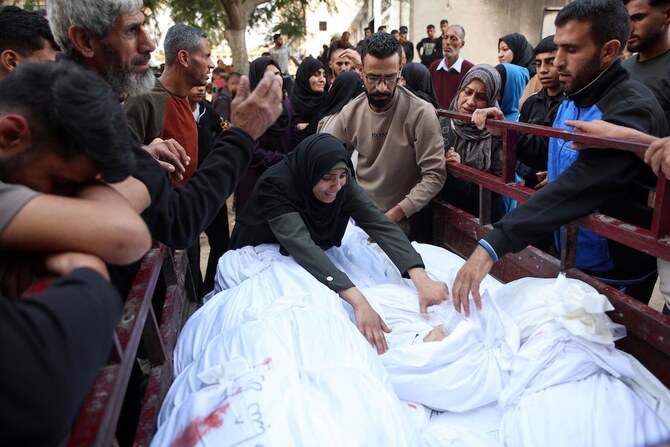
The UN breakdown of the victims’ age and gender backs the Palestinian assertion that women and children represent a large portion of those killed in the Israeli war on Gaza. (AFP)
Short Url
Updated 08 November 2024
Follow

Israel must comply with ICJ measures to prevent genocide: UN human rights chief

  • Volker Turk’s office publishes report covering violations between November 2023, April 2024
  • UN Human Rights Office: Almost 70% of fatalities in Gaza are children, women

NEW YORK: The UN high commissioner for human rights on Friday called on Israel to “fully and immediately” comply with the provisional measures issued in January by the International Court of Justice demanding action to prevent a genocide from being perpetrated against the Palestinians.

Volker Turk also called on states to honor their obligations under international law and “assess arms sales or transfers and provision of military, logistical or financial support to a party to the conflict, with a view to ending such support if this risks serious violations of international law.”

His warning comes as a new report by his office, published on Friday, warned that “if committed with intent to destroy, in whole or in part, a national, ethnical, racial or religious group, (Israel’s violations) may constitute genocide.”

In January, after considering an original case brought by South Africa accusing Israel of genocide, the ICJ issued a ruling that included provisional measures ordering Israel to take action to prevent and punish the commission of, or the incitement to commit, genocide; to halt the indiscriminate killing of Palestinians; and to immediately facilitate the delivery of humanitarian aid to the people of Gaza.

Turk said Israel’s compliance with the ICJ ruling is now “even more critical and urgent” in light of the new report, which details “the horrific reality that has unfolded for the people of Israel and Gaza since 7 October 2023,” and concludes by demanding justice with respect to the grave violations of international law that have been committed.

The ICJ measures are also more pertinent than ever given the most recent events, Turk said, including Israel’s operations in northern Gaza and its adoption of legislation banning the main UN aid agency for Palestinian refugees from operating in Israel and occupied East Jerusalem.

“It is essential that there is due reckoning with respect to the allegations of serious violations of international law through credible and impartial judicial bodies and that, in the meantime, all relevant information and evidence are collected and preserved,” said Turk.

The new report covers violations that occurred from November 2023 to April 2024, including the killing of civilians and breaches of international law that it said could amount to war crimes.

“If committed as part of a widespread or systematic attack directed against a civilian population, further to a State or organizational policy, these violations may constitute crimes against humanity,” the report says.

Turk urged support for the work of accountability mechanisms, including the International Criminal Court, in relation to the conflict in Gaza, for the exercise of universal jurisdiction to investigate and try crimes under international law in national courts, and for compliance with extradition requests of suspects of such crimes to countries where they would receive a fair trial.

The report highlights repeated statements from Israeli officials calling for Gaza’s entire destruction and the exodus of its people.

It documents Israel’s efforts to “rationalize discrimination, hostility and violence towards, and even the elimination of, Palestinians.”

The report underscores how civilians have borne the brunt of the attacks, including through the initial “complete siege” of Gaza, as well as Israel’s continuing “unlawful failures” to allow the entry of humanitarian aid, the destruction of civilian infrastructure, and mass displacement of Palestinians.

“This conduct by Israeli Forces has caused unprecedented levels of killings, death, injury, starvation, illness and disease,” the reports says, adding that Hamas and other Palestinian armed groups have also committed serious violations of international law on a wide scale

“The rules of war, in force now for 160 years, were designed to limit and prevent human suffering in times of armed conflict,” Turk said.

“Their wanton disregard has led to the current extremes of human suffering which we continue to see today.

“It seems inconceivable that the parties to the conflict refuse to apply universally accepted and binding norms developed to preserve the very bare minimum of humanity.”  

The UN Human Rights Office says close to 70 percent of fatalities in Gaza are children and women, indicating “a systematic violation of the fundamental principles of international humanitarian law, including distinction and proportionality.”

The continuation of these attacks “demonstrates an apparent indifference to the death of civilians and the impact of the means and methods of warfare selected,” the report states. 

It also raises concerns over the forcible transfer of Palestinians, attacks on hospitals in “apparent systematic fashion” as well as journalists, and the reported use of white phosphorus munitions.

“Our monitoring indicates that this unprecedented level of killing, and injury of civilians is a direct consequence of the failure to comply with fundamental principles of international humanitarian law — namely the principles of distinction, proportionality and precautions in attack,” Turk said. 

“Tragically, these documented patterns of violations continue unabated, over one year after the start of the war.

“The trends and patterns of violations, and of applicable international law as clarified by the International Court of Justice, must inform the steps to be taken to end the current crisis,” he added.

“The violence must stop immediately, the hostages and those arbitrarily detained must be released, and we must focus on flooding Gaza with humanitarian aid.” 


Syrian army pushes into Aleppo district after Kurdish groups reject withdrawal

Updated 10 January 2026
Follow

Syrian army pushes into Aleppo district after Kurdish groups reject withdrawal

  • Two Syrian security officials told Reuters the ceasefire efforts had failed and that the army would seize the neighborhood by force

ALEPPO, Syria: The Syrian army said it would push into the last Kurdish-held district of Aleppo ​city on Friday after Kurdish groups there rejected a government demand for their fighters to withdraw under a ceasefire deal.
The violence in Aleppo has brought into focus one of the main faultlines in Syria as the country tries to rebuild after a devastating war, with Kurdish forces resisting efforts by President Ahmed Al-Sharaa’s Islamist-led government to bring their fighters under centralized authority.
At least nine civilians have been killed and more than 140,000 have fled their homes in Aleppo, where Kurdish forces are trying to cling on to several neighborhoods they have run since the early days of the war, which began in 2011.

HIGHLIGHTS

• Standoff pits government against Kurdish forces

• Sharaa says Kurds are ‘fundamental’ part of Syria

• More than 140,000 have fled homes due to unrest

• Turkish, Syrian foreign ministers discuss Aleppo by phone

ِA ceasefire was announced by the defense ministry overnight, demanding the withdrawal of Kurdish forces to the Kurdish-held northeast. That would effectively end Kurdish control over the pockets of Aleppo that Kurdish forces have held.

CEASEFIRE ‘FAILED,’ SECURITY OFFICIALS SAY
But in a statement, Kurdish councils that run Aleppo’s Sheikh Maksoud and Ashrafiyah districts ‌said calls to leave ‌were “a call to surrender” and that Kurdish forces would instead “defend their neighborhoods,” accusing government forces ‌of intensive ⁠shelling.
Hours ​later, the ‌Syrian army said that the deadline for Kurdish fighters to withdraw had expired, and that it would begin a military operation to clear the last Kurdish-held neighborhood of Sheikh Maksoud.
Two Syrian security officials told Reuters the ceasefire efforts had failed and that the army would seize the neighborhood by force.
The Syrian defense ministry had earlier carried out strikes on parts of Sheikh Maksoud that it said were being used by the Kurdish-led Syrian Democratic Forces (SDF) to launch attacks on the “people of Aleppo.” It said on Friday that SDF strikes had killed three army soldiers.
Kurdish security forces in Aleppo said some of the strikes hit a hospital, calling it a war crime. The defense ministry disputed that, saying the structure was a large arms depot and that it had been destroyed in the resumption of strikes on Friday.
It ⁠posted an aerial video that it said showed the location after the strikes, and said secondary explosions were visible, proving it was a weapons cache.
Reuters could not immediately verify the claim.
The SDF is ‌a powerful Kurdish-led security force that controls northeastern Syria. It says it withdrew its fighters from ‍Aleppo last year, leaving Kurdish neighborhoods in the hands of the Kurdish ‍Asayish police.
Under an agreement with Damascus last March the SDF was due to integrate with the defense ministry by the end of 2025, ‍but there has been little progress.

FRANCE, US SEEK DE-ESCALATION
France’s foreign ministry said it was working with the United States to de-escalate.
A ministry statement said President Emmanuel Macron had urged Sharaa on Thursday “to exercise restraint and reiterated France’s commitment to a united Syria where all segments of Syrian society are represented and protected.”
A Western diplomat told Reuters that mediation efforts were focused on calming the situation and producing a deal that would see Kurdish forces leave Aleppo and provide security guarantees for Kurds who remained.
The diplomat ​said US envoy Tom Barrack was en route to Damascus. A spokesperson for Barrack declined to comment. Washington has been closely involved in efforts to promote integration between the SDF — which has long enjoyed US military support — and Damascus, with which the ⁠United States has developed close ties under President Donald Trump.
The ceasefire declared by the government overnight said Kurdish forces should withdraw by 9 a.m. (0600 GMT) on Friday, but no one withdrew overnight, Syrian security sources said.
Barrack had welcomed what he called a “temporary ceasefire” and said Washington was working intensively to extend it beyond the 9 a.m. deadline. “We are hopeful this weekend will bring a more enduring calm and deeper dialogue,” he wrote on X.

TURKISH WARNING
Turkiye views the SDF as a terrorist organization linked to the outlawed Kurdistan Workers’ Party and has warned of military action if it does not honor the integration agreement.
Turkish Foreign Minister Hakan Fidan, speaking on Thursday, expressed hope that the situation in Aleppo would be normalized “through the withdrawal of SDF elements.”
Though Sharaa, a former Al-Qaeda commander who belongs to the Sunni Muslim majority, has repeatedly vowed to protect minorities, bouts of violence in which government-aligned fighters have killed hundreds of Alawites and Druze have spread alarm in minority communities over the last year.
The Kurdish councils in Aleppo said Damascus could not be trusted “with our security and our neighborhoods,” and that attacks on the areas aimed to bring about displacement.
Sharaa, in a phone call with Iraqi Kurdish leader Masoud Barzani on Friday, affirmed that the Kurds were “a fundamental part ‌of the Syrian national fabric,” the Syrian presidency said.
Neither the government nor the Kurdish forces have announced a toll of casualties among their fighters from the recent clashes.