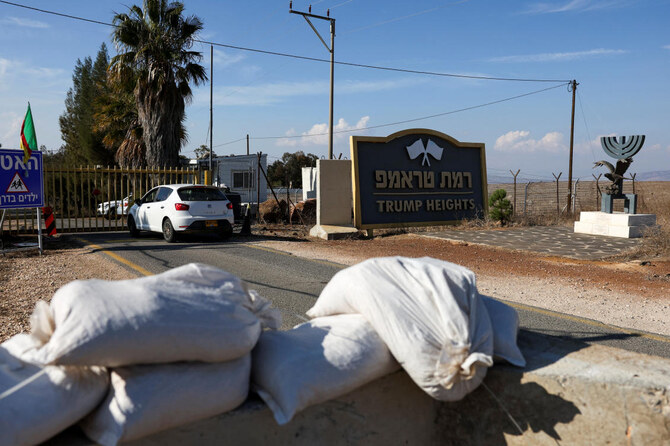
RAMAT TRUMP, Golan Heights: Israeli residents of “Trump Heights” are welcoming the election of their namesake, hoping Donald Trump’s return to the US presidency will breathe new life into this tiny, remote settlement in the central Golan Heights.
During his first term, Trump became the first and only foreign leader to recognize Israel’s control of the Golan, which it seized from Syria in the 1967 Mideast war. Israel thanked him by rebranding this outpost after him.
But a large-scale influx of new residents never materialized after that 2019 ceremony, and just a couple dozen families live in Trump Heights, or “Ramat Trump” in Hebrew. Job opportunities are limited, and Israel’s more than yearlong war against Hezbollah militants in nearby Lebanon has added to the sense of isolation.
Trump’s election has inspired hope in the community that it will attract more members and also more funding for security improvements.
“Maybe it can raise more awareness and maybe some support to help here and help our kids here,” said Yarden Freimann, Trump Heights’ community manager.
Ori Kallner, head of the Golan’s regional council, showed off dozens of plots of land, replete with new asphalt roads, lampposts and utility lines, that residents have prepared for future housing developments.
“President Trump’s return to the White House definitely puts the town in the headlines,” he said.
Hanging on while war rages nearby
Kallner stood next to a metal statue of an eagle and a menorah, symbolizing the United States and Israel, as Israeli warplanes flew overhead. Two explosions from rockets fired from Lebanon punched the hills nearby, and just across the border in Lebanon, plumes of smoke rose into the air from Israeli airstrikes.
An enormous sign with the settlement’s name in Hebrew and English gleamed in the sun, while two large sunbaked metal flags of Israel and the United States were faded almost beyond recognition.
Surrounded by ashen ruins of villages fled by Syrians in the 1967 war, the town is perched above the Hula Valley, where Israel has amassed tanks, artillery and troops for its fight in Lebanon. Most towns in the valley have been evacuated. Trump Heights sends its kids to a makeshift daycare in a nearby settlement after the government shuttered all schools in the region in the wake of the Oct. 1 invasion of Lebanon.
“We find ourselves hanging by our fingernails to be in our own community, not be evacuated, and on the other hand, we cannot work, we cannot send our kids to any kind of an education system,” said Freimann.
Trump Heights is only about 12 kilometers from Lebanon and Syria. Alerts for incoming fire gives residents about 30 seconds’ head start to get to a bomb shelter.
Trump broke with other leaders on the Golan Heights
Israel annexed the Golan, a strategic plateau overlooking northern Israel, in 1981 in a move that is not internationally recognized.
That changed in March 2019 when Trump, without notice, tweeted that the US would “fully recognize” Israel’s control of the territory. His announcement drew widespread condemnation from the international community, which considers the Golan to be occupied Syrian territory and Israel’s settlements to be illegal. The Biden administration left the decision intact, but the US remains the lone country to recognize the Israeli annexation.
Kallner said he hopes Trump will now persuade European countries to recognize Israeli sovereignty there.
According to Israeli figures, the Golan is home to about 50,000 people — roughly half of them Jewish Israelis and the other half Arab Druze, many of whom still consider themselves Syrians under occupation.
Israel has encouraged and promoted settlements in the Golan, and the Druze residents operate farms and a tourism and restaurant sector popular with Israelis. But the area has struggled to develop because of its remoteness, several hours from Israel’s economic center in Tel Aviv.
That economic hardship has only worsened during the war as the hospitality sector cratered. On July 28, a rocket killed 12 Druze children on a soccer field in the city of Majdal Shams, about 12 miles (20 kilometers) away. Israel invaded Lebanon months later.
In June 2019, Prime Minister Benjamin Netanyahu led an inauguration ceremony for Trump Heights. The US ambassador at the time, David Friedman, noted that the ceremony came days after Trump’s birthday and said: “I can’t think of a more appropriate and a more beautiful birthday present.”
As president, Trump was close with Netanyahu
The Golan recognition was among a series of diplomatic gifts that Trump delivered to Israel during his first term. They included recognizing Jerusalem as Israel’s capital and moving the American embassy to the contested city, and a series of diplomatic agreements with Arab countries known as the Abraham Accords.
He has vowed to bring peace to the tumultuous region during his second term, but has not said how.
Netanyahu enjoyed a close relationship with Trump during his first term but ran afoul of the former president when he congratulated Joe Biden on his 2020 victory. The Israeli prime minister announced Tuesday that he was one of the first foreign leaders to call the president-elect and congratulate him on his victory. An official in his office, speaking on condition of anonymity to discuss internal communications, said aides were upbeat and giddy.
“Congratulations on history’s greatest comeback!” the Israeli leader said in a statement. “Your historic return to the White House offers a new beginning for America and a powerful recommitment to the great alliance between Israel and America.”
At Trump Heights, Kallner was optimistic too: “The Golan community is strong and resilient, and people that want to come and live here are from the same material. I believe we will overcome these challenging times and won’t stop growing.”


![]()

Residents of Israeli settlement ‘Trump Heights’ welcome Donald’s return to US presidency
Short Url
https://arab.news/yse4r
Residents of Israeli settlement ‘Trump Heights’ welcome Donald’s return to US presidency
- During his first term, Donald Trump became the first and only foreign leader to recognize Israel’s control of the Golan Heights
- Trump’s election has inspired hope in the community that it will attract more members and also more funding for security improvements


Latest updates


© 2026 SAUDI RESEARCH & PUBLISHING COMPANY, All Rights Reserved And subject to Terms of Use Agreement.