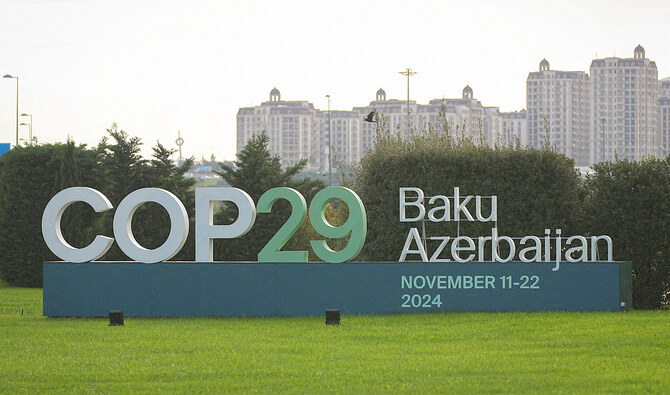

ISLAMABAD: Pakistan will urge developed countries attending the upcoming Conference of the Parties (COP29) in Baku to fulfill their pledges and provide easy access to climate funding without attaching conditions, Prime Minister Shehbaz Sharif’s coordinator on climate change said on Thursday.
The COP29 climate conference, scheduled to take place in Baku between November 11 and 22, will layout new policies and bring together representatives from various nations to discuss the adverse impacts of climate change and evaluate available solutions for adaptation.
Pakistan is ranked as the 5th most vulnerable country to climate change, according to the Global Climate Risk Index. In 2022, devastating floods affected over 33 million people and caused economic losses exceeding $30 billion, highlighting the country’s high susceptibility to extreme weather events.
“Pakistan is very clear on our stance that we need all the developed countries when it comes to the pledges, one, they need to complete their pledges, they need to fulfil their pledges, and two, easy access toward the fundings,” Romina Khurshid Alam, PM Sharif’s coordinator on climate change, told Arab News in an exclusive interview.

In this file photo, taken on August 30, 2024, people wade through flood waters after heavy monsoon rains in Multan. (AFP/File)
Due to the rising temperatures, extreme climatic phenomena, including floods, droughts, cyclones, torrential rainstorms and heatwaves, have been occurring more frequently and with greater intensity across Pakistan.
The South Asian country is among the most severely threatened countries in terms of climate–induced challenges, especially in the context of its dependency on climate-sensitive sectors such as agriculture, water, natural resources and the environment, and socio-economic issues such as poverty. The country’s adaptation to the adverse impacts of climate change is inevitable and likely to become critical in the future.
Alam said vulnerable countries were suffering from their own economic challenges and vulnerabilities, while at the same time, many countries faced additional restraints on climate funding.
“It’s not fair that we always get demands to ‘do more and to do this, to do that, these sanctions are coming,’ that is something which is on the human rights violation as well,” she said, adding that Pakistan wanted to raise its voice on what happened to the pledges, how many countries benefited from them and what straightforward mechanisms could be pursued to provide effective support.
Asked about the total amount pledged by developed nations, Alam said she would provide the exact figure after COP29, but noted that “the number is very low.”
“At COP29, we are talking about the data bank system like in a way that what countries are suffering and looking forward for the carbon credits policies,” she added.

In this file photo, taken on August 30, 2024, residents gather at the site of a landslide owing to heavy monsoon rains in the remote area of Patrak, in Upper Dir district, Khyber Pakhtunkhwa province. (AFP/File)
Last month, Pakistan proposed the establishment of a regional climate data bank to help Vulnerable Twenty (V20) group of countries prepare an evidence-based response to climate disasters.
Alam said the South Asian country had planned “many things” to showcase at Pakistan Pavilion during COP29.
Speaking about the prevailing smog issue, she said Pakistan would take it up with the Indian team at COP29.
“We are open to dialogues and open to come up with the solution, we want to get the things done by dialogue,” she said, noting that the chief minister of Pakistan’s Punjab, Maryam Nawaz, had also urged India to sit together to resolve this issue.
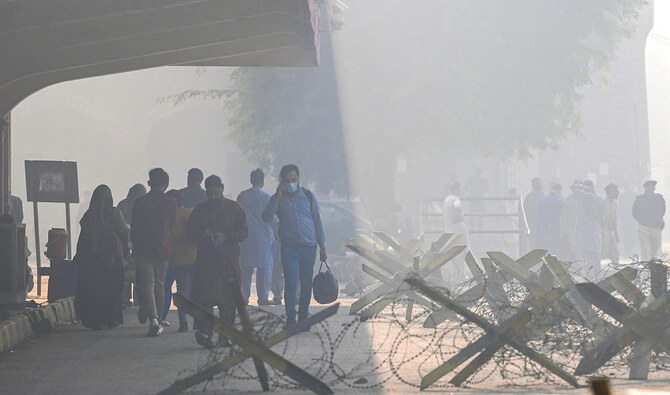
People walk along a street amid smog in Lahore on November 2, 2024. (AFP/File)
“CM Punjab very clearly said that ‘let’s sit together to sort out this issue because this cannot be done in a way that we are not doing this or you are doing this’,” Alam said.
“This is not a game, the main thing is to think about the children and to think about the future.”
Winter smog has become an annual crisis in Pakistan’s Punjab, particularly the provincial capital of Lahore, with air quality deteriorating to hazardous levels each season. The city consistently ranks among the world’s worst for air pollution, leading to a significant rise in respiratory issues and hospital admissions, especially affecting children and the elderly.
Last year, severe pollution levels prompted a surge in cases of asthma, lung infections and other respiratory problems among residents, according to media reports.
The problem this week prompted Punjab CM Nawaz to propose cross-border cooperation with Indian authorities to tackle shared pollution sources, such as crop residue burning, which exacerbate the region’s smog problem.