WASHINGTON: Republican leaders projected confidence Thursday that they will keep control of the US House as more races were decided in their favor, while Democrats insisted they still see a path toward the majority and sought assurances every vote will be counted.
The GOP picked up two more hard-fought seats in Pennsylvania, which became a stark battlefield of Democratic losses up and down the ticket. Democrats notched another win in New York, defeating a third Republican incumbent in that state.
Both parties in the House huddled privately on conference calls to assess the political landscape as Congress prepared to return next week to a changed Washington, where a sweep of MAGA-infused GOP power is within reach for President-elect Donald Trump.
“The latest data indicates that we will also hold — and likely grow — our Republican majority in the House,” Speaker Mike Johnson said in a letter to colleagues, seeking their support to keep the gavel.
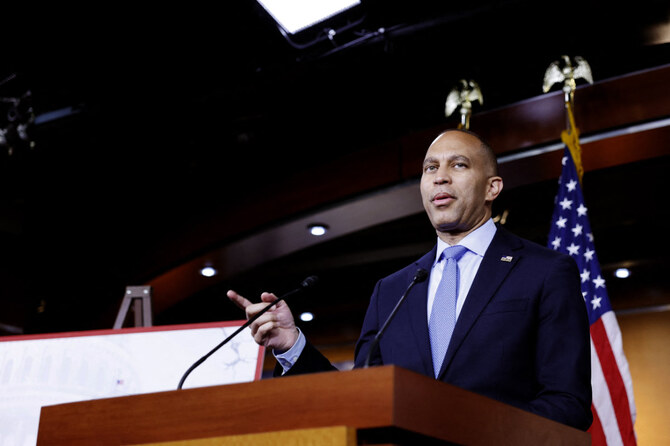
But Democratic Minority Leader Hakeem Jeffries said “it has yet to be decided” which party will control the House as several key races remained uncalled.
Seeing their options narrow, Democrats focused on flipping a handful of seats in Arizona, California and possibly Oregon to close the gap.
“We must count every vote,” Jeffries said.
A final tally in the House will almost certainly have to wait until next week, at the soonest, when Congress is back in session and prepares to elect its new leaders, including nominees for House speaker and the senator who will replace outgoing GOP Minority Leader Mitch McConnell.
The election results were beyond what Republicans had even hoped for, including a majority in the Senate, where two races were still undecided — in Arizona between Democrat Ruben Gallego and Republican Kari Lake and in Nevada between Democratic Sen. Jacky Rosen and Republican Sam Brown.
The Associated Press called more races Thursday. In Pennsylvania, Republican Ryan Mackenzie defeated incumbent Democratic Rep. Susan Wild in the Allentown-area district, and Republican Robert Bresnahan dislodged Democratic Rep. Matt Cartwright in the Northeast part of the state.
Pennsylvania’s Senate race between Sen. Bob Casey and wealthy businessman Dave McCormick was decided in McCormick’s favor, giving Republicans a 53rd seat in the chamber.
Democrats made up some ground in New York, where Laura Gillen beat incumbent GOP Rep. Anthony D’Esposito, the third flip for Democrats in Jeffries’ home state.
Attention increasingly focused on the West, where Democrats were eyeing what’s left of their path to the majority.
Democrats would need to sweep the most contested races, including two in Arizona and several in California, to win power. But tallies are expected to drag on as California, in particular, counts mail-in ballots that are arriving in the week after the election.
Republican Rep. Richard Hudson, chairman of the National Republican Congressional Committee, told lawmakers on a private call that he’s confident the GOP will hold the House majority, according to a Republican who is familiar with the call but spoke on condition of anonymity because they were not authorized to disclose details.
Trump is consolidating power in Washington, returning to the White House a much more dominant force than in his first term, when Republicans split over their support for him and some were openly skeptical of if not opposed to his rise.
This time, Johnson and Senate GOP leaders have drawn closer to Trump, relying on his power for their own as they drive a common Republican agenda more aligned with his “Make America Great Again” priorities.
Johnson, in his letter to colleagues, used a football metaphor to say he’s “ready to take the field with all of you” to play “the biggest offense of our lives.”
While Johnson is in line to remain House speaker in the new Congress, if Republicans keep control, the question of who will replace McConnell, who led his party in flipping Senate control, is its own intense contest.
The choices facing Republican senators for a new leader are between the “Johns” — No. 2 Republican Sen. John Thune and Texas Sen. John Cornyn — and a longshot, Sen. Rick Scott of Florida, who is favored by hard-right Senate conservatives who want Trump to weigh in on the race.
Cornyn and Thune, who both campaigned for Trump, are building support among senators in what is expected to be a close race on private ballots.
Thune has worked to mend a rocky relationship with Trump, and the two spoke as recently as Wednesday, according to another Republican familiar with the private conversation who spoke on condition of anonymity to discuss it.
The South Dakota senator had been critical of Trump in the aftermath of the 2020 election for stoking claims of fraudulent voting ahead of the Jan. 6, 2021, Capitol attack. Thune and Trump have been in touch throughout the year, the person said.
Thune has suggested it might be best if Trump stayed out of the leadership race.
“It’s his prerogative to weigh in on that,” Thune said on Fox News. “Frankly, I think if he lets it play out, we’ll get the right person. I’ve had conversations with him and have told him that we want to get his team in place so that he can hit the ground running and get to work on an agenda to make sure that he and our team succeeds.”
The Republicans are eyeing quick action aligned with Trump’s day-one priorities, which revolve around cutting taxes, deporting immigrants who are in the country without certain legal status, and reducing federal regulations and operations.
But after the chaos of the past two years of GOP control of the House, it’s unclear how much Republicans will be able to accomplish, especially if they have another razor-thin majority with few seats to spare for dissent, in the face of resistance from Democrats.


![]()

Republicans pick up more key House seats while Democrats insist they still have a path to a majority
Short Url
https://arab.news/ryfaw
Republicans pick up more key House seats while Democrats insist they still have a path to a majority
- Seeing their options narrow, Democrats focused on flipping a handful of seats in Arizona, California and possibly Oregon to close the gap
- Trump is consolidating power in Washington, returning to the White House a much more dominant force than in his first term


Latest updates




© 2026 SAUDI RESEARCH & PUBLISHING COMPANY, All Rights Reserved And subject to Terms of Use Agreement.