

Logistics and healthcare startups to get boost from Saudi government, assistant deputy minister says

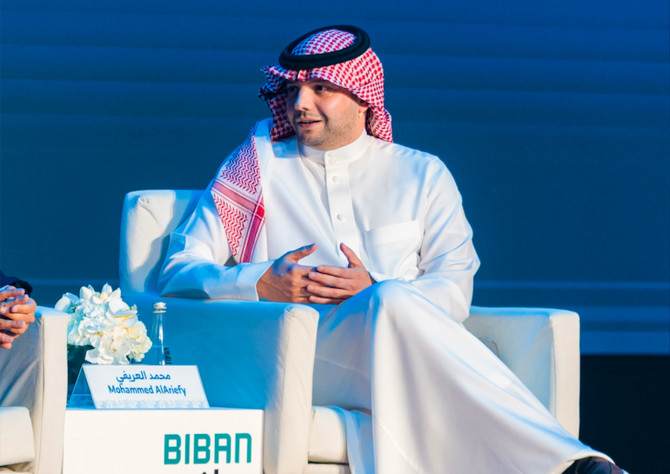
Assistant Deputy Minister of Entrepreneurship at the Ministry of Communications and Information Technology Mohammed Al-Ariefy. AN
Short Url
Updated 07 November 2024
Follow

Logistics and healthcare startups to get boost from Saudi government, assistant deputy minister says

RIYADH: Saudi Arabia is set to launch multiple programs to boost its rapidly expanding startup ecosystem, focusing on the healthcare and logistics sectors, according to a senior official.

Speaking to Arab News on the sidelines of Biban 24 in Riyadh, the Assistant Deputy Minister of Entrepreneurship at the Ministry of Communications and Information Technology, Mohammed Al-Ariefy, highlighted that these programs will be unveiled at the forum in the coming days.

These initiatives are designed to empower startups with resources and opportunities that align with the Kingdom’s ambitions to lead tech-driven industries and accelerate growth in its digital economy.

“We’re planning to launch multiple programs at Biban that focus on partnerships within logistics and healthcare. One of these is a hackathon that we’re calling the Tech Challenges, which will be launched in the next two days at Biban,” Al-Ariefy said.

He continued: “But we utilize Biban, not only to launch or sign MoUs (memorandum of understanding), but to be a part of this great ecosystem, and (we are) thanking Monsha’at for their great support and organizing such beautiful events (that) are very vibrant and very active.”

He added that these tech challenges aim to identify real-world business challenges within specific sectors, like logistics and healthcare, that these companies or industries face.

Once these challenges are identified, the Ministry of Communications and Information Technology helps create or support startups aimed explicitly at developing solutions. 

Al-Ariefy further outlined a strategic focus within the ministry on growing the technology sector by supporting both large corporations and agile startups.

“The technology sector has big tech large corporations, big technology companies that are growing and performing very, very well, and we will continue to work with them and closely,” he said.

Al-Ariefy added: “Then we have the entrepreneurs. If we take one example, there are many startups that started just three or four years ago, and now they have 1,000 employees, and they are contributing to the GDP and to the technology sector and the Kingdom significantly.”

The ministry’s overarching vision is to grow the tech sector’s contribution to the economy, which requires a dual approach, retaining the growth momentum of established companies while also fostering an environment where startups can flourish.

Al-Ariefy underscored that startups in particular are seen as crucial because their speed and flexibility make it easier for them to expand and adapt, adding jobs and increasing economic output at a faster pace.

“Startups tend to scale faster, run (more) agile, so it is easier to grow faster and easier to help us increase the contribution to the economy from digital companies, as well as technology jobs,” he said.

Al-Ariefy highlighted the startup zone at Biban 24, which is focused on promoting and supporting new companies by providing them with opportunities to network, connect with potential investors and customers, and collaborate with other businesses.

The ministry also seeks to promote sector-agnostic technological advancement across real estate, finance, healthcare, and sustainable construction by enabling startups to adopt deep-tech and emerging systems that are reshaping these industries.

“We focus on the technology side. We focus on introducing more emerging and deep technology, providing support that helps startups or founders adopt those technologies, whether they choose to adopt it in proptech or in real estate, health, education or in any other sector,” he said.


First EU–Saudi roundtable on critical raw materials reflects shared policy commitment

Updated 16 January 2026
Follow

First EU–Saudi roundtable on critical raw materials reflects shared policy commitment

RIYADH: The EU–Saudi Arabia Business and Investment Dialogue on Advancing Critical Raw Materials Value Chains, held in Riyadh as part of the Future Minerals Forum, brought together senior policymakers, industry leaders, and investors to advance strategic cooperation across critical raw materials value chains.

Organized under a Team Europe approach by the EU–GCC Cooperation on Green Transition Project, in coordination with the EU Delegation to Saudi Arabia, the European Chamber of Commerce in the Kingdom and in close cooperation with FMF, the dialogue provided a high-level platform to explore European actions under the EU Critical Raw Materials Act and ResourceEU alongside the Kingdom’s aspirations for minerals, industrial, and investment priorities.

This is in line with Saudi Vision 2030 and broader regional ambitions across the GCC, MENA, and Africa.

ResourceEU is the EU’s new strategic action plan, launched in late 2025, to secure a reliable supply of critical raw materials like lithium, rare earths, and cobalt, reducing dependency on single suppliers, such as China, by boosting domestic extraction, processing, recycling, stockpiling, and strategic partnerships with resource-rich nations.

The first ever EU–Saudi roundtable on critical raw materials was opened by the bloc’s Ambassador to the Kingdom, Christophe Farnaud, together with Saudi Deputy Minister for Mining Development Turki Al-Babtain, turning policy alignment into concrete cooperation.

Farnaud underlined the central role of international cooperation in the implementation of the EU’s critical raw materials policy framework.

“As the European Union advances the implementation of its Critical Raw Materials policy, international cooperation is indispensable to building secure, diversified, and sustainable value chains. Saudi Arabia is a key partner in this effort. This dialogue reflects our shared commitment to translate policy alignment into concrete business and investment cooperation that supports the green and digital transitions,” said the ambassador.

Discussions focused on strengthening resilient, diversified, and responsible CRM supply chains that are essential to the green and digital transitions.

Participants explored concrete opportunities for EU–Saudi cooperation across the full value chain, including exploration, mining, and processing and refining, as well as recycling, downstream manufacturing, and the mobilization of private investment and sustainable finance, underpinned by high environmental, social, and governance standards.

From the Saudi side, the dialogue was framed as a key contribution to the Kingdom’s industrial transformation and long-term economic diversification agenda under Vision 2030, with a strong focus on responsible resource development and global market integration.

“Developing globally competitive mineral hubs and sustainable value chains is a central pillar of Saudi Vision 2030 and the Kingdom’s industrial transformation. Our engagement with the European Union through this dialogue to strengthen upstream and downstream integration, attract high-quality investment, and advance responsible mining and processing. Enhanced cooperation with the EU, capitalizing on the demand dynamics of the EU Critical Raw Materials Act, will be key to delivering long-term value for both sides,” said Al-Babtain.

Valere Moutarlier, deputy director-general for European industry decarbonization, and directorate-general for the internal market, industry, entrepreneurship and SMEs at European Commission, said the EU Critical Raw Materials Act and ResourceEU provided a clear framework to strengthen Europe’s resilience while deepening its cooperation with international partners.

“Cooperation with Saudi Arabia is essential to advancing secure, sustainable, and diversified critical raw materials value chains. Dialogues such as this play a key role in translating policy ambitions into concrete industrial and investment cooperation,” she added.