

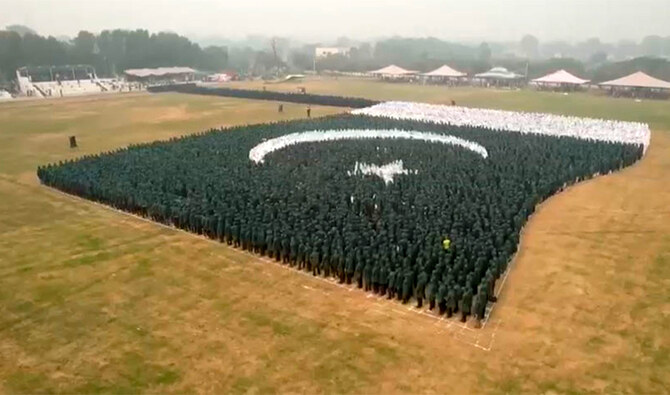
Pakistan smashes Indian record by creating largest human image of waving flag

This handout photo, released by Radio Pakistan on November 7, 2024, shows formation of a human image of waving Pakistani flag during the Lahore Youth Festival in Lahore on November 6, 2024. (Radio Pakistan)
Short Url
Updated 07 November 2024
Follow

Pakistan smashes Indian record by creating largest human image of waving flag

  • Over 10,000 students participate in activity held during Punjab government-backed youth festival in Lahore
  • Record was previously held by India where 7,368 students formed the waving flag image in March this year 

ISLAMABAD: Pakistan smashed India’s record by forming the world’s largest human image of a waving flag in the eastern city of Lahore city, with over 10,000 students participating in the activity this week, state-run media reported on Thursday. 

The new world record was made during the Lahore Youth Festival, organized by the provincial Punjab government and currently underway at the Fortress Stadium in Lahore.

“Pakistan has set a new world record by making the largest human flag,” Radio Pakistan said. “The record was achieved by the students of Army Public School Lahore who participated in the formation of the flag.”

The Guinness World Record website showed that the record for the largest human image of a waving flag was last held by India where 7,368 students formed the flag in March this year in Sonipat. 

State media in Pakistan widely reported on Thursday that Pakistan had now broken India’s record, with over 10,000 students from the Army Public School in Lahore forming the image of the nation’s flag. 

The national flag of Pakistan, also known as the Flag of the Star and Crescent, is made up of a green field with a stylized tilted white descending crescent moon, and five-pointed star at its center, and a vertical white stripe at its hoist-end. It was adopted by the Constituent Assembly of Pakistan Aug. 11, 1947, and became the official flag of Pakistan on Aug. 14, following independence from the British Empire. 

The flag is referred to in the third verse of Pakistan’s national anthem and is widely flown on several important days of the year, including Republic Day, Independence Day and Defense Day. It is also hoisted every morning at schools, offices and government buildings to the playing of the national anthem and lowered again before sunset.


Tolerance for ‘cross-border terrorism’ has reached its limit, Pakistan warns Afghanistan after airstrikes

Updated 7 sec ago
Follow

Tolerance for ‘cross-border terrorism’ has reached its limit, Pakistan warns Afghanistan after airstrikes

  • Pakistan says carried out intelligence-based airstrikes in border regions with Afghanistan on Saturday, killing 80 militants
  • Afghan authorities dismiss allegations, saying Pakistan killed and injured dozens of civilians, vowing an “appropriate” response 

ISLAMABAD: President Asif Ali Zardari has warned Kabul in a recent statement that Islamabad’s tolerance for “cross-border terrorism” has reached its limit after Pakistan carried out airstrikes in Afghanistan to target alleged militant camps. 

A Pakistani security official said Islamabad carried out intelligence-based airstrikes on Saturday and destroyed seven centers of the Pakistani Taliban or the TTP militant group in the three Afghan provinces of Nangarhar, Paktika and Khost. The official said more than 80 militants were killed in the attacks. An earlier statement from Pakistan’s information ministry said the targets included a camp of a Daesh regional affiliate, the Islamic State Khorasan Province (ISKP), which claimed a suicide bombing at an Islamabad Shia mosque that killed 32 people this month.

Saturday’s airstrikes followed a series of attacks inside Pakistan amid a surge in militancy. Authorities say the attacks, particularly in the northwestern Khyber Pakhtunkhwa (KP) province bordering Afghanistan and the Pakistani capital of Islamabad, were carried out by the TTP and allied groups that Islamabad alleges are operating from sanctuaries in Afghanistan. Kabul denies this and urges Pakistan to concentrate on its security issues without blaming Afghanistan.

In a post on X on Sunday, Afghan government spokesperson Zabihullah Mujahid said Pakistani forces had violated Afghanistan’s territory and killed and wounded dozens of civilians in Nangarhar and Paktika. The Afghan Taliban’s claims of civilian casualties could not be independently verified. Pakistan did not immediately comment on the allegation. 
In a statement issued by his office on Sunday night, Zardari said Pakistan’s recent actions in Afghanistan are rooted in its “inherent right” to defend its people against “terrorism” from across the border. 

 “Tolerance for cross-border terrorism has reached its limit,” Zardari said. 

The Pakistani president reiterated Islamabad’s stance that it is concerning that de facto authorities in Kabul continue to allow “terrorist elements” to operate from Afghan soil in violation of their commitments under the Doha Accord, an agreement signed between both sides in October after fierce border clashes last year, Kabul pledged that Afghanistan’s soil would not be used against any country for militant activities.

The president said it was regrettable that despite warnings and repeated engagement from Islamabad, Afghan authorities failed to take action against militants. 

“He said Pakistan exercised restraint for a considerable period and confined its response to terrorist hideouts located near the border areas,” the president’s office said.

“However, he warned that Pakistan is fully aware of where the planners, facilitators and patrons of violence are based. If bloodshed continues inside Pakistan, those responsible will not remain beyond reach.”

Zardari reaffirmed Pakistan seeks peace, stability and cooperative relations with its neighbors. However, the Pakistani president said peace “cannot rest on denial, duplicity or inaction against terrorism.”

“The protection of Pakistani lives remains paramount and non-negotiable,” he added. 

Afghanistan’s Ministry of National Defense said on Sunday that Pakistan’s airstrikes were in breach of international law and Islamic principles.

It warned that an “appropriate and measured response” will be given in a “suitable time.”

Saturday’s airstrikes and subsequent allegations marks one of the most direct confrontations between Islamabad and Kabul in recent months. It risks further straining already fragile ties along the volatile border between the two neighbors.