Japanese envoy bids farewell, reflects on Saudi Arabia’s transformation, cultural legacy

1 / 3
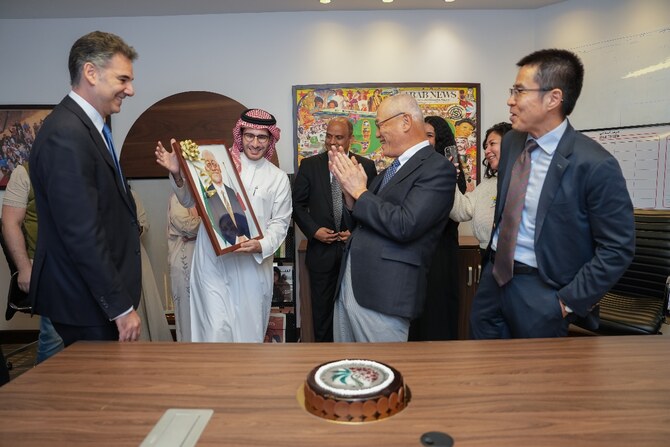
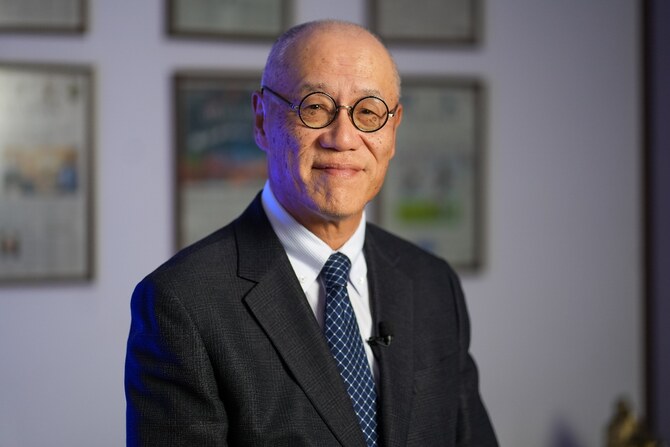
“The connection I feel to this country and its people is truly unique,” Iwai added..(AN photo/Huda Bashatah)
2 / 3
“The connection I feel to this country and its people is truly unique,” Iwai added..(AN photo/Huda Bashatah)
3 / 3
“The connection I feel to this country and its people is truly unique,” Iwai added..(AN photo/Huda Bashatah)
Short Url
Updated 07 November 2024
Follow

Japanese envoy bids farewell, reflects on Saudi Arabia’s transformation, cultural legacy

RIYADH: As he prepares to leave Saudi Arabia, Japan’s ambassador to the Kingdom, Iwai Fumio, affectionately known as “Abu Kuji” among his Saudi friends, reflects on the sweeping transformations he witnessed during his tenure.

“Saudi Arabia feels like a second home,” he said.

“The connection I feel to this country and its people is truly unique,” Iwai added.

Under the ambitious Vision 2030 framework, he observed the Kingdom evolving at an unprecedented pace, blending progress with the preservation of its cultural legacy. 

“Vision 2030 isn’t just about change — it’s a complete reimagining of what Saudi Arabia can be,” he said, emphasizing how the initiative reshaped the Kingdom’s economy and expanded its influence.

As Saudi Arabia emerged as a regional hub, attracting investment and establishing global partnerships, the ambassador noted the Kingdom’s growing role on the world stage.

From the bustling streets of Riyadh to the awe-inspiring landscapes of AlUla and the towering peaks of Asir, he has seen firsthand the beauty and spirit of a nation embracing change while honoring its heritage.

“Each place tells a story of resilience and pride,” he said, noting how the Kingdom’s diverse regions reflect the harmony of tradition and progress.

Iwai spoke with deep appreciation of the hospitality he encountered throughout his time in Saudi Arabia. “The warmth here is unmatched,” he said, recalling how Saudis welcomed him not just as a diplomat but as part of their extended community. 

The title “Abu Kuji” itself, bestowed upon him by his Saudi friends, symbolizes a personal connection and affection that goes beyond formal diplomacy.

“There is a sincerity here, a tradition of openness and generosity that is incredibly touching,” he remarked. “It’s rare to find such genuine warmth in the world.”

The ambassador also praised the Arab News Japanese edition, a key initiative fostering closer ties between Saudi Arabia and Japan.

He acknowledged the publication’s vital role in promoting mutual understanding, enabling Japanese readers to appreciate the breadth and depth of Saudi Arabia’s transformation. 

“Arab News Japan has allowed people back home to witness this journey of growth and ambition,” he said. “It has been instrumental in bridging our cultures and deepening the friendship between our nations.”

Reflecting on his years in Saudi Arabia, he expressed admiration for the rapid advancements in technology, infrastructure and economic diversification under Vision 2030.

From newly developed hotels and infrastructure projects to the ease of new digital visa services, he noted the strides the Kingdom has made to attract international businesses and tourists alike.

“These developments show Saudi Arabia’s readiness to welcome the world,” he said.

The ambassador highlighted how Japan, with its experience and technological expertise, is well positioned to collaborate with Saudi Arabia on these fronts.

Yet beyond the visible changes, it is the people and their shared pride in tradition that left the most indelible mark on him. From experiencing the energy of Saudi cities to the tranquil beauty of its historical sites, the ambassador described his journey through the Kingdom as transformative on a personal level.

“It’s not just the landscapes or the cities,” he said, “but the people, their warmth, their traditions — these are the true treasures of Saudi Arabia.”

As he bid farewell, Iwai voiced optimism for a future of strengthened collaboration, particularly in fields such as energy, technology, and cultural exchange, where Japan’s expertise aligns with Saudi Arabia’s goals under Vision 2030.

He leaves with a sense of gratitude and hope, confident that the friendship between Saudi Arabia and Japan will continue to deepen.

Reflecting on his next chapter, the ambassador shared his excitement for his upcoming assignment in Egypt, a country he believes will offer new opportunities to deepen Japan’s ties in the region.

“Each country has its unique story and path, and I am grateful for the opportunity to carry forward the spirit of partnership I’ve cherished here in Saudi Arabia,” he said.

“Saudi Arabia will always hold a special place in my heart,” he added, “for the incredible transformations I witnessed, but most of all, for the friendships and warmth of its people, who welcomed me like family.”


National program identifies 165 native plants for afforestation efforts in Asir

Updated 29 December 2025
Follow

National program identifies 165 native plants for afforestation efforts in Asir

  • The survey is part of broader plans focused on restoring degraded land, using native vegetation 

JEDDAH: Saudi Arabia’s National Afforestation Program has identified more than 165 species of native plants suitable for afforestation in the Asir region, highlighting the ecological diversity of one of the Kingdom’s most environmentally varied areas, the Saudi Press Agency reported.

The findings form part of broader national efforts to expand vegetation cover, address land degradation, and support sustainability goals linked to the Saudi Green Initiative and Vision 2030.

According to the program, the identified species are distributed across a wide range of natural environments in Asir, including mountainous terrain, highlands, slopes, valleys, plains, rocky landscapes, and coastal areas stretching from the Red Sea to Tihama.

The species belong to numerous plant families, including Fabaceae, Anacardiaceae, Burseraceae, Capparaceae, Ebenaceae, Euphorbiaceae, Malvaceae, Myrtaceae, Oleaceae, and Primulaceae, among others.

Plants suitable for afforestation range from large and small trees to perennial and annual shrubs, herbs, succulents, bulbs, and climbing plants. 

Among the most notable species identified are the grey mangrove, mastic tree, mooring or ben tree, juniper, sycamore fig, wild olive, henna, wild jasmine, hawthorn, and arak.

The Saudi Arabian Botanical Society described the announcement as an important step in protecting plant diversity and strengthening the ecosystem conservation in the Kingdom. 

Munirah bin Hamad Al-Hazani, founder and president of the society, said that prioritizing native species is central to sustainable afforestation.

“Focusing on the cultivation of native plants adapted to diverse environments forms the cornerstone of sustainable afforestation projects, as it plays a pivotal role in enhancing vegetation cover, combating land degradation, and conserving natural and financial resources,” she told Arab News.

Al-Hazani added that long-term success depends on cooperation between government bodies and the nonprofit sector, alongside community involvement and environmental awareness programs.

The National Afforestation Program has increasingly emphasized community participation, working with government agencies, private companies, and nonprofit organizations to support planting initiatives and environmental education. Its approach includes promoting volunteerism and discouraging harmful environmental practices, while focusing on the use of native plants adapted to local conditions.

Parallel efforts are underway in other regions of the Kingdom to support vegetation restoration through research and infrastructure development. In Jouf, often referred to as the Kingdom’s food basket, the King Salman bin Abdulaziz Royal Reserve Development Authority has established a Central Nursery and a Wild Seeds Research and Production Station to address the growing demand for reliable sources of native seeds and seedlings.

The project was launched in 2023 under the directive of Prince Abdulaziz bin Saud bin Naif, the minister of interior and chairman of the authority’s board of directors. 

Since then, the facilities has become a key component of vegetation restoration efforts within the reserve.

The authority has focused on building operational capacity by recruiting and training specialists to manage cultivation and research activities. The research and production station includes 14 mother-seed production fields containing over 400,000 trees and shrubs. 

Planting began in late 2024, with more than 30 native plant species represented, selected for their role in the reserve’s natural ecosystem. 

The facility also includes two seed storage units with a combined capacity of 3,000 kilograms. Seeds are collected annually from multiple sites within the reserve and used for seedling production habitat rehabilitation.

The Central Nursery spans 6,000 square meters and includes 30 greenhouses spanning 1,500 square meters, as well as two shade houses used during summer months. A plant hardening facility, designed to prepare seedlings for natural environmental conditions, covers 10,000 square meters and is divided into seven sections. The nursery’s annual production capacity reaches 1.5 million seedlings, representing more than 15 native plant species. 

Together, these initiatives underscore the growing role of native plant research and propagation in Saudi Arabia’s afforestation strategy, particularly as the Kingdom works to balance environmental restoration with long-term sustainability goals.