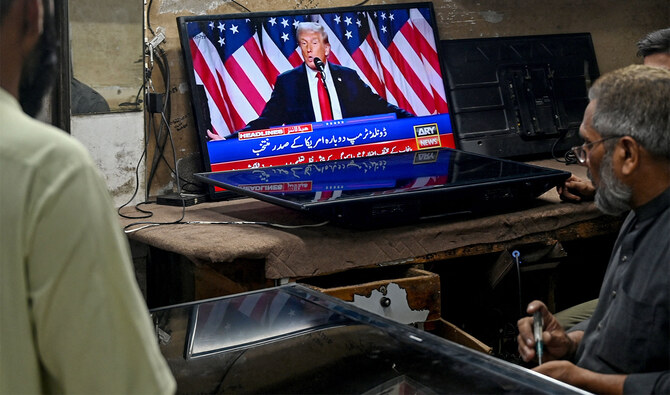

ISLAMABAD: Federal Defense Minister Khawaja Muhammad Asif said Wednesday Pakistan would collaborate with the new US administration where interests aligned but cautioned that cooperation could be strained if interests diverged or Washington persisted in supporting wars in the Middle East.
Asif made the statement following the election of Republican candidate Donald Trump as US president for a second term, nearly four years after he left office. Hours later, Vice President Kamala Harris, who was running against Trump, conceded defeat, acknowledging the election result was not what Democrats had hoped for but pledging a peaceful transfer of power.
Trump is widely regarded as an unpredictable leader, with analysts worldwide assessing the potential impact of his return to the top US office on global affairs. However, the Pakistani defense minister praised him during Geo TV’s special election transmission for promising to end conflicts around the world after assuming power in Washington.
“Where our interests and those of the United States converge, we will definitely work together,” he said while responding to a question. “However, where there’s a clash between our interests and those of the United States, we’ll try to find a way to avoid conflict.”
The minister said things could get challenging if there was a direct clash of interests and no way out, as he specifically mentioned the conflicts in Gaza, Lebanon and Iran.
“If these wars persist, if this atmosphere of destruction remains, with cities being devastated and the United States backing this, then it will be an environment in which cooperation will be difficult,” he continued.
Responding to a question about the impact of Trump’s election on Pakistan’s domestic politics, he said the government believed that the new US president would not call for the release of former prime minister of the country Imran Khan who has been in prison for over a year on multiple charges.
Members of Khan’s Pakistan Tehreek-e-Insaf (PTI) party widely expressed hope on social media platforms that Trump’s election could lead to the release of their leader from prison, saying Khan enjoyed a good relationship with the US president-elect.
The former premier also congratulated Trump in a social media post, saying his presence in the top US office would be good for the bilateral relations between the two countries.
Asif noted during the special television transmission that government always prepared themselves for local and international contingencies, adding: “No one [in the US] will want to go on bad terms with Pakistan for the sake of a single individual.”