

Pakistan army chief meets Saudi crown prince to discuss regional peace, defense cooperation

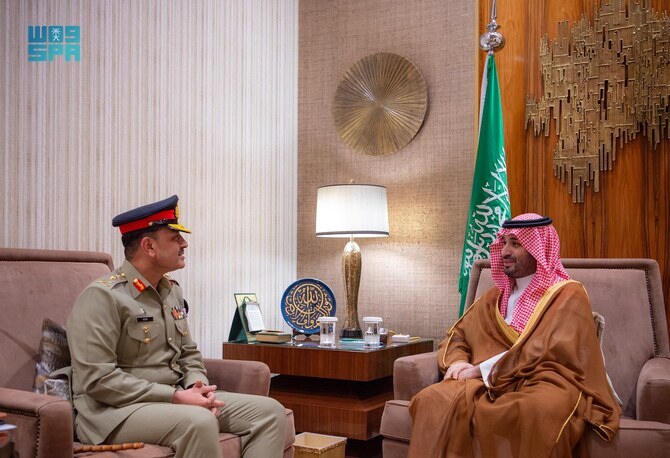
In this handout photograph, released by the Saudi Press Agency on November 6, 2024, Pakistan Army Chief General Syed Asim Munir meets Saudi Crown Prince Mohammed bin Salman in Riyadh. (SPA)
Short Url
Updated 07 November 2024
Follow

Pakistan army chief meets Saudi crown prince to discuss regional peace, defense cooperation

  • PM Shehbaz Sharif last week met Saudi crown prince to discuss bilateral economic, defense ties
  • Meeting takes place amid regional tensions due to Israel’s military campaigns in Gaza, Lebanon

ISLAMABAD: Pakistan Army Chief General Asim Munir met Saudi Crown Prince Mohammed bin Salman on Wednesday to discuss issues of common interest such as regional peace, bilateral defense and security cooperation, the military said.
The development takes place after Prime Minister Shehbaz Sharif’s meeting with Crown Prince Mohammed bin Salman last week during his two-day visit to the Kingdom. The two leaders discussed bilateral economic ties and regional developments, with Sharif apprising the crown prince that the Kingdom had a “central role” to play in Pakistan’s “future economic plans.”
In October, Pakistani and Saudi businesses signed 27 agreements and memorandums of understanding valued at $2.2 billion. During Sharif’s visit to the Kingdom last week, the two countries agreed to increase this figure to $2.8 billion.
Munir, who is currently on an official visit to the Kingdom, met the Saudi crown prince at the Royal Palace in Riyadh, the Inter-Services Public Relations, (ISPR) the military’s media wing, said in a statement.
“The two dignitaries engaged in a comprehensive discussion on a range of issues of mutual interest, including regional peace, defense and security cooperation, and strategies for enhancing bilateral relations,” the ISPR said.
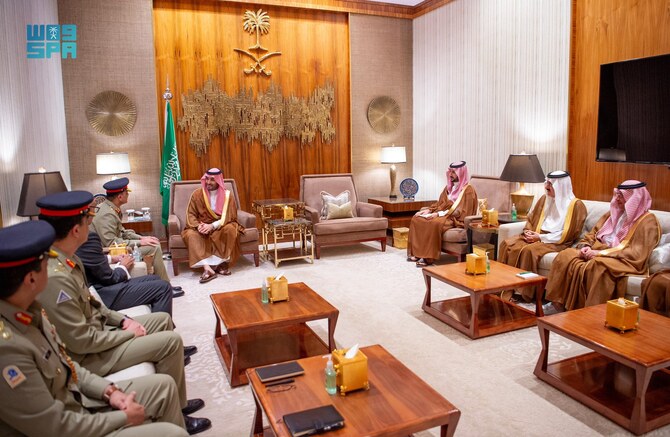


In this handout photograph, released by the Saudi Press Agency on November 6, 2024, Pakistan Army Chief General Syed Asim Munir meets Saudi Crown Prince Mohammed bin Salman in Riyadh. (SPA)

The army’s media wing said Munir expressed his gratitude to the Saudi crown prince for his “steadfast support for Pakistan,” acknowledging his role in fostering peace and stability across the region.
Their meeting also takes place amid a surge in regional tensions following Israel’s military campaigns in Palestine and Lebanon, and its missile attack on Iran last month.
Munir also separately met Saudi Arabia’s Defense Minister Prince Khalid Bin Salman, the ISPR said, adding that the two vowed to further strengthen cooperation in the defense and security domains.
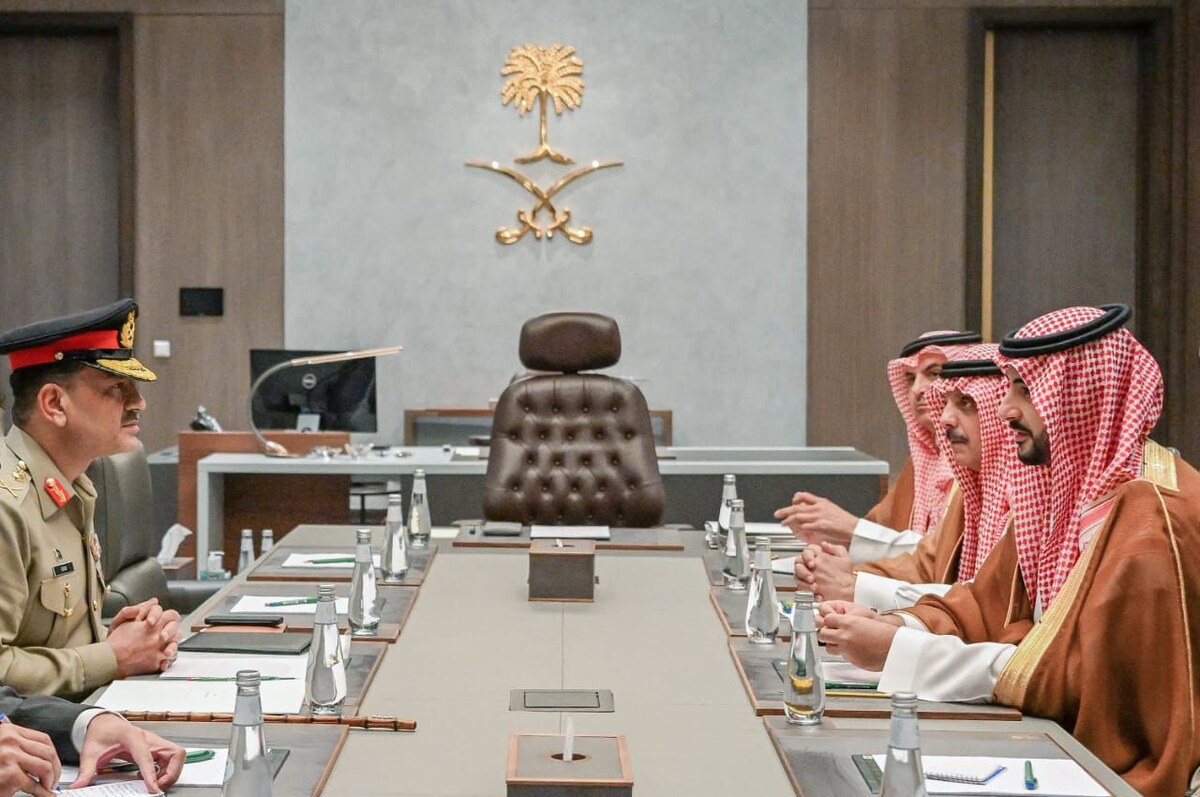


In this handout photograph, released by Pakistan’s Inter-Services Public Relations (ISPR) on November 6, 2024, Pakistan Army Chief General Syed Asim Munir meets Saudi Arabia’s Defense Minister Prince Khalid Bin Salman in Riyadh. (Photo courtesy: ISPR)

The Pakistan army chief also held meetings with Saudi Arabia’s assistant minister of defense, air chief, chief of general staff of the Royal Saudi Armed Forces and chief of Royal Saudi Land Forces, the ISPR said.
Pakistan and Saudi Arabia enjoy cordial ties rooted in shared history, culture, faith and economic ties. The Kingdom is the top source of workers’ remittances for Pakistan, crucial for Islamabad to help keep its $350 billion economy afloat.
Saudi Arabia has often come to cash-strapped Pakistan’s aid, bailing it out of its prolonged economic crisis through debt rollers and by providing it oil on deferred payments.


Pakistan planning minister says exports must double to $60 billion in four years to avoid IMF

Updated 5 sec ago
Follow

Pakistan planning minister says exports must double to $60 billion in four years to avoid IMF

  • Government may declare “export emergency” under URAAN Pakistan plan
  • Economists warn $60 billion target is ambitious amid weak global growth

KARACHI: Pakistan must double its exports to $60 billion within four years or risk returning to the International Monetary Fund, Planning Minister Ahsan Iqbal said on Thursday, underscoring the scale of the challenge facing the country as it seeks to break its long-standing dependence on external bailouts.

The comments come as the government pushes ahead with URAAN Pakistan (Flying Pakistan), Prime Minister Shehbaz Sharif’s flagship economic transformation plan aimed at reviving growth, improving competitiveness and strengthening external finances in an economy still vulnerable to balance-of-payments pressures.

As part of the push, Sharif has set up a high-level committee led by Deputy Prime Minister Ishaq Dar to drive implementation of the plan and propose measures to accelerate export growth.

“The only way Pakistan could avoid IMF bailouts is to raise exports to $60 billion in four years and to $100 billion over the next decade,” Iqbal told Arab News, warning that failure to sharply expand overseas sales would leave Islamabad with few alternatives.

“[The plan] includes a proposal to declare an export emergency to double export earnings to $60 billion,” he added on the mandate of the newly established economic panel, saying faster tax refunds for export-oriented sectors and the removal of structural bottlenecks would be central to the effort.

Pakistan has struggled for years to expand exports, which rose about five percent last year to $32.1 billion but have weakened in the current fiscal year. Exports fell more than 20 percent to $2.32 billion in December, according to Pakistan Bureau of Statistics data.

Overall shipments declined nine percent to $15.2 billion during July-December FY26, while imports rose 11 percent to $34.4 billion, widening the trade deficit by 35 percent to $19.2 billion, PBS figures show.

“If exports are not increased, we will have to go to our friendly countries for help or go back to the IMF,” Iqbal warned, referring to Pakistan’s long history with the IMF, which has approved 25 loan arrangements for the country since 1950. 

Pakistan last secured a $7 billion IMF program in 2024 to stabilize its economy.

“UNREALISTIC TARGET”

Pakistan has recently lifted its foreign exchange reserves to around $16 billion, but continues to rely on financial support from partners such as China, Saudi Arabia and the United Arab Emirates.

Iqbal said his ministry had briefed Pakistan’s civil and military leadership last month on strategies to reduce dependence on IMF support, adding that the Dar-led committee is expected to submit its recommendations to the prime minister next week.

“Pakistan possesses the potential to achieve these targets,” he said.

Economists, however, are divided on whether the export goal is achievable within the proposed timeframe.

Mohammed Sohail, chief executive officer of Topline Securities, described the target as “ambitious” but said stronger growth in services exports could help narrow the gap.

“While goods exports face challenges due to higher energy charges and taxation, Pakistan should also focus aggressively on services exports which is rising at a fast pace,” Sohail told Arab News.

Pakistan’s services exports rose nine percent to $8.41 billion in FY25, and climbed 17 percent to $3.83 billion in the first five months of the current fiscal year, according to State Bank of Pakistan data.

Others were more skeptical.

“Obviously, this is an unrealistic target,” said Muhammad Saad Ali, head of research at Lucky Investments.

“You cannot double your exports that roughly stand at $30 billion today. You can’t double them in three-four years magically,” he said.

“If we had set a 10-year target, then we would have said that there is a roadmap. But 3-4 years is absolutely not possible.”