

Pakistan PM visits China embassy after guard shoots Chinese nationals at Karachi factory

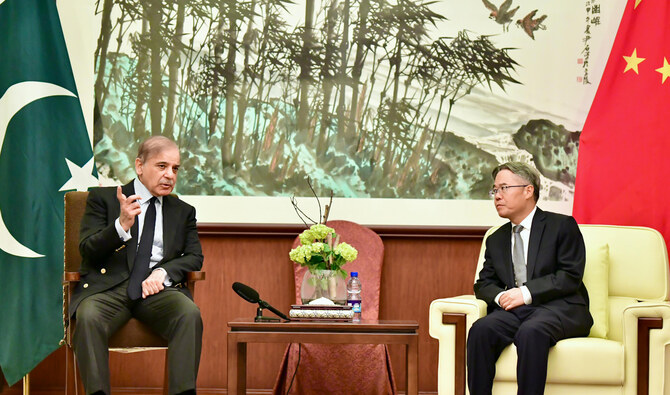
Prime Minister Shehbaz Sharif meets Chinese Ambassador to Pakistan Jiang Zaidong at the Chinese Embassy in Islamabad on November 6, 2024. (Photo courtesy: PMO)
Short Url
Updated 06 November 2024
Follow

Pakistan PM visits China embassy after guard shoots Chinese nationals at Karachi factory

  • Pakistani security guard shot two Chinese nationals at Karachi textile mill on Tuesday 
  • Shehbaz Sharif vows culprit will be punished, says security of Chinese nationals top priority

ISLAMABAD: Pakistan’s Prime Minister Shehbaz Sharif visited the Chinese embassy in Islamabad on Wednesday to condemn an attack on Chinese nationals in Karachi a day earlier, vowing to bring the perpetrator of the crime to book.
Pakistan police have filed terrorism charges against a security guard for firing at four Chinese nationals on Tuesday morning at a textile mill in Karachi. The Chinese nationals were at the mill to install new machinery when the guard opened fire at them “for unknown reasons” before fleeing, police said.
Two Chinese nationals were injured in the attack. Sharif visited the Chinese embassy in Islamabad on Wednesday where he met the country’s envoy Jiang Zaidong to condemn the incident.
“I have come here to meet you to condemn this attack on Chinese nationals and to inquire after the injured,” Sharif told Zaidong according to a statement by the Prime Minister’s Office (PMO).
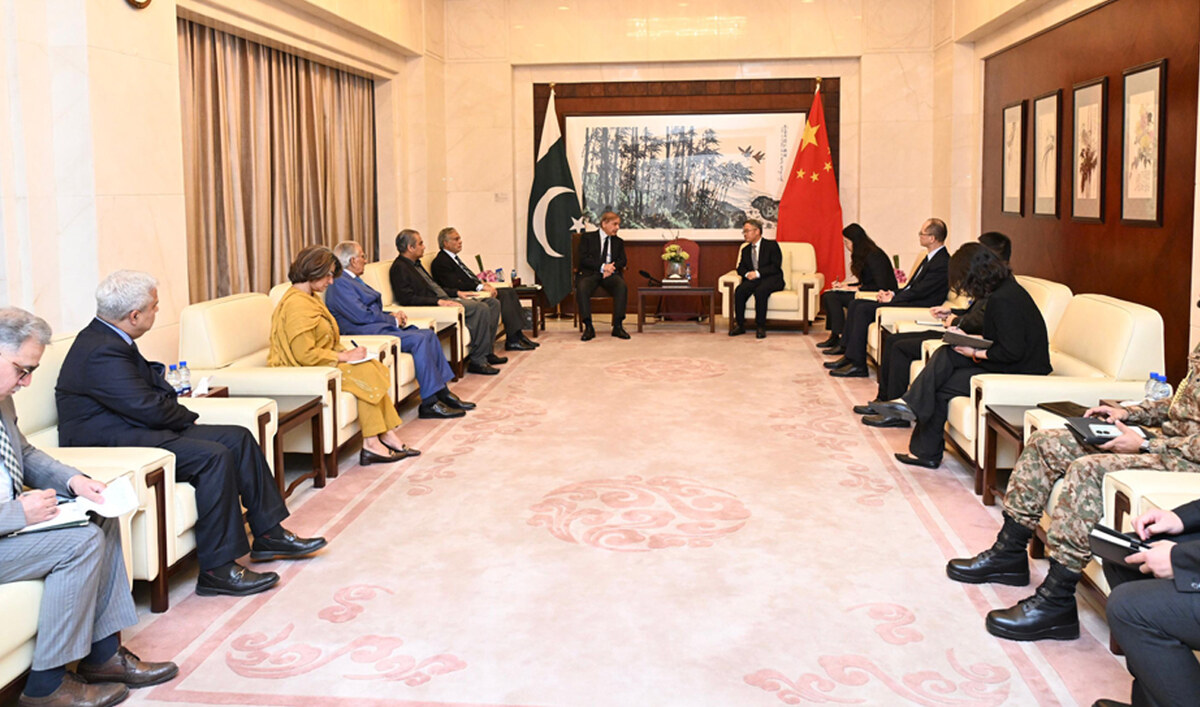


Prime Minister Shehbaz Sharif meets Chinese Ambassador to Pakistan Jiang Zaidong at the Chinese Embassy in Islamabad on November 6, 2024. (Photo courtesy: PMO)

The prime minister assured the Chinese ambassador that the culprit would be arrested soon and handed an exemplary punishment.
“I am personally monitoring the process of arresting the people involved in the incident and bringing them to justice,” Sharif said.
The Pakistani premier said he had issued instructions for the injured Chinese nationals to be provided the best possible medical care, describing China as a longstanding friend of Pakistan.
“The attack on Chinese citizens is a blatant attempt to damage the brotherly relations between Pakistan and China,” Sharif said.
He said that the security of Chinese nationals in Pakistan is the government’s top priority. The Chinese ambassador thanked Sharif for his visit and hoped the premier would play his role in ensuring the culprit is punished, the PMO said.
Sharif was accompanied by Deputy Prime Minister Ishaq Dar, Interior Minister Mohsin Naqvi and his aide Tariq Fatemi.
ATTACKS ON CHINESE NATIONALS
Pakistan has witnessed a surge in attacks on Chinese nationals in recent months by separatist outfits based in its southwestern Balochistan province. 
China, breaking with tradition, recently spoke out publicly against security threats to its workers and nationals in Pakistan, where hundreds work on Beijing-funded projects linked to the over $60 billion China-Pakistan Economic Corridor (CPEC).
Last month, two Chinese nationals were killed in a suicide bombing near the international airport in Karachi. In March this year, a suicide bombing killed five Chinese engineers and a Pakistani driver in northwestern Pakistan as they headed to the Dasu Dam, the largest hydropower project in the country.
In 2022, three Chinese educators and their Pakistani driver were killed when an explosion tore through a van at the University of Karachi. A bus blast in northern Pakistan in 2021 killed 13 people, including nine Chinese nationals.
Pakistan announced in a joint statement with China last month it had agreed to increase security for Chinese citizens and projects in the South Asian nation, as Beijing called for urgent security measures following a surge in militant threats.


Islamabad dismisses claims about paying up to 8 percent interest on foreign loans as ‘misleading’

Updated 22 February 2026
Follow

Islamabad dismisses claims about paying up to 8 percent interest on foreign loans as ‘misleading’

  • Pakistan has long relied on external loans to help bridge persistent gaps in public finances and foreign exchange reserves
  • Pakistan’s total external debt, liabilities stand at $138 billion at an overall average cost of around 4 percent, ministry says

KARACHI: Pakistan’s finance ministry on Sunday dismissed as “misleading” claims that the country is paying up to 8 percent interest on external loans, saying the overall average cost of external public debt is approximately 4 percent.

Pakistan has long relied on external loans to help bridge persistent gaps in public finances and foreign exchange reserves, driven largely by a narrow tax base, chronic trade deficits, rising debt-servicing costs and repeated balance-of-payments pressures.

Over the decades, successive governments have turned to multilateral and bilateral lenders, including the International Monetary Fund, the World Bank and the Asian Development Bank, to support budgetary needs and shore up foreign exchange reserves.

The finance ministry on Sunday issued a clarification in response to a “recent press commentary” regarding the country’s external debt position and associated interest payments, and said the figures required contextual explanation to ensure accurate understanding of Pakistan’s external debt profile.

“Pakistan’s total external debt and liabilities currently stand at $138 billion. This figure, however, encompasses a broad range of obligations, including public and publicly guaranteed debt, debt of Public Sector Enterprises (both guaranteed and non-guaranteed), bank borrowings, private-sector external debt, and intercompany liabilities to direct investors. It is therefore important to distinguish this aggregate figure from External Public (Government) Debt, which amounts to approximately $92 billion,” it said.

“Of the total External Public Debt, nearly 75 percent comprises concessional and long-term financing obtained from multilateral institutions (excluding the IMF) and bilateral development partners. Only about 7 percent of this debt consists of commercial loans, while another 7 percent relates to long-term Eurobonds. In light of this composition, the claim that Pakistan is paying interest on external loans ‘up to 8 percent’ is misleading.

The overall average cost of External Public Debt is approximately 4 percent, reflecting the predominantly concessional nature of the borrowing portfolio.”

With respect to interest payments, public external debt interest outflows increased from $1.99 billion in Fiscal Year (FY) 2022 to $3.59 billion in FY2025, representing an increase of 80.4 percent, not 84 percent as reported. In absolute terms, interest payments rose by $1.60 billion over this period, not $1.67 billion, it said.

According to the State Bank of Pakistan’s records, Pakistan’s total debt servicing payments to specific creditors during the period under reference were as follows: the IMF received $1.50 billion, of which $580 million constituted interest; Naya Pakistan Certificates payments totaled $1.56 billion, including $94 million in interest; the Asian Development Bank received $1.54 billion, including $615 million in interest; the World Bank received $1.25 billion, including $419 million in interest; and external commercial loans amounted to nearly $3 billion, of which $327 million represented interest payments.

“While interest payments have increased in absolute terms, this rise cannot be attributed solely to an expansion in the debt stock,” the ministry said. “Although the overall debt stock has increased slightly since FY2022, the additional inflows have primarily originated from concessional multilateral sources and the IMF’s Extended Fund Facility (EFF) under the ongoing IMF-supported program.”

Pakistan secured a $7 billion IMF bailout in Sept. 2024 as part of Prime Minister Shehbaz Sharif’s efforts to stabilize the South Asian economy that narrowly averted a default in 2023. The government has since been making efforts to boost trade and bring in foreign investment to consolidate recovery.

“It is also important to note that the increase in interest payments reflects prevailing global interest rate dynamics. In response to the inflation surge of 2021–22, the US Federal Reserve raised the federal funds rate from 0.75-1.00 percent in May 2022 to 5.25–5.50 percent by July 2023. Although rates have since moderated to around 3.75 percent, they remain significantly higher than 2022 levels,” the finance ministry said.

“The government remains committed to prudent debt management, transparency, and the continued strengthening of Pakistan’s macroeconomic stability,” it added.