

Pakistani teen captivates social media with intricate leaf art

Pakistani artist Kamran Khan carving the logo of Arab News on a leaf during an interview with Arab News in Peshawar on October 31, 2024. (AN Photo)
Short Url
Updated 06 November 2024
Follow

Pakistani teen captivates social media with intricate leaf art

  • Kamran Khan, 19, specializes in making intricate designs, patterns and portraits on dried leaves
  • Artist says social media has played “huge role” in expanding his outreach, he also takes orders online

PESHAWAR: A young Pakistani artist based in the northwestern Khyber Pakhtunkhwa province has captivated social media with his unusual canvas: plant leaves. 
From a small corner in Peshawar city’s bustling Storytellers’ Market, popularly known as Qissa Khwani Bazaar, Kamran Khan carves intricate portraits on delicate leaves, blending tradition with artistry and earning a growing online fan base.
Originally from Bajaur in Pakistan’s tribal belt, the 19-year-old artist moved to Peshawar for his education and livelihood and is now a third-semester political science student at the city’s historic Islamia College. While he has to balance his studies and a small family business he helps run, he also finds moments in between to pursue his passion.
“I have been doing art and drawing since childhood, but then I thought of taking it in a new direction to make it more unique,” he told Arab News in an interview this week. “I started practicing leaf art. I watched a video from where I decided to adopt the idea since it felt different.”
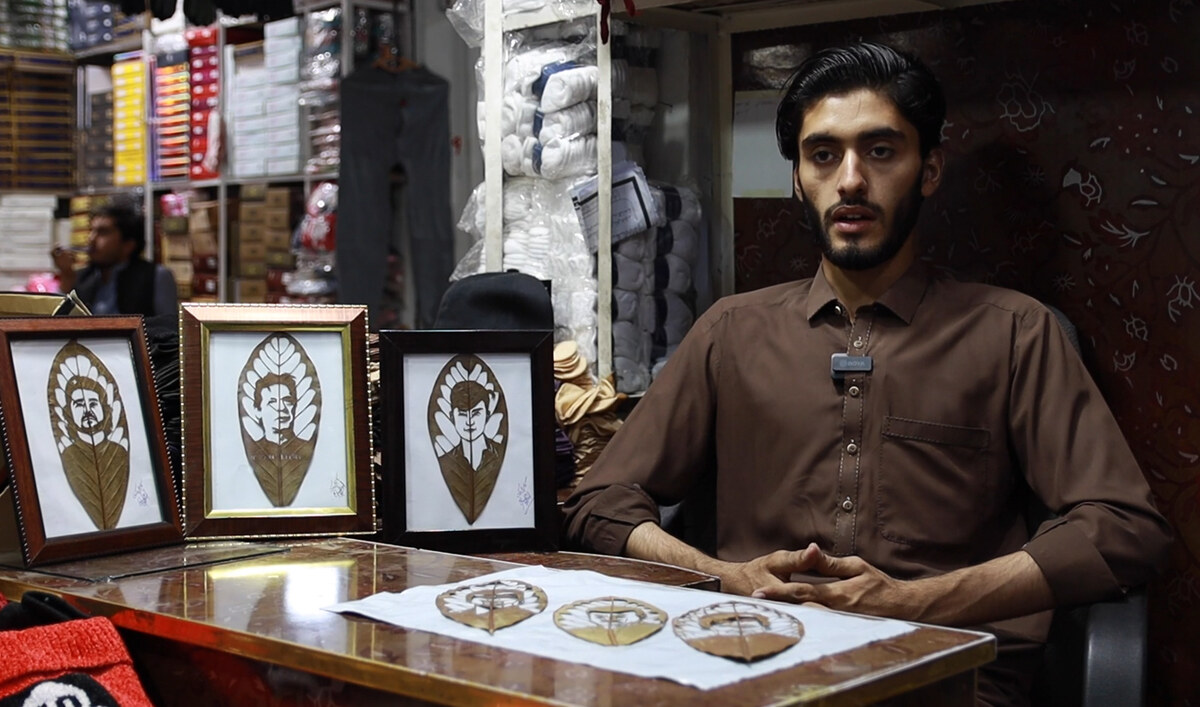


Pakistani artist Kamran Khan speaks during an interview with Arab News in Peshawar on October 31, 2024. (AN Photo)

Khan specializes in leaf carving, carefully etching designs and images into the surface of leaves, often using blades to create detailed scenes and portraits. The process requires a firm hand, patience and precision to avoid damaging the delicate structure of the leaf. He also uses a special kind of leaf that is dried for two days before it is ready to be used. 
The artist has made hundreds of portraits and designs, including images of politicians, artists, tribal elders, celebrities and world leaders.
Carving the logo of Arab News, he said, “I have sketched many leaders. I made the sketch of [Saudi Crown Prince] Mohammed bin Salman and uploaded its video on TikTok.”
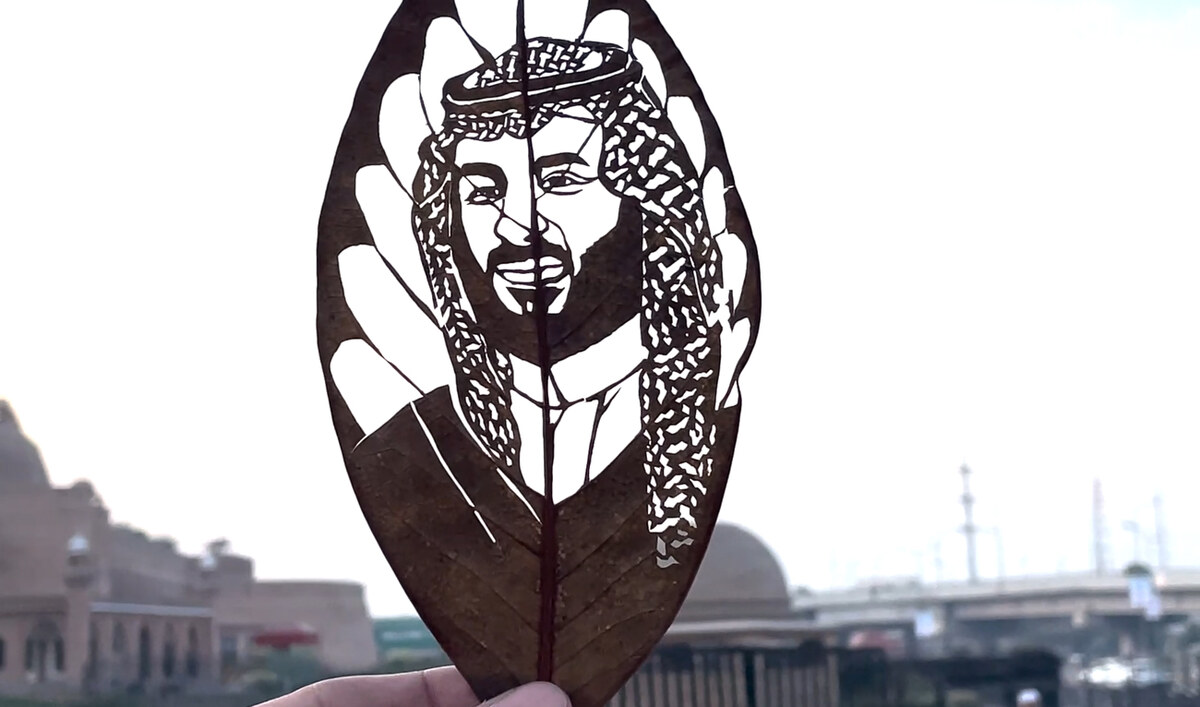


This photo, taken on October 31, 2024, shows Pakistani artist Kamran Khan’s artwork featuring Saudi Crown Prince Mohammed bin Salman, during an interview with Arab News in Peshawar. (AN Photo)
 

Social media had played a “huge role” in expanding his outreach, Khan said. 
“I take orders [to create art] using social media platforms, from TikTok, Instagram and Facebook,” he said. “International orders also come in, often requesting videos only. Orders are also placed for leaf art in physical frames, and we can adjust to both.”
Khan’s dedication was rewarded when a piece featuring Maryam Nawaz Sharif, a Pakistani politician who became the chief minister of Punjab after the last general elections, caught her attention.


In this photo, taken and released by Punjab Chief Minister office on October 9, 2024, shows Punjab Chief Minister Maryam Nawaz receives artwork, featuring her portrait, created by Kamran Khan in Lahore. (Photo courtesy: Facebook/Maryam Nawaz)

“I made a video of Maryam Nawaz’s sketch, and then she picked up my [work] from the social media platform and invited me over,” he added. “When we reached the CM House in Lahore to meet her, she appreciated [my work] and gave me a cash prize.”
Sharing his future plans, he said that he wanted to represent Pakistan on the world stage.
“I strive to promote our province and culture through this art,” he said, “and would love to represent my country Pakistan as well.”


Saudi-shot historical epic ‘Desert Warrior’ brings Arab heroine to global screens

Updated 09 December 2025
Follow

Saudi-shot historical epic ‘Desert Warrior’ brings Arab heroine to global screens

JEDDAH: Shot in Saudi Arabia, director Rupert Wyatt’s “Desert Warrior” is coming home after making its global premiere at the Zurich Film Festival in September, followed by its Middle East debut at the Red Sea International Film Festival this week.

The action-thriller, set in seventh-century Arabia and filmed across NEOM and Tabuk, marks a major milestone for MBC Studios. It was produced in partnership with US-based JB Pictures and AGC Studios. MBC Studios describes the film as the most expensive and lavish feature ever made in Saudi Arabia, and the first major tent-pole title shot at NEOM, with the budget reported to be $150 million.

Led by an international ensemble cast including Anthony Mackie, Aiysha Hart, Sharlto Copley, Ghassan Massoud, Geza Rohrig, Sami Bouajila, Lamis Ammar and Academy Award winner Ben Kingsley, the film blends historical drama, large-scale action and a narrative centered on one of the Arab world’s most compelling early heroines.

Saïd Boumazoughe, Ghassan Massoud, Omar Al Atawi, Rupert Wyatt, Aiysha Hart, Sharlto Copley and Samar Akrouk attended the "Desert Warrior" screening at the Red Sea International Film Festival 2025. (Getty Images)

The film is directed by British filmmaker Wyatt, known for “Rise of the Planet of the Apes” and “The Mosquito Coast,” with a screenplay co-written by Wyatt, Erica Beeney, David Self and Oscar nominee Gary Ross. JB Pictures’ Jeremy Bolt serves as producer.

Set against the tribal conflicts of seventh-century Arabia and the growing force of the Sassanid Empire, “Desert Warrior” follows Princess Hind bint Al-Nu‘man (Hart), who refuses to submit to Emperor Kisra (Kingsley). Fleeing with her father King Numan (Massoud), she must rely on a mysterious desert bandit (Mackie) as they evade mercenaries led by the ruthless Jalabzeen (Copley).

The story builds toward the legendary Battle of Dhi Qar, a pivotal pre-Islamic confrontation remembered throughout Arab history, and positions Princess Hind as a unifying hero who rallies fractured tribes to defend their homeland.

“This story is historically huge,” Wyatt told Arab News during a press junket at the RSIFF, explaining that his entry point was Princess Hind herself. “I think like anything it’s always the most human story, isn’t it? So, it’s the story of Aiysha and Princess Hind. And just the idea of being able to tell a story that starts incredibly small and very intimate about this young woman hunted in the desert, and then how gradually it fills with every action that she takes and the people around her take and how it grows.”

The director said this emotional center guided the arc from desert fugitive to military leader. “My aim was to start with one person in the desert, the bandit finding this young woman and her father, and then from there building, ultimately, to the mountains.”

Sharlto Copley attends the "Desert Warrior" screening at the Red Sea International Film Festival 2025. (Getty Images)

Wyatt said the team strove for historical accuracy while still ensuring the story remained visually compelling.

“I think like any movie, you have to take a little bit of license. You have to tell the story, but you also have to be faithful to reality, of course,” he told Arab News. “I mean, in the seventh century horses didn’t have saddles and stirrups, you know … but how do you film something like that? It’s not possible.”

He added that certain details such as belts and costume fastenings had to be adjusted for practical reasons. “The historical accuracy is always something that has to be clear but invisible.”

On technology, he said: “We did use CGI in certain areas. Of course, our elephants are CGI and the hyenas are CGI. But in terms of, like, artificial intelligence manipulating things, no.”

For South African actor Copley, who plays Jalabzeen, Kisra’s loyal and relentless mercenary determined to capture Hind by any means, the film offered a rare chance to inhabit a part of the world and an era seldom depicted on screen.

“I was excited to play a character that was from a part of the world in a time of the world that I had never seen on camera before,” Copley told Arab News. “That was unique and it’s hard to find unique projects to be honest in this day and age.

“I’d always been nervous of horse riding,” he admitted. “I almost didn’t take the movie … I knew a movie was going to come where you’re just going to say you’re going to have to ride a horse.”

“The very first description … was like, scene appears riding the biggest war horse … leading a charge … and I just read it I was like, oh God, here’s that movie. It’s here.”

After long conversations with a director friend who encouraged him to take the leap, Copley embraced the challenge and fell in love with it.

“At the end of the day … they let us ride our horses back to the stables,” he said. “We would just ride … as the sun was setting. Some of the best memories of my life.”

For British Saudi actor Hart, portraying Princess Hind, a figure celebrated in Arab history, was a transformative opportunity.

“It’s just such an honor to play a character like this,” she told Arab News. “I didn’t actually know about the history, so for me it was a revelation.”

She added: “To know that that’s what a woman did in the seventh century, she united the Arab tribes and faced down the Byzantine Empire and the strongest empire of the time, is no small feat even by modern standards.”

Like Copley, Hart’s preparation involved intensive physical training.

“She — Princess Hind — grew up on a horse,” Hart said. “I hadn’t ridden a horse since I was maybe 10 … I got thrown off a couple of times, so I stopped riding.”

Determined to honor the character, she trained daily in Saudi Arabia: “An hour of stunt training, two hours of horse riding, then stunt sword fighting. It is a really physical role.”

Hart said she connected deeply with Hind’s spirit.

“In terms of where Hind resonates with me, I think she has a passion and a fire that I also have,” she said. “I think she’s a bit more courageous than I am and I hope I took some of that courage from her.”

She added: “I just feel really honored to play the role … I feel very lucky to have taken that role and to have been able to offer it to the world.”

With its international cast, sweeping desert landscapes and dramatic portrayal of a defining moment in regional history, “Desert Warrior” represents a new ambition in Saudi filmmaking, both in scale and global reach.

Shot over four and a half months in NEOM and Tabuk, the film showcases the Kingdom’s rapidly expanding production infrastructure and highlights an Arab woman’s leadership in a pivotal historical moment.

As Princess Hind unites the tribes and rides toward the Battle of Dhi Qar, “Desert Warrior” positions itself not only as a cinematic epic, but also a celebration of identity, resistance and unity.