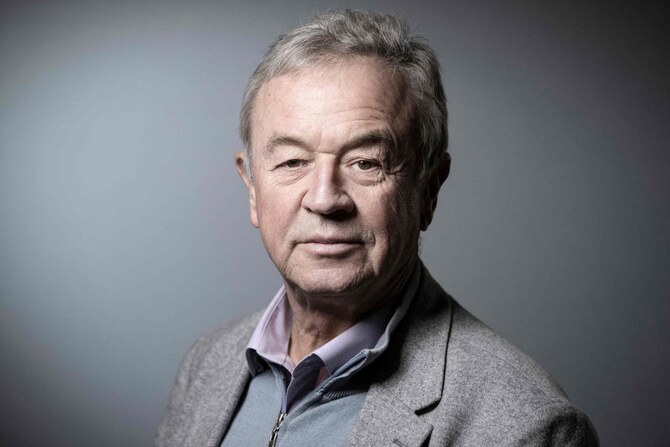
ALGIERS: As one of the Arab world’s largest book fairs opens in Algeria on Wednesday, there is one conspicuous absence. French-Algerian author Kamel Daoud, who won France’s most prestigious literary award earlier this week, was not invited to this year’s event.
This year’s Prix Goncourt winner and his French publisher Gallimard — a regular participant — are among those who won’t be welcomed at the Algiers International Book Fair. The exclusion of several prominent authors and publishers from this year’s event reflects the ongoing limitations on freedom of expression in Algeria.
Daoud’s novels and their subject matter often polarize opinions in both France, where he lives, and Algeria, where he was born. His Goncourt-winning third novel Houris (Virgins, in English) centers on the memories of victims of Algeria’s “Black Decade.” After Islamists won the first round of legislative elections in 1990, Algeria descended into civil war after the second round was canceled by the military-backed government.
Though memories of that history loom large, Houris will not be among the more than 300,000 titles available at the book fair, which is being marketed under the slogan “Read to Triumph” and billed for having a special focus on history.
Ali Bey, the owner of Algiers’ Librarie du Tiers Monde, said he was “delighted” to see Daoud’s international recognition but lamented that Algerian readers would not be able to purchase his novels.
The censorship extends beyond Daoud and Gallimard. Koukou Publishing, an independent Algerian house led by former political activist Arezki Ait Larbi, has also been excluded from this year’s festival. Koukou — known for publishing works by essayists, novelists and journalists whose writings often challenge official narratives — wasn’t invited either, Ait Larbi wrote in a Facebook post.
“Our house is under threat of a complete ban from publishing,” Ait Larbi said, accusing the Ministry of Culture’s censors of targeting his books.

Algeria opens book fair without winner of top French language literary prize
https://arab.news/wg5ds
Algeria opens book fair without winner of top French language literary prize
- This year’s Prix Goncourt winner and his French publisher Gallimard — a regular participant — are among those who won’t be welcomed at the Algiers International Book Fair
Sudan defense minister dismisses ‘intelligence document’ as fabrication after convoy strike
- Gen. Hassan Kabroun tells Arab News claims that army hid weapons in aid convoy are “completely false”
RIYADH: Sudan’s defense minister has firmly denied reports attributed to Sudanese intelligence alleging that a convoy targeted in North Kordofan was secretly transporting weapons under the cover of humanitarian aid.
Gen. Hassan Kabroun described the claims as “false” and an attempt to distract from what he called a militia crime.
The controversy erupted after news reports emerged that a document attributed to Sudan’s General Intelligence Service claimed the convoy struck in Al-Rahad on Friday was not a purely humanitarian mission, but was instead carrying “high-quality weapons and ammunition” destined for Sudanese Armed Forces units operating in the state.
The report further alleged that the convoy had been outwardly classified as humanitarian in order to secure safe passage through conflict zones, and that the Rapid Support Forces had destroyed it after gathering intelligence on its route and cargo.
Kabroun categorically rejected the narrative.
“First of all, we would like to stress the fact that this news is false,” he told Arab News. “Even the headline that talks about the security of the regions, such as Al-Dabbah, is not a headline the army would use.”
He described the document as fabricated and politically motivated, saying it was designed to “cover up the heinous crime they committed.”
The minister affirmed that the area targeted by drones is under full control of the Sudanese Armed Forces and does not require any covert military transport.
“Second, we confirm that the region that was targeted by drones is controlled by the army and very safe,” Kabroun said. “It does not require transporting any military equipment using aid convoys as decoys because it is a safe area controlled by the army, which has significant capabilities to transport humanitarian aid.”
According to the minister, the Sudanese military has both the logistical capacity and secure routes necessary to move equipment openly when needed.
“The army is professional and does not need to deliver anything to Kadugli or Dalang on board aid convoys,” he said. “The road between Dalang and Kadugli is open. The Sudanese forces used that road to enter and take control of the region. The road is open and whenever military trucks need to deliver anything, they can do so without resorting to any form of camouflage.”
Kabroun further rejected any suggestion that the military uses humanitarian operations as cover.
“Aid is transported by dedicated relief vehicles to the areas in need of this assistance,” he said. “Aid is not transported by the army. The army and security apparatus do not interfere with relief efforts at all, and do not even accompany the convoys.”
He stressed that the Sudanese Armed Forces maintains a clear institutional separation between military operations and humanitarian work, particularly amid the country’s crisis.
“These are false claims,” he said. “This fake news wanted to cover up the heinous crime they committed.”
Sudan has been gripped by conflict since April 2023, when fighting broke out between the Sudanese Armed Forces and the Rapid Support Forces, plunging the country into what the United Nations has described as one of the world’s worst humanitarian disasters.
The latest dispute over the convoy comes amid intensified fighting in South Kordofan, a strategically sensitive region linking central Sudan with the contested areas of Darfur and Blue Nile.
The false report suggested that intelligence monitoring had enabled the RSF to strike what it described as a military convoy disguised as humanitarian aid. But Kabroun dismissed that version outright.
“The intelligence agency is well aware of its duties,” he said. “The Sudanese Army has enough weapons and equipment to use in the areas of operations. These claims are completely false.”
He argued that the narrative being circulated seeks to shift blame for attacks on civilian infrastructure and humanitarian movements.
“This shows that they are trying to cover up the atrocities,” he added, referring to the militia.
Kabroun maintained that the army has regained momentum on multiple fronts and remains fully capable of sustaining its operations without resorting to deception.
“The region is secure, the roads are open, and the army does not need camouflage,” he said. “We are operating professionally and transparently.”
“These claims are completely false,” Kabroun said. “The Sudanese Army does not use humanitarian convoys for military purposes.”


