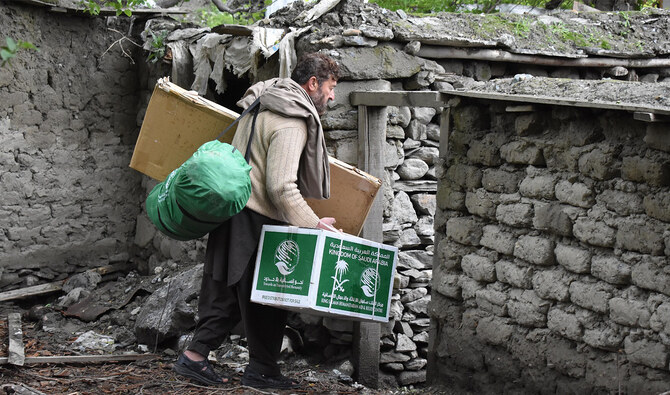
ISLAMABAD: The King Salman Humanitarian Aid and Relief Center (KSrelief) has completed the distribution of 50,000 shelters and winter kits among Pakistan’s most vulnerable communities, the Saudi charity said on Tuesday.
The aid distribution was part of KSrelief’s Shelter, Non-Food Items (NFIs) and Winter Kit Project for 2023-24, according to a statement issued by the charity organization.
By focusing on the disaster-stricken regions, the project provided essential support to over 350,000 individuals across Pakistan, enabling communities to recover and regain stability.
“Spanning four phases from September 2023 to October 2024, the initiative targeted areas severely affected by flash floods, heavy rainfall, and snowfall across 44 high-need districts in Pakistan,” KSrelief said in a statement.
“Through this effort, KSrelief distributed a total of 25,000 Shelter NFIs and 25,000 Winter Kits, aimed at helping communities withstand harsh winter conditions and rebuild their lives in the aftermath of these disasters.”
KSrelief coordinated with Pakistan’s national and provincial disaster management authorities and United Nations (UN) agencies for the effort, according to the statement.
“This approach ensured a cohesive, well-targeted response to meet the immediate needs of those impacted,” it read.
The Saudi charity organization has one of the largest humanitarian budgets available to any aid agency across the world, which has allowed its officials to undertake a wide variety of projects in more than 80 countries.
Pakistan is the fifth largest beneficiary of its aid and humanitarian activities and has greatly benefited from its assistance since 2022 monsoon floods.

Saudi Arabia’s KSrelief completes distribution of 50,000 shelters, winter kits in Pakistan
https://arab.news/nmeaw
Saudi Arabia’s KSrelief completes distribution of 50,000 shelters, winter kits in Pakistan
- The initiative targeted areas severely affected by flash floods, heavy rain and snowfall in the South Asian country
- It provided essential support to over 350,000 individuals, enabling communities to recover and regain stability
Bangladesh leader pushes for SAARC revival after meeting Indian, Pakistani dignitaries
- Muhammad Yunus met Pakistan’s parliamentary speaker, Indian FM at Khaleda Zia’s funeral on Wednesday
- SAARC has been dysfunctional since 2016, after India withdrew following a militant attack it blamed on Islamabad
ISLAMABAD: Bangladesh Chief Adviser Muhammad Younus this week pushed for reviving the South Asian Association for Regional Cooperation (SAARC) platform after meeting dignitaries from India, Pakistan and other parts of the region.
SAARC has been effectively dysfunctional since 2016, when its planned Islamabad summit collapsed after India withdrew following a militant attack it blamed on Pakistan. Islamabad denied involvement, but New Delhi’s decision prompted Afghanistan, Bangladesh and Bhutan to pull out, leading to the indefinite postponement of the summit.
Younus met Pakistan’s National Assembly Speaker Ayaz Sadiq and Indian External Affairs Minister Subrahmanyam Jaishankar at former Bangladesh premier Khaleda Zia’s state funeral in Dhaka on Wednesday. The funeral also saw a handshake between the Indian and Pakistani representatives, the first high-level contact between officials of the two countries since their conflict in May.
“During the meetings, Professor Yunus repeatedly emphasized the need to revive the South Asian Association for Regional Cooperation (SAARC),” Yunus’ account on social media platform X said.
“We witnessed a true SAARC spirit at the funeral yesterday,” the account quoted Yunus as saying. “SAARC is still alive. The SAARC spirit is still alive.”
The Bangladesh leader said apart from Jaishankar and Sadiq, representatives from South Asia who attended the funeral included Nepal’s Foreign Minister Bala Nanda Sharma, Sri Lanka’s Minister of Foreign Affairs, Employment and Tourism Vijitha Herath, and Maldives Minister of Higher Education and Labor Ali Haider Ahmed.
Yunus said he tried to convene an informal gathering of SAARC leaders on the sidelines of the UN General Assembly in New York last year.
His statement to revive SAARC follows that of Pakistan’s Prime Minister Shehbaz Sharif, who earlier this month also called for reviving the South Asian platform.
Sharif’s message last month came as the bloc marked the 40th anniversary of its founding charter. The Pakistani premier stressed the importance of deeper economic collaboration and collective responses to shared regional challenges such as poverty, climate-induced natural disasters, food and energy insecurity, and public-health vulnerabilities.


