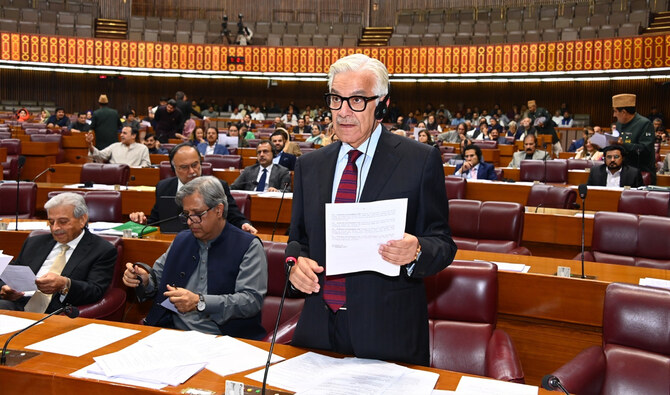

ISLAMABAD: Defense Minister Khawaja Asif has defended the passage this week by Pakistan’s parliament of bills that extend the tenures of the army, navy and air force chiefs, saying the move would check against services chiefs granting themselves extensions and “formalize” the duration of their service.
The bills, approved by Pakistan’s National Assembly and Senate on Monday, have been pushed by the coalition government led by Prime Minister Shehbaz Sharif which argues that they are aimed at building continuity and avoiding some of the political turmoil that usually surrounds the appointment of the army chief every three years. The bills also extend the tenure of the heads of the navy and air force, though those positions hold less influence in Pakistan.
The office of the army chief is considered to be the most powerful in the country, with the army having ruled Pakistan for almost half of its 75-year -long history. Even when not directly in power, the army is considered to be the invisible guiding hand in politics and holds considerable sway in internal security, foreign policy, and economic affairs, among other domains. Several army chiefs in the past have been given extensions in service.
“What we did [passage of bills], these extensions [in army chief’s term] started from Ayub Khan’s time,” Defense Minister Khawaja Asif said, referring to a Pakistani general who carried out a military coup in 1958 and ruled until 1969.
“That thing has been formalized now, and we have increased the tenure. You pick up the rest of the institutions. [...] the National Assembly [term] is also for five years.”
“Now the trend of extensions, how it was in the past that people gave an extension to themselves [will be ended],” Asif added, referring to now retired Gen Qamar Javed Bajwa, who served as army chief from 2016-22 after getting a three-year extension.
Speaking to a Pakistani news channel, Information Minister Ataullah Tarar also said the uncertainty surrounding the army chief’s appointment had been addressed through the new legislation.
“The five-year tenure [of the services chiefs] will not affect the institution’s merit-based system … The amendments are not introduced suddenly, instead the consultation on them was underway, and this legislation is not done for any individual.”
OPPOSITION STANCE
As the bills were passed on Monday in the National Assembly, opposition lawmakers from the PTI party of imprisoned former Prime Minister Imran Khan chanted against the measure. Some of them tore up copies of the bills and threw them at Speaker Ayaz Sadiq for not allowing debate. A similar protest by lawmakers from Khan’s party took place when the bill was quickly passed by the Senate, where Sharif’s party also holds a majority. The bill will now go to the president for his approval.
Omar Ayub Khan, a top leader of Khan’s Pakistan Tehreek-e-Insaf party, or PTI, told reporters after the bill passed that the legislation “is neither good for country nor for the armed forces.”
The PTI is widely believed to be against an extension in service particularly for incumbent Army Chief Gen. Asim Munir, who it considers to be behind the ouster of Khan from the PM’s office in a parliamentary vote of no-confidence in 2022. The PTI also says the army is behind legal cases against Khan that have kept him in prison since August last year. The military denies any interference in politics.
The passage of the new bills follows controversial amendments made to the constitution last month, granting lawmakers the authority to nominate the chief justice of Pakistan, who previously used to be automatically appointed according to the principle of seniority.
The amendments allowed the government to bypass the senior-most judge of the Supreme Court, Justice Mansoor Ali Shah, and appoint Justice Yahya Afridi as the country’s top judge.
The opposition and the legal fraternity had opposed the amendments, arguing that they were aimed at granting more power to the executive in making judicial appointments and curtailing the independence of the judiciary. The government denies this.