

Saudi Vision 2030 to catalyze banking sector growth: Moody’s

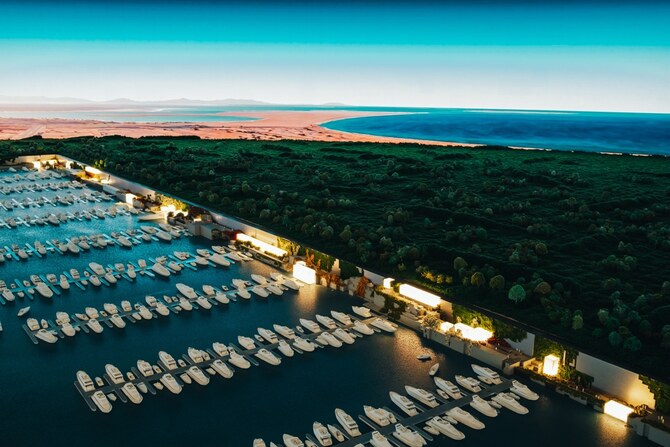
Development of planned mega projects in Saudi Arabia will play important role in generating huge business and lending opportunities for banks. File
Short Url
Updated 04 November 2024
Follow

Saudi Vision 2030 to catalyze banking sector growth: Moody’s

  • Rating agency said development of planned mega projects in Saudi Arabia will play important role in generating huge business and lending opportunities for banks
  • Kingdom’s housing program has been a driver of credit growth for the banks over the last five years

RIYADH: Saudi Arabia’s Vision 2030 program to diversify the economy could accelerate the country’s banking sector development in the coming years, according to an analysis by Moody’s. 

In its latest report, the US-based credit rating agency said the development of planned mega projects in Saudi Arabia will play an important role in generating huge business and lending opportunities for banks. The infrastructure required to host major events like the Asia Cup in 2027, the Asian Winter Games in 2029, Expo 2030, and the FIFA World Cup in 2034 is expected to support this growth further.

Vision 2030 aims to reduce the Kingdom’s decades-long dependence on crude revenues and steadily bolster its presence in other sectors like tourism, technology, and real estate. 

“Planned mega projects to diversify the economy include the tourism, real estate, and infrastructure sectors, and the government provides the country’s banks the opportunity to help fund them,” said Abdulla Al-Hammadi, assistant vice president and analyst at Moody’s Ratings. “One part of Saudi Vision 2030 is a plan to raise home ownership to 70 percent by 2030 from 47 percent in 2016.”

The report said the Kingdom’s housing program has been a driver of credit growth for the banks over the last five years, with household mortgages reaching SR607 billion ($161.67 billion) at the end of 2023, up from SR110 billion in 2016. They now comprise around 24 percent of total banking sector loans.

“Given these mortgages were secured at a fixed rate during a time of low interest rates and that tenures are often for 25 to 30 years, this could place some pressure on margins in the sector. We believe that larger banks will be hit hardest due to their dominant position in the Saudi mortgage market,” said Al-Hammadi. 

If deposit development continues to lag loan growth, banks could also face growing funding shortages. Given the nature of mortgage fixed-rate loans, it may be challenging for financial institutions to offload them in the still-developing secondary markets.

The agency said Saudi banks could also face challenges in this run, which include insufficient deposit growth to meet the growing credit demand associated with Vision 2030 infrastructure and development projects. 

“A challenge is that availability of deposit growth is lagging behind accelerated credit growth at Saudi banks, while the home-ownership push has packed the banks with long-term, fixed-rate mortgages that tie up funds. 

“The banks will need to tap more confidence-sensitive market funding. This could entail foreign deposits, interbank syndications, and debt issuance, particularly Islamic bonds or sukuk,” said Al-Hammadi.

According to the report, reliance on short-term foreign funding will be riskier than long-term, such as senior unsecured debt and additional tier one, since long-term allocations will better match these banks’ long-term loans.


Saudi Maaden reports 156% surge in annual net profit to $2bn on strong commodity prices and record production

Updated 8 sec ago
Follow

Saudi Maaden reports 156% surge in annual net profit to $2bn on strong commodity prices and record production

RIYADH: Saudi mining and metals company Maaden has reported a 156 percent jump in its net profit attributable to shareholders for 2025, driven by higher commodity prices, record production volumes, and a one-off bargain purchase gain.

The state-backed giant posted a net profit of SR7.35 billion ($1.95 billion) for the full year 2025, an increase from SR2.87 billion in the previous year. The firm’s revenue surged by 19 percent to SR38.58 billion, up from SR32.55 billion in 2024.

This comes as Saudi Arabia steps up efforts to expand its mining sector as a pillar of economic diversification, encouraging international participation and private investment to unlock the Kingdom’s estimated $2.5 trillion in untapped mineral resources under Vision 2030.    

In a statement on Tadawul, the company said: “Performance was led by record phosphate production, near record aluminum production, an increase in all three of Maaden’s main output commodity prices.”

The performance was also fueled by a 60 percent increase in gross profit, which reached SR14.79 billion. In its annual results announcement, Maaden attributed the top-line growth to “higher commodity market prices for phosphate, aluminum and gold business units,” as well as increased sales volumes in its phosphate and aluminum segments. This was partially offset by slightly lower sales volume in the gold unit.

Maaden’s CEO, Bob Wilt, hailed 2025 as a transformative year for the company, marked by strategic growth and operational excellence. “This was a great year for Maaden’s strategic growth. We delivered strong financial results and sustained operational excellence across the business,” he said in a statement.

“This was driven by growth in production across all businesses, including record-breaking DAP (di-ammonium phosphatevolumes), disciplined cost control across and a clear commitment to our role as a cornerstone of the Saudi economy,” Wilt added.

Profitability was further bolstered by an increased share of net profit from joint ventures and an associate. This included a one-off bargain purchase gain of SR768 million related to Maaden’s investment in Aluminium Bahrain B.S.C. The company also benefited from lower finance costs.

The fourth quarter of 2025 was strong, with Maaden swinging to a net profit of SR1.67 billion, compared to a loss of SR106 million in the same period of the prior year. Quarterly revenue rose 7 percent to SR10.64 billion.

The firm achieved record production of di-ammonium phosphate, reaching 6.72 million tonnes for the year, a 9 percent increase. Aluminum production remained near-record levels, while the company added a net 7.8 million ounces to its reportable gold mineral resources through discovery and resource development.

The phosphate division saw sales jump 17 percent to SR20.77 billion, with the earnings before interest, taxes, depreciation, and amortization margin expanding to 47 percent. The aluminum business reported a 9 percent increase in sales to SR10.99 billion, with EBITDA more than doubling in the fourth quarter.

Looking ahead, Wilt emphasized that the pace of growth will accelerate as the company advances key initiatives, including the Phosphate 3 Phase 1 and Ar Rjum projects, which remain on budget and schedule. Maaden has also secured a gas supply for its future Phosphate 4 project.

“This pace of growth will only accelerate. Not only as we advance projects and increase the scale of our exploration program, but as we continue to grow production and implement technology that will further modernize, streamline and unlock value,” Wilt added.

Earnings per share for the year rose sharply to SR1.91, up from SR0.78 in 2024. Total shareholders’ equity increased by 18.7 percent to SR61.59 billion.