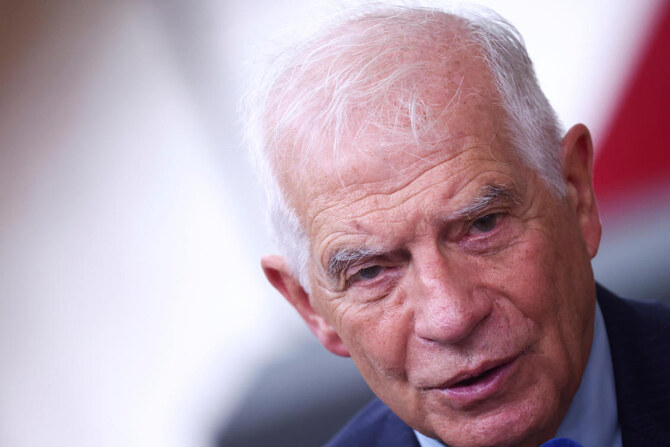
SEOUL: The European Union’s foreign policy chief Josep Borrell holds talks on Monday with his South Korean counterpart Cho Tae-yul, amid growing concerns in Seoul over the dispatch of North Korean troops to Russia for its war with Ukraine.
Borrell arrived in South Korea after a trip to Japan and visited the heavily fortified Demilitarized Zone separating the two Koreas, the diplomat said in a post on social media platform X on Sunday.
“My visit today of the Demilitarized Zone — DMZ — between the Republic of Korea and the DPRK is yet another reminder of the need to invest more in peace,” Borrell said in the post, referring to the initials of the North’s official name, the Democratic People’s Republic of Korea.
Borrell is visiting South Korea to take security and defense cooperation between the the EU and Seoul to “the next level,” he said in another post, without elaborating.
The first such Strategic Dialogue meeting between the EU and South Korea comes as Washington and Seoul have been sounding the alarm about the dispatch of North Korean troops to Russia for its war with Ukraine.
Borrell met with South Korea’s defense minister Kim Yong-hyun in Seoul on Monday and expressed concern over the development, the Yonhap news agency reported.
Cho said last week that all possible scenarios were under consideration, when asked about whether Seoul could send weapons to Ukraine in response to North Korea’s aiding Russia.
South Korea has provided non-lethal aid to Ukraine, including mine clearance equipment, but so far has resisted Kyiv’s requests for weapons.
Seoul also sees it as likely that the North will be compensated by Moscow with military and civilian technology, as it races to launch a spy satellite and upgrade its missile capabilities.
North Korea last week flexed its military muscle with the test of a huge new solid-fuel intercontinental ballistic missile dubbed Hwasong-19.
Washington expects North Korean troops in Russia’s Kursk region to enter the fight against Ukraine in the coming days, US Secretary of State Antony Blinken said last week.
North Korean Foreign Minister Choe Son Hui said her country intended to back Russia until it achieved victory in the Ukraine war at talks in Moscow on Friday with Russian Foreign Minister Sergei Lavrov.


![]()

EU’s Borrell visits South Korea amid alarm over North Korean troops in Russia
Short Url
https://arab.news/ppyrp
EU’s Borrell visits South Korea amid alarm over North Korean troops in Russia
- Borrell arrived in South Korea after a trip to Japan and visited the heavily fortified Demilitarized Zone separating the two Koreas
- Borrell is visiting South Korea to take security and defense cooperation between the the EU and Seoul to “the next level”


Latest updates


Recommended


© 2026 SAUDI RESEARCH & PUBLISHING COMPANY, All Rights Reserved And subject to Terms of Use Agreement.