

Angry crowd hurl mud at Spanish royals, prime minister on visit to flood disaster town

1 / 4
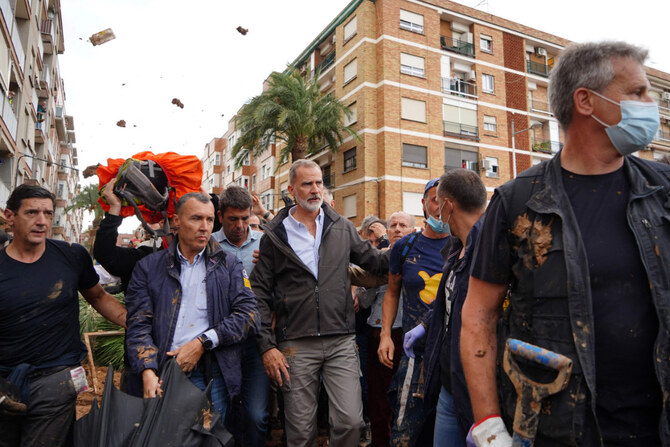
King Felipe VI of Spain and his delegation visit Paiporta, in Spain's eastern region of Valencia, on Nov. 3, 2024, in the aftermath of devastating deadly floods. (AFP)
2 / 4
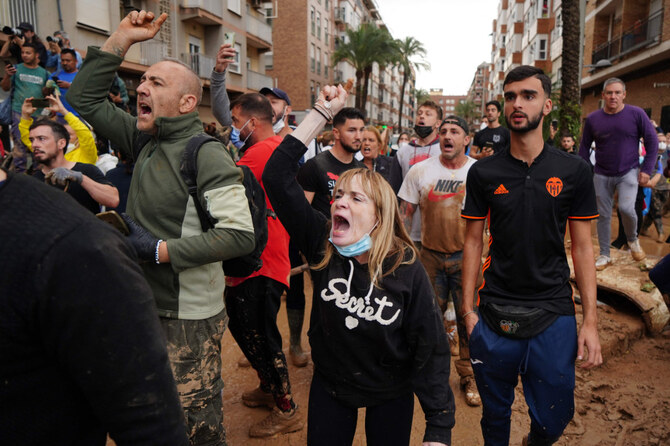
Angry residents heckle and hrow mud and objects as King Felipe VI of Spain visits Paiporta, in Spain's eastern region of Valencia, on Nov. 3, 2024, in the aftermath of devastating deadly floods. (AFP)
3 / 4
Police restrain protesters during a visit of Spain's King Felipe, following heavy rains that caused floods, in Paiporta, in Spain's eastern region of Valencia, on Nov. 3, 2024, in the aftermath of devastating deadly floods. (Reuters)
4 / 4
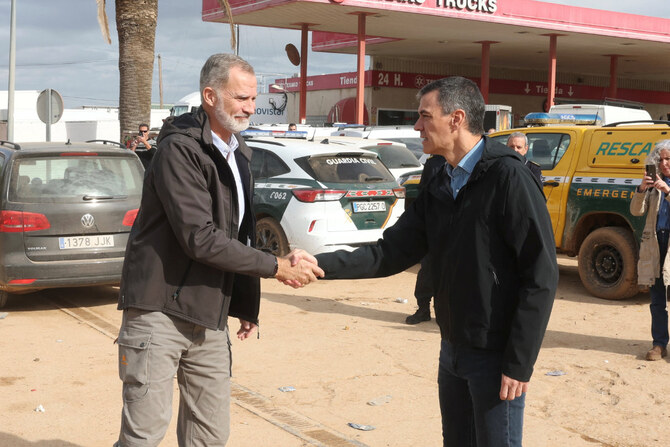
Spain's King Felipe and Spanish Prime Minister Pedro Sanchez shake hands as they visit the areas affected by the DANA, following heavy rains that caused floods, in Paiporta, in the eastern region of Valencia, on Nov. 3, 2024. (Casa de S.M. el Rey/Jose Jimenez/Handout via REUTERS)
Short Url
Updated 04 November 2024
Follow

Angry crowd hurl mud at Spanish royals, prime minister on visit to flood disaster town

  • Nasty protest underscored the fury over the response to the disaster that has now killed at least 217 people with many more still missing
  • Most of the fury seemed directed at Prime Minister Sanchez and Valencia regional government head
  • Spanish media later reported of the possible involvement of far-right groups during the incident

VALENCIA, Spain: Furious locals hurled mud and insults at Spain’s king, queen and prime minister on Sunday in a startling show of anger in the worst hit town in the flood disaster that has killed more than 210 people.
More heavy rain fell on the Valencia region after King Felipe VI, Queen Letizia and Prime Minister Pedro Sanchez were forced to leave Paiporta where more than 70 people died in floods last Tuesday.

Mud hit the monarchs in the face and clothes as they tried to calm the angry crowd in scenes that underscored the fury over the response to the disaster that has now killed at least 217 people with many more still missing.


The king and queen went to a crisis center in Paiporta. But extra security guards soon had to keep the angry crowd, shouting “murders,” away from the royals and prime minister. They put up umbrellas to stop mud hitting the royal couple.
The king said later that Spain had to “understand the anger and frustration” of people affected by the devastation to towns where cars have been left in muddy heaps in streets.

In a social media video, the king called on the public to give the victims “hope and their guarantee that the state in its entirety is present.”
Most of the fury seemed directed at Prime Minister Sanchez and Valencia regional government head Carlos Mazon.
“I understand the social anger and of course, I’m here to receive it. This is my political and moral obligation,” Mazon said in a post on X.


Queen Letizia of Spain (L) talks with a person as angry residents heckled during the Spanish royal couple's visit to Paiporta on Nov. 3, 2024. (AFP)

The rear window of Sanchez’s car was broken before he and the local politicians quickly left. The socialist leader said that while he empathized with the “anguish and suffering” of the victims, he condemned “all forms of violence.”
Spanish media later reported of the possible involvement of far-right groups during the incident. Sanchez’s deputy Maria Jesus Montero reacted to the allegations on X, saying “We will not allow radical groups to profit from people’s pain.”
Spain’s meteorological agency issued a “red alert” for new storms in the Valencia region on Sunday and heavy rain started falling in the night.
Police using megaphones urged Valencia residents to stay in their homes. While the alert was later downgraded, schools in Valencia were to remain closed Monday.

Authorities have come under fire over the lack of warnings before the floods and the slow reaction after.
“I am aware the response is not enough, there are problems and severe shortages ... towns buried by mud, desperate people searching for their relatives ... we have to improve,” Sanchez said.
With an extra 10,000 troops, police and civil guards sent to the Valencia region, Spain has now ordered its largest peacetime military and security force deployment, Sanchez said.
“Thank you to the people who have come to help us, to all of them, because from the authorities: nothing,” a furious Estrella Caceres, 66, told AFP in the town of Sedavi.
In Chiva, restaurant owner Danna Daniella said she was still in shock, haunted by memories of people trapped by the raging floods “asking for help and there was nothing we could do.”
“It drives you crazy. You look for answers and you don’t find them.”


Soldiers clean a street covered in mud in Massanassa, near Valencia, Spain, on Nov. 3, 2024. (REUTERS)

Transport Minister Oscar Puente told El Pais daily that certain places would probably remain inaccessible by land for weeks.
An army of volunteers with food, water and cleaning equipment have played a key role in the recovery, though authorities have urged people to stay home to avoid congestion.
On Sunday, the Valencia government limited the number of volunteers authorized to travel to the city’s southern suburbs to 2,000 and restricted access to 12 localities.
Despite this thousands made their way to stricken communes on foot, carrying brooms and shovels.


Locals and volunteers remove muddy water on Nov. 1, 2024, after a flooding devastated the town of Paiporta, in the region of Valencia, eastern Spain. (AFP)

Storms coming off the Mediterranean are common this time of year. But scientists have warned that climate change is increasing the ferocity, length and frequency of extreme weather events.
Emergency services on Sunday listed 213 dead in the Valencia region, one in Andalusia in the south and three in Castilla-La Mancha neighboring Valencia.
Authorities have warned the toll could rise as vehicles trapped in tunnels and underground car parks are cleared.


Trump has ‘productive’ talks with Putin before Zelensky meet

Updated 37 min 36 sec ago
Follow

Trump has ‘productive’ talks with Putin before Zelensky meet

  • Trump’s upbeat tone on peace deal comes after Russia carried out another massive bombardment of Kyiv
  • US president due to meet Zelensky at his Mar-a-Lago estate today

PALM BEACH: Donald Trump said Sunday he had “productive” talks with Russian leader Vladimir Putin hours before the US president meets Ukraine’s Volodymyr Zelensky, in a year-end sprint to seal a deal to end the war.
Trump’s renewed upbeat tone comes despite wide skepticism in Europe about Putin’s intentions after Russia carried out another massive bombardment of the Ukrainian capital Kyiv just as Zelensky was heading to Trump’s Florida estate.
“I just had a very good and productive telephone call with President Putin of Russia,” Trump announced on his Truth Social platform.
The Kremlin gave a more pointed readout, saying that Trump agreed that a mere ceasefire “would only prolong the conflict” as it demanded Ukraine compromise on territory.
Trump is meeting Zelensky in the dining room of his Mar-a-Lago estate, where he frequently brings both foreign guests and domestic supporters.
Trump has made ending the Ukraine war a centerpiece of his second term as a self-proclaimed “president of peace,” and he has repeatedly blamed both Kyiv and Moscow for the failure to secure a ceasefire.
Zelensky, who has faced verbal attacks from Trump, has sought to show willingness to work with the contours of the US leader’s plans, but Putin has offered no sign that he will accept it.
Sunday’s meeting will be Trump’s first in-person encounter with Zelensky since October, when the US president refused to grant his request for long-range Tomahawk missiles.
And the Ukrainian leader could face another hard sell this time around, with Trump insisting that he “doesn’t have anything until I approve it.”

European allies

The talks are expected to last an hour, after which the two presidents are scheduled to hold a joint call with the leaders of key European allies.
Polish Prime Minister Donald Tusk, who will join the call, wrote on X that the Russian attacks on Kyiv were “contrary to President Trump’s expectations and despite the readiness to make compromises” by Zelensky.
The revised peace plan, which emerged from weeks of intense US-Ukraine negotiations, would stop the war along its current front lines and could require Ukraine to pull troops back from the east, allowing the creation of demilitarized buffer zones.
As such, it contains Kyiv’s most explicit acknowledgement yet of possible territorial concessions.
It does not, however, envisage Ukraine withdrawing from the 20 percent of the eastern Donetsk region that it still controls — Russia’s main territorial demand.
The Ukrainian leader said he hoped the talks in Florida would be “very constructive” but stressed that Putin had shown his hand with a deadly drone and missile assault on Kyiv that temporarily knocked out power and heating to hundreds of thousands of residents during freezing temperatures.
“This attack is again Russia’s answer on our peace efforts. And this really showed that Putin doesn’t want peace,” he said as he visited Canada.
He also told reporters that he would press Trump on the importance of providing security guarantees that would prevent any renewed Russian aggression if a ceasefire were secured.
“We need strong security guarantees. We will discuss this and we will discuss the terms,” he said.
Ukraine insists it needs more European and US funding and weapons — especially drones.

Russian opposition

Russia has accused Ukraine and its European backers of trying to “torpedo” a previous US-brokered plan to stop the fighting, and recent battlefield gains — Russia announced on Saturday it had captured two more towns in eastern Ukraine — are seen as strengthening Moscow’s hand when it comes to peace talks.
“If the authorities in Kyiv don’t want to settle this business peacefully, we’ll resolve all the problems before us by military means,” Putin said on Saturday.
Russian Foreign Minister Sergei Lavrov told state news agency TASS that Moscow would continue its engagement with US negotiators but criticized European governments as the “main obstacle” to peace.
“They are making no secret of their plans to prepare for war with Russia,” Lavrov said, adding that the ambitions of European politicians are “literally blinding them.”