

Saudi road maintenance time down 40% thanks to modern technology, transport minister says

1 / 2
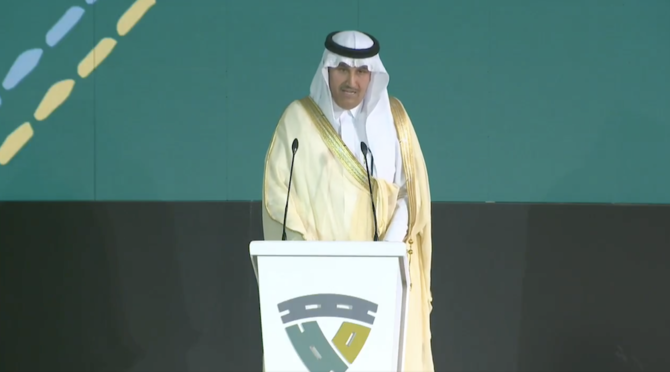
Saudi Minister of Transport and Logistics Services Saleh Al-Jasser was speaking on the first day of the Road Safety and Sustainability Conference in Riyadh. X/@RGAsaudi
2 / 2
Saudi Minister of Transport and Logistics Services Saleh Al-Jasser was speaking on the first day of the Road Safety and Sustainability Conference in Riyadh. X/@RGAsaudi
Short Url
Updated 03 November 2024
Follow

Saudi road maintenance time down 40% thanks to modern technology, transport minister says

  • Saleh Al-Jasser said cutting-edge innovations have helped reduce carbon emissions
  • Several road networks were surveyed to identify shortcomings and execute safety initiatives, minister said

RIYADH: Saudi road maintenance time has been slashed by 40 percent thanks to modern technologies, according to the Kingdom’s Minister of Transport and Logistics Services. 

During a speech on the first day of the Road Safety and Sustainability Conference taking place in Riyadh from Nov. 3—4, Saleh Al-Jasser said the cutting-edge innovations have also helped reduce carbon emissions.

This falls in line with Saudi Arabia’s Roads General Authority’s vision of enhancing the safety and sustainability of the road sector through national competencies. It also aligns with the body’s keenness to improve the quality of road networks and user experience, as well as foster innovation. 

It is also in line with the authority’s objective to reduce the number of road deaths to less than five cases per 100,000 people.

“Modern technologies have helped reduce road maintenance time by up to 40 percent while reducing carbon emissions,” Al-Jasser said. 

He added: “The Kingdom has implemented many scientific innovations such as road cooling and rubber roads and has advanced in the road quality index to fourth place among the G20 countries.”

The minister highlighted how this confirms its leadership in achieving the highest safety and quality standards on roads. 

“The Kingdom’s vision has given great attention to quality of life and road safety,” Al-Jasser said.

“The Kingdom’s road network is the world’s first in terms of connectivity, and enhances sustainable development for individuals and goods according to the highest standards of security and safety,” he also said. 

The minister went on to say a large number of road networks were surveyed to identify shortcomings and execute safety initiatives. Several measures have been implemented following the reviews. 

Speaking at the same event, the Vice Minister of Transport and Logistics Services for Road Affairs and Acting CEO of RGA, Badr Abdullah Al-Dulami, shared findings from the world’s largest road survey, which confirmed that 77 percent of the Kingdom’s roads meet safety standards. He also highlighted that protection measures in traffic diversions have risen to 95 percent.

“Expanding an advanced research study that the authority is working on to use the products of building demolition in asphalt mixtures, which contributes to preserving the environment and investing in natural resources,” Al-Dulami said. 

“Launching the Saudi Road Code, which contributes to raising the level of safety, preserving the environment, and preparing the infrastructure for self-driving vehicles,” he added. 

Chairman of the International Road Federation, Abdullah bin Abdulrahman Al-Muqbil, was also present during the event. 

“To make roads safer for travel, we have harnessed modern technologies to sustain them and raise their efficiency,” Al-Muqbil said. 

The chairman said the federation has established effective partnerships with member states, including the Kingdom, which has led to enhanced safety and sustainability in the road sector and the adoption of modern technologies.


Saudi Aramco, ExxonMobil, Samref ink deal to study Yanbu refinery upgrade

Updated 08 December 2025
Follow

Saudi Aramco, ExxonMobil, Samref ink deal to study Yanbu refinery upgrade

RIYADH: Energy giants Saudi Aramco, ExxonMobil, and Samref have signed a venture framework agreement to upgrade the Yanbu refinery and expand it into an integrated petrochemical complex.

As a part of the deal, the companies will explore capital investments to upgrade and diversify production, including high-quality distillates that result in lower emissions and high-performance chemicals, according to a joint press statement.

The agreement will also see the parties explore opportunities to improve the refinery’s energy efficiency and reduce environmental impacts from operations through an integrated emissions-reduction strategy.

Samref is an equally owned joint venture between Aramco and Mobil Yanbu Refining Co. Inc., a wholly owned subsidiary of Exxon Mobil Corp.

The refinery currently has the capacity to process more than 400,000 barrels of crude oil per day, producing a diverse range of energy products, including propane, automotive diesel oil, marine heavy fuel oil, and sulfur.

“This next phase of Samref marks a step in our long-term strategic collaboration with ExxonMobil. Designed to increase the conversion of crude oil and petroleum liquids into high-value chemicals, this project reinforces our commitment to advancing Downstream value creation and our liquids-to-chemicals strategy,” said Aramco Downstream President, Mohammed Y. Al Qahtani.

He added that the deal will help position Samref as a key driver of the Kingdom’s petrochemical sector’s growth.

The press statement further said that companies will commence a preliminary front-end engineering and design phase for the proposed project, which would aim to maximize operational advantages, enhance Samref’s competitiveness, and help to meet growing demand for high-quality petrochemical products in Saudi Arabia.

The firms added that these plans are subject to market conditions, regulatory approvals, and final investment decisions by Aramco and ExxonMobil.

“We value our partnership with Aramco and our long history in Saudi Arabia. We look forward to evaluating this project, which aligns with our strategy to focus on investments that allow us to grow high-value products that meet society’s evolving energy needs and contribute to a lower-emission future,” said Jack Williams, senior vice president of Exxon Mobil Corp.