Air monitor records pollution level in Lahore 80 times above WHO limit

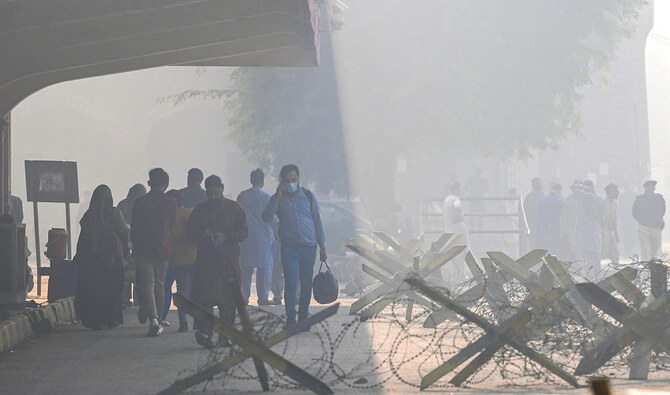
People walk along a street amid smog in Lahore on November 2, 2024. (AFP)
Short Url
Updated 02 November 2024
Follow

Air monitor records pollution level in Lahore 80 times above WHO limit

  • For days, Lahore has been enveloped by smog, smoke from seasonal crop burning and winter cooling
  • The level of deadly PM2.5 pollutants peaked at 1,067, before dropping to around 300 in the morning

LAHORE: Air pollution in Pakistan’s second biggest city Lahore soared on Saturday more than 80 times over the level deemed acceptable by the World Health Organization (WHO), with an official calling it record high.
The level of deadly PM2.5 pollutants — fine particulate matter in the air that causes the most damage to health — peaked at 1,067, before dropping to around 300 in the morning, with anything above 10 considered unhealthy by the WHO.
“We have never reached a level of 1,000,” Jahangir Anwar, a senior environmental protection official in Lahore told AFP.
For days, Lahore has been enveloped by smog, a mix of fog and pollutants caused by low-grade diesel fumes, smoke from seasonal agricultural burning and winter cooling.
“The air quality index will remain high for the next three to four days,” Anwar said.
On Wednesday, the provincial environmental protection agency announced new restrictions in four “hot spots” in the city.
Tuk-tuks equipped with polluting two-stroke engines are banned, as are restaurants that barbecue without filters.
Government offices and private companies will have half their staff work from home from Monday.
Construction work has been halted and street and food vendors, who often cook over open fires, must close at 8 pm.
Smog is particularly pronounced in winter, when cold, denser air traps emissions from poor-quality fuels used to power the city’s vehicles and factories at ground level.


Pakistan says PIA stake sale will trigger ‘greater investor interest’ for privatization of DISCOs

Updated 11 sec ago
Follow

Pakistan says PIA stake sale will trigger ‘greater investor interest’ for privatization of DISCOs

  • Pakistan to next focus on privatizing Islamabad, Gujranwala and Faisalabad electric supply companies, says state minister
  • Pakistan’s power sector has drained its public finances due to high losses, inefficiencies and mounting subsidies over the years

ISLAMABAD: State Minister for Finance Bilal Azhar Kayani this week said the government’s move to successfully sell its stake in the state-owned Pakistan International Airlines (PIA) will trigger greater investor interest in Islamabad’s privatization program. 

In December, a consortium led by the Arif Habib Group won the bid for a 75 percent controlling stake in Pakistan’s flag carrier by offering Rs 135 billion ($482 million).

Pakistan’s government has undertaken the drive to privatize or restructure its loss-making state-owned enterprises (SOEs) at the International Monetary Fund’s (IMF) insistence.

In an interview with the state-run Pakistan Digital on Thursday, Kayani said the government will next focus on privatizing electricity distribution companies (DISCOs) such as the Islamabad Electric Supply Company (IESCO), Gujranwala Electric Supply Company (GESCO) and Faisalabad Electric Supply Company (FESCO).

“The momentum created by the PIA deal will help generate greater investor and advisory interest going forward for the privatization program,” Kayani was quoted as saying by Pakistan Digital. 

“The next phase of privatization is focused on electricity distribution companies, including IESCO, GEPCO and FESCO.”

The power sector has drained Pakistan’s public finances due to high losses, inefficiencies and mounting subsidies, making it a central focus of Pakistan’s reform agenda under the IMF program.

Pakistan’s Privatization czar Muhammad Ali last month announced the government plans to issue Expressions of Interest (EoIs) for the privatization of state-owned DISCOs in January. 

Pakistan’s government owns or controls much of the power infrastructure. It is also grappling with ballooning “circular debt,” or unpaid bills and subsidies, that have choked the power sector and weighed on the economy.