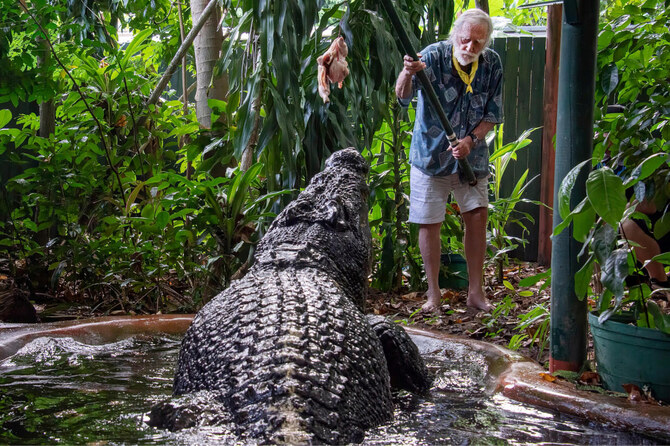
SYDNEY: A 5.48-meter (18 feet) Australian crocodile that held the world record as the largest crocodile in captivity has died, a wildlife sanctuary said on Saturday. He was thought to be more than 110 years old.
Cassius, weighing in at more than one tonne, had been in declining health since Oct. 15, Marineland Melanesia Crocodile Habitat said on Facebook.
“He was very old and believed to be living beyond the years of a wild Croc,” according to a post by the organization, based on Green Island near the Queensland tourist town of Cairns.
“Cassius will be deeply missed, but our love and memories of him will remain in our hearts forever.”
The group’s website said he had lived at the sanctuary since 1987 after being transported from the neighboring Northern Territory, where crocodiles are a key part of the region’s tourist industry.
Cassius, a saltwater crocodile, held the Guinness World Records title as the world’s largest crocodile in captivity.
He took the title after the 2013 death of Philippines crocodile Lolong, who measured 6.17m (20 feet 3 inches) long, according to Guinness.

World’s largest captive crocodile Cassius dies in Australia
https://arab.news/8h435
World’s largest captive crocodile Cassius dies in Australia
- Cassius, weighing in at more than one tonne, had been in declining health since October 15
- He took the title after the 2013 death of Philippines crocodile Lolong, who measured 6.17 meters
Paraplegic engineer first wheelchair user to blast into space
- An ecstatic Benthaus said she laughed all the way up — the capsule soared more than 105 kilometers — and tried to turn upside down once in space. “It was the coolest experience,” she said shortly after landing.
WEST TEXAS: A paraplegic engineer from Germany blasted off on a dream-come-true rocket ride with five other passengers, leaving her wheelchair behind to float in space while beholding Earth from on high.
Severely injured in a mountain bike accident seven years ago, Michaela Benthaus became the first wheelchair user in space, launching from West Texas with Jeff Bezos’ company Blue Origin. She was accompanied by a retired SpaceX executive also born in Germany, Hans Koenigsmann, who helped organize and, along with Blue Origin, sponsored her trip. Their ticket prices were not divulged.
An ecstatic Benthaus said she laughed all the way up — the capsule soared more than 105 kilometers — and tried to turn upside down once in space. “It was the coolest experience,” she said shortly after landing.
The 10-minute space-skimming flight required only minor adjustments to accommodate Benthaus, according to the company. That’s because the autonomous New Shepard capsule was designed with accessibility in mind, “making it more accessible to a wider range of people than traditional spaceflight,” said Blue Origin’s Jake Mills, an engineer who trained the crew and assisted them on launch day.
Among Blue Origin’s previous space tourists: those with limited mobility and impaired sight or hearing, and a pair of 90-year-olds.
For Benthaus, Blue Origin added a patient transfer board so she could scoot between the capsule’s hatch and her seat. The recovery team also unrolled a carpet on the desert floor following touchdown.


