

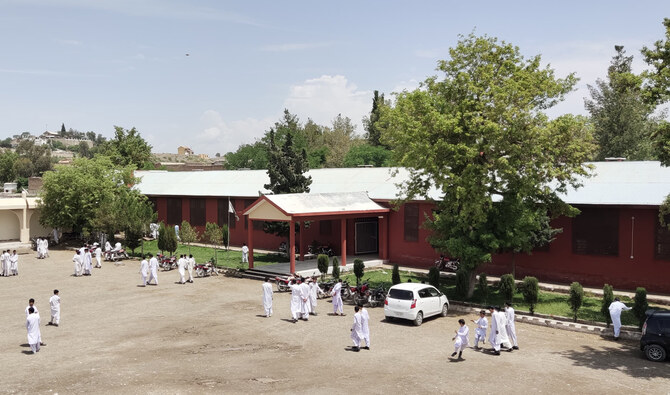

QUETTA: Police in Pakistan’s southwestern Balochistan province have arrested a school clerk accused of gambling away Rs2.3 million ($8,282) in exam fees, collected from over 800 students, a senior official confirmed Friday.
The clerk, Shahzad Jamal, worked at Government Model High Secondary School in Zhob district, located about 335 kilometers from Quetta, the provincial capital.
Tasked with gathering annual matriculation exam fees from 9th and 10th-grade students and depositing them in a bank, Jamal instead used the funds for online gambling.
Superintendent of Police in Zhob Saboor Agha told Arab News on phone that Jamal was detained during a raid on his residence on Tuesday night.
“Shahzad Jamal had already shifted his family to Peshawar and was planning to escape, but we apprehended him from his residence in Zhob,” he said.

In this photo, taken on October 25, 2024, Principal Wazir Khan meets students at the Government Model Secondary High School in Zhob district, Balochistan. The clerk, Shahzad Jamal, worked at Government Model High Secondary School has been arrested for gambling away Rs2.3 million ($8,282) in exam fees, collected from over 800 students, according to police. (Photo courtesy: Wazir Khan)
“During the interrogation, he confessed to his crime,” he added. “Jamal had previously won around Rs500,000 [$1,800] through online gambling, which emboldened him and made him hope for another big win.”
A conversation with the school authorities revealed that Jamal had been collecting examination money for several weeks.
“The clerk had been collecting the annual exam fee from the students since the beginning of October,” Wazir Khan, the school principal, said. “He kept the money in a safe inside his office, but after the school hours, he started using the Rs2.3 million on an online gambling app called 1Xbet where he lost it.”
1Xbet, an international online gambling platform operated from Cyprus, has thousands of users worldwide, including in Pakistan.
When Khan discovered the loss, he reported it to the police.
According to Zaki Khalid, a Rawalpindi-based analyst who studies online gambling, such platforms operate within the shadows of the global financial system.

In this photo, taken on October 26, 2024, students and local tribesmen protest outside the Government Model Secondary High School in Zhob district, Balochistan, against the clerk, Shahzad Jamal, who gambled away Rs2.3 million ($8,282) in exam fees, collected from over 800 students, according to police. (Photo courtesy: Wazir Khan)
“These gambling companies avoid using traditional banking channels for deposits and withdrawals, instead encouraging users to use mobile cash-transfer apps,” he explained.
Khalid added that online gambling saw a boom in Pakistan during the coronavirus pandemic, driven by increased Internet usage.
“Social media platforms like Facebook, Instagram, and YouTube are major advertising spaces for these companies,” he continued. “In Pakistan and India, YouTubers even promote earning money through apps like 1Xbet.”
Abdullah Khan, a 17-year-old 10th-grade student at the school, was devastated to learn his exam fees were lost to gambling.

In this photo, taken on October 26, 2024, students and local tribesmen protest outside the Government Model Secondary High School in Zhob district, Balochistan, against the clerk, Shahzad Jamal, who gambled away Rs2.3 million ($8,282) in exam fees, collected from over 800 students, according to police. (Photo courtesy: Wazir Khan)
“I worked hard to save Rs2,800 ($10) to pay for my matriculation exams after 10 years of my education career,” he told Arab News, adding that he earns his living selling fruit from a pushcart.
Khan, who dreams of becoming a successful businessman, said many of his classmates come from families with limited means, making it difficult to pay the exam fees again.
In response to the incident, provincial education authorities extended the exam fee deadline to November 11 to support affected students.
“We have extended the form submission date, but the school must pay the exam fees and recover the amount from the clerk, which is mandatory,” said Ejaz Baloch, Chairman of the Balochistan Board of Intermediate and Secondary Education, while speaking to Arab News.


