

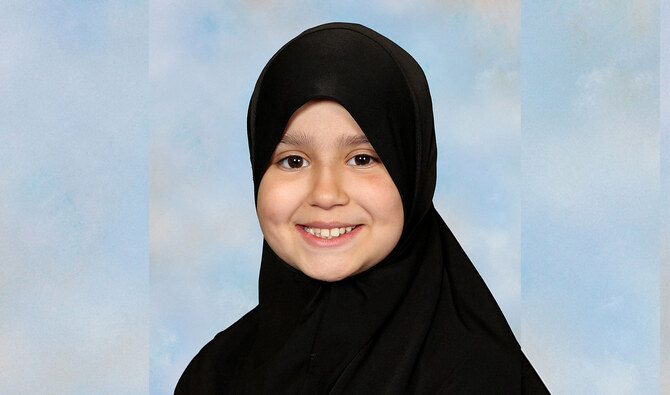

LONDON: The trial of three family members accused of murdering a 10-year-old British-Pakistani girl has shocked the UK, as details of the horrific abuse she endured have emerged in court.
Sara Sharif was found dead in bed — with fractured bones, bites and burn marks throughout her body — at her family’s home in Woking, southern England, in August 2023.
The discovery sparked an international manhunt for the relatives accused of the killing, after they had fled to Pakistan the previous day along with five of Sara’s siblings.
Her father, 42-year-old taxi driver Urfan Sharif, step-mother Beinash Batool, 30, and uncle Faisal Malik, 29, returned to Britain the following month and have been on trial since mid-October. They deny the charges.
London’s Old Bailey court has heard how Sara had 25 fractures, including the hyoid bone in the neck.
Pathologist and bone specialist Anthony Freemont told the jury he had concluded that was the result of “neck compression” most commonly caused by “manual strangulation.”
The youngster had dozens of bruises, including bite marks, while her DNA as well as that of her father and uncle were detected on a cricket bat and both ends of a belt.
Sara’s blood was found inside a carrier bag believed to have been put over her head, while blood and hairs were detected on a piece of brown tape.
Jurors heard Friday that Batool was the only defendant who had refused to provide dental impressions of her teeth.
The court had previously learned of WhatsApp messages she had sent her sister over several years in which she reported that Sharif had hit Sara for being “rude and rebellious.”

This combination of pictures created on September 13, 2023 shows undated handout photos released by Surrey Police in London on September 6, 2023, of Urfan Sharif (L), Beinash Batool, and Faisal Malik. Urfan Sharif, the British-Pakistani father of 10-year-old Sara Sharif, who was found dead at her home in England last month. (Photo courtesy: SURREY POLICE via AFP)
“She’s covered in bruises, literally beaten black,” one message stated.
“She’s got a jinn in her,” Batool had added, referring to genie-like supernatural beings from mythology.
Prosecutor William Emlyn Jones revealed Friday that four months before her death, Sharif had told Sara’s school that she would be homeschooled “with immediate effect.”
Around the same time the family relocated the short distance from the town of West Byfleet to Woking.
By then, teachers had noted bruising on her body, in June 2022 and March 2023.
Asked about the injuries, Sara had not wanted to answer and hid her head in her arms, the court has heard.
Giving evidence earlier in the trial, teacher Helen Simmons described her as a “happy child,” who at times would be “sassy.”
Simmons recounted how she twice saw bruises on her face, and when the girl had not given a consistent account of her injuries the school had made a referral to watchdog services.
That had prompted Batool to confront her at the school two weeks later and claim the marks had been made by a pen, jurors have heard.
Meanwhile neighbors regularly heard shouting, commotions and crying.
Rebecca Spencer, who lived below the family, said she would hear Batool “screaming.”
“I would hear the stepmother shout at Sara,” she testified.
Spencer also said she heard noises that sounded like someone “locked in a bedroom,” with “the constant rattling of the door” as they were “trying to get it open.”
Sitting in court behind plexiglass, the three defendants listened Friday morning with their heads bowed.
Sharif — a short, thin man with hard features — looked up to watch clips of their arrests at Gatwick Airport in September 2023 being shown to jurors.
In the footage from arresting officers’ body-cameras, Batool raised her hand and said: “I think you are looking for us.”
The day after fleeing Britain a month earlier, Sharif had called UK police from Pakistan to explain that he had “legally punish(ed) my daughter and she died.”
“I beat her, I didn’t want to kill her but I beat her too much,” he added, claiming she had been “naughty.”
Police found Sara’s body on a bunk bed covered with a sheet, alongside a note in which her father claimed he had not intended to kill her but wrote: “I lost it.”
The trial continues next week.


