Pakistan central bank set to deliver fourth consecutive rate cut to revive economy

The logo of the State Bank of Pakistan (SBP) is pictured on a reception desk at the head office in Karachi, Pakistan July 16, 2019. (REUTERS/File)
Short Url
Updated 01 November 2024
Follow

Pakistan central bank set to deliver fourth consecutive rate cut to revive economy

  • All 15 investors and analysts surveyed by Reuters expect the central bank to cut rates next week
  • Policymakers continue efforts to revive a fragile economy as inflation eases off recent record highs

KARACHI: Pakistan’s central bank is expected to cut its key interest rate further at its policy meeting on Monday, with policymakers continuing their efforts to revive a fragile economy as inflation eases off recent record highs.
The central bank, the State Bank of Pakistan, has slashed the benchmark policy rate to 17.5% from an all time-high of 22% in three consecutive policy meetings since June, having last reduced it by 200 basis points in September.
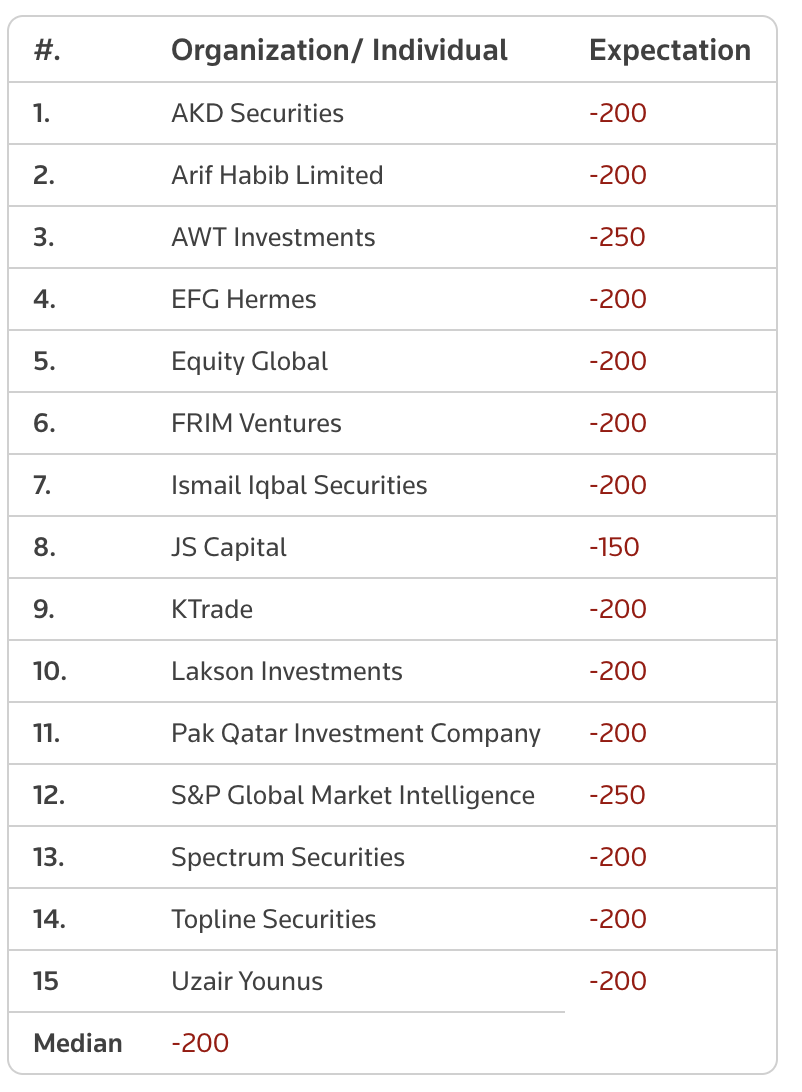
All 15 investors and analysts surveyed by Reuters expect the central bank to cut rates next week. Two expect a 150 bps cut, twelve predict a 200 bps reduction, and one forecasts a 250 bps cut.
Economic activity has stabilized since last summer when the country came close to a default before an eleventh hour bailout by the International Monetary Fund (IMF).
The IMF, which in September gave a boost to Pakistan’s struggling economy by approving a long-awaited $7 billion facility, said that the South Asian nation had taken key steps to restore economic stability with consistent policy implementation under the 2023-24 standby arrangement.
Advertisement · Scroll to continue
While the economy has started to gradually recover, and inflation has moved sharply down from a multi-decade high of nearly 40% in May 2023, analysts say further rate cuts are needed to bolster growth.
Mustafa Pasha, Chief Investment Officer at Lakson Investments, said rates must drop under 15% and hold below that for six months to have a material impact.
The IMF in its latest October report forecast Pakistan’s gross domestic product growth at 3.2% for the fiscal year ending June 2025, up from 2.4% in fiscal 2024.
The government expects annual inflation to have come in at 6-7% last month and slow further to 5.5-6.5% in November.
However, inflation could pick up again in 2025, driven by electricity and gas tariff hikes under the new $7 billion IMF bailout, and the potential impact of taxes on the retail and wholesale sector proposed in the June budget.
Ahmad Mobeen, senior economist at S&P Global Market Intelligence, said that while lower rates will offer some relief to the manufacturing sector, the benefits may be limited due to “elevated input costs, driven by high electricity and gas tariffs, combined with global supply and shipping constraints.”
The survey responses on Monday’s policy rate decision are listed below:

Arab food and beverage sector draws $22bn in foreign investment over 2 decades: Dhaman 

Updated 28 December 2025
Follow

Arab food and beverage sector draws $22bn in foreign investment over 2 decades: Dhaman 

JEDDAH: Foreign investors committed about $22 billion to the Arab region’s food and beverage sector over the past two decades, backing 516 projects that generated roughly 93,000 jobs, according to a new sectoral report. 

In its third food and beverage industry study for 2025, the Arab Investment and Export Credit Guarantee Corp., known as Dhaman, said the bulk of investment flowed to a handful of markets. Egypt, Saudi Arabia, the UAE, Morocco and Qatar attracted 421 projects — about 82 percent of the total — with capital expenditure exceeding $17 billion, or nearly four-fifths of overall investment. 

Projects in those five countries accounted for around 71,000 jobs, representing 76 percent of total employment created by foreign direct investment in the sector over the 2003–2024 period, the report said, according to figures carried by the Kuwait News Agency. 

“The US has been the region's top food and beverage investor over the past 22 years with 74 projects or 14 projects of the total, and Capex of approximately $4 billion or 18 percent of the total, creating more than 14,000 jobs,” KUNA reported. 

Investment was also concentrated among a small group of multinational players. The sector’s top 10 foreign investors accounted for roughly 15 percent of projects, 32 percent of capital expenditure and 29 percent of newly created jobs.  

Swiss food group Nestlé led in project count with 14 initiatives, while Ukrainian agribusiness firm NIBULON topped capital spending and job creation, investing $2 billion and generating around 6,000 jobs. 

At the inter-Arab investment level, the report noted that 12 Arab countries invested in 108 projects, accounting for about 21 percent of total FDI projects in the sector over the past 22 years. These initiatives, carried out by 65 companies, involved $6.5 billion in capital expenditure, representing 30 percent of total FDI, and generated nearly 28,000 jobs. 

The UAE led inter-Arab investments, accounting for 45 percent of total projects and 58 percent of total capital expenditure, the report added, according to KUNA. 

The report also noted that the UAE, Saudi Arabia, Egypt, and Qatar topped the Arab ranking as the most attractive countries for investment in the sector in 2024, followed by Oman, Bahrain, Algeria, Morocco, and Kuwait. 

Looking ahead, Dhaman expects consumer demand to continue rising. Food and non-alcoholic beverage sales across 16 Arab countries are projected to increase 8.6 percent to more than $430 billion by the end of 2025, equivalent to 4.2 percent of global sales, before exceeding $560 billion by 2029. 

Sales are expected to remain highly concentrated geographically, with Egypt, Saudi Arabia, Algeria, the UAE and Iraq accounting for about 77 percent of the regional total. By product category, meat and poultry are forecast to lead with sales of about $106 billion, followed by cereals, pasta and baked goods at roughly $63 billion. 

Average annual per capita spending on food and non-alcoholic beverages in the region is projected to rise 7.2 percent to more than $1,845 by the end of 2025, approaching the global average, and to reach about $2,255 by 2029. Household spending on these products is expected to represent 25.8 percent of total expenditure in 13 Arab countries, above the global average of 24.2 percent. 

Arab external trade in food and beverages grew more than 15 percent in 2024 to $195 billion, with exports rising 18 percent to $56 billion and imports increasing 14 percent to $139 billion. Brazil was the largest foreign supplier to the region, exporting $16.5 billion worth of products, while Saudi Arabia ranked as the top Arab exporter at $6.6 billion.