

Pakistan central bank set to deliver fourth consecutive rate cut to revive economy

The logo of the State Bank of Pakistan (SBP) is pictured on a reception desk at the head office in Karachi, Pakistan July 16, 2019. (REUTERS/File)
Short Url
Updated 01 November 2024
Follow

Pakistan central bank set to deliver fourth consecutive rate cut to revive economy

  • All 15 investors and analysts surveyed by Reuters expect the central bank to cut rates next week
  • Policymakers continue efforts to revive a fragile economy as inflation eases off recent record highs

KARACHI: Pakistan’s central bank is expected to cut its key interest rate further at its policy meeting on Monday, with policymakers continuing their efforts to revive a fragile economy as inflation eases off recent record highs.
The central bank, the State Bank of Pakistan, has slashed the benchmark policy rate to 17.5% from an all time-high of 22% in three consecutive policy meetings since June, having last reduced it by 200 basis points in September.
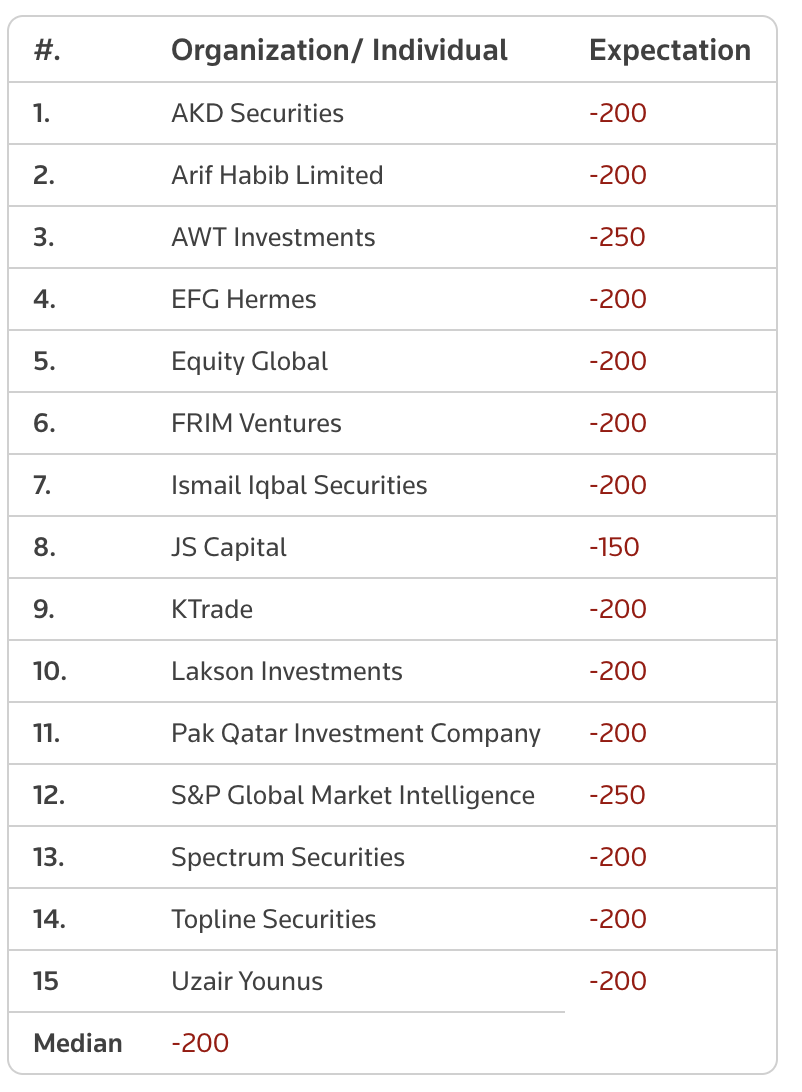
All 15 investors and analysts surveyed by Reuters expect the central bank to cut rates next week. Two expect a 150 bps cut, twelve predict a 200 bps reduction, and one forecasts a 250 bps cut.
Economic activity has stabilized since last summer when the country came close to a default before an eleventh hour bailout by the International Monetary Fund (IMF).
The IMF, which in September gave a boost to Pakistan’s struggling economy by approving a long-awaited $7 billion facility, said that the South Asian nation had taken key steps to restore economic stability with consistent policy implementation under the 2023-24 standby arrangement.
Advertisement · Scroll to continue
While the economy has started to gradually recover, and inflation has moved sharply down from a multi-decade high of nearly 40% in May 2023, analysts say further rate cuts are needed to bolster growth.
Mustafa Pasha, Chief Investment Officer at Lakson Investments, said rates must drop under 15% and hold below that for six months to have a material impact.
The IMF in its latest October report forecast Pakistan’s gross domestic product growth at 3.2% for the fiscal year ending June 2025, up from 2.4% in fiscal 2024.
The government expects annual inflation to have come in at 6-7% last month and slow further to 5.5-6.5% in November.
However, inflation could pick up again in 2025, driven by electricity and gas tariff hikes under the new $7 billion IMF bailout, and the potential impact of taxes on the retail and wholesale sector proposed in the June budget.
Ahmad Mobeen, senior economist at S&P Global Market Intelligence, said that while lower rates will offer some relief to the manufacturing sector, the benefits may be limited due to “elevated input costs, driven by high electricity and gas tariffs, combined with global supply and shipping constraints.”
The survey responses on Monday’s policy rate decision are listed below:

ACWA Power inks deal with AfDB to boost energy and water projects across Africa 

Updated 11 sec ago
Follow

ACWA Power inks deal with AfDB to boost energy and water projects across Africa 

RIYADH: Saudi utility giant ACWA Power has signed a cooperation framework agreement with the African Development Bank to enhance collaboration on power generation and water desalination projects across Africa.

According to a press statement, the agreement was formalized during the Africa Investment Forum in Rabat, Morocco. 

Under the deal, both parties will work together to identify, develop, and finance sustainable energy and water initiatives with a target of investing up to $5 billion between 2025 and 2030. 

The development aligns with ACWA Power’s broader plans to expand its global footprint and to triple its assets under management to over SR937.5 billion ($250 billion) by the end of this decade. 

“This Cooperation Framework with the African Development Bank is a testament to our unwavering commitment to Africa,” said Hashim Ghabashi, ACWA Power’s president for the Africa region. 

He added: “The continent represents a vital market for ACWA Power, and this partnership will significantly accelerate our ability to deliver transformative power and water projects. Execution of this framework with AfDB is a crucial step toward achieving energy and water security for millions.” 

According to the press statement, the cooperation will focus on appraising and supporting renewable energy, desalination, and grid-connected power projects on the continent, with a particular emphasis on sub-Saharan Africa.

This aligns closely with Mission 300, a joint initiative of the AfDB and the World Bank Group, which aims to bring electricity to 300 million people in sub-Saharan Africa by 2030. In addition to financial collaboration, the framework includes a focus on environmental and social development. 

“The Framework marks a major milestone, reinforcing both ACWA Power’s and AfDB’s commitment to sustainable, inclusive growth in Africa’s energy and water sectors,” the press statement said.

It further added that the framework will accelerate energy access, enhance water security, and promote green investment in Africa. 

Last year, Marco Arcelli, CEO of ACWA Power, said the company’s investments in Africa totaled $7 billion, all of which were focused on renewable projects.

He added that these investments fall in line with the firm’s position as the leading private investor in the continent’s renewable energy sector.