



RAHIM YAR KHAN: With a showman’s flair and an outlaw’s moustache, the Pakistani gangster dials the hotline on his own most wanted notice — taunting the authorities who put a bounty on his head.
Staring down the lens in a social media clip, Shahid Lund Baloch challenges the official on the phone and his thousands of viewers: “Do you know my circumstances or my reasons for taking up arms?“
The 28-year-old is hiding out in riverine terrain in central Punjab which has long offered refuge to bandits — using the Internet to enthral citizens even as he preys on them, police say.
On TikTok, Facebook, YouTube and Instagram he fascinates tens of thousands with messages delivered gun-in-hand, romanticizing his rural lifestyle and cultivating a reputation as a champion of the people.
But he is wanted for 28 cases including murder, abduction and attacks on police — with a 10 million rupee ($36,000) price on his head.
“People who are sitting on the outside think he is a hero, but the people here know he is no hero,” said Javed Dhillon, a former lawmaker for Rahim Yar Khan district close to the hideouts of Baloch, and other bandits like him.
“They have been at the receiving end of his cruelty and violence.”
Baloch is said to dwell on a sandy island in the “Katcha lands” — roughly translating as “backwaters” — on the Indus River which skewers Pakistan from top to bottom.
High-standing crops provide cover for ambushes and the region is riven by shifting seasonal waterways that complicate pursuit over crimes ranging from kidnapping to highway robbery and smuggling.

An elite police personnel monitoring security near a post on a sandy island along the Indus river, in the 'Katcha lands' at Rahim Yar Khan district, Pakistan, on October 9, 2024 (AFP)
At the intersection of three of Pakistan’s four provinces, gangs with hundreds of members have for decades capitalized on poor coordination between police forces by flitting across jurisdictions.
“The natural features of these lands support the criminals,” said senior police officer Naveed Wahla. “They’ll hide out in a water turbine, move in boats, or through sugarcane crops.”
Sweeping police operations and even an army incursion in 2016 failed to impose law and order. This August, a rocket attack on a police convoy killed 12 officers.
“In the current state of affairs here there is only fear and terror,” said Haq Nawaz, whose adult son was abducted late September for a five million rupee ransom he cannot afford.
“There is no one to look after our wellbeing,” he complains.
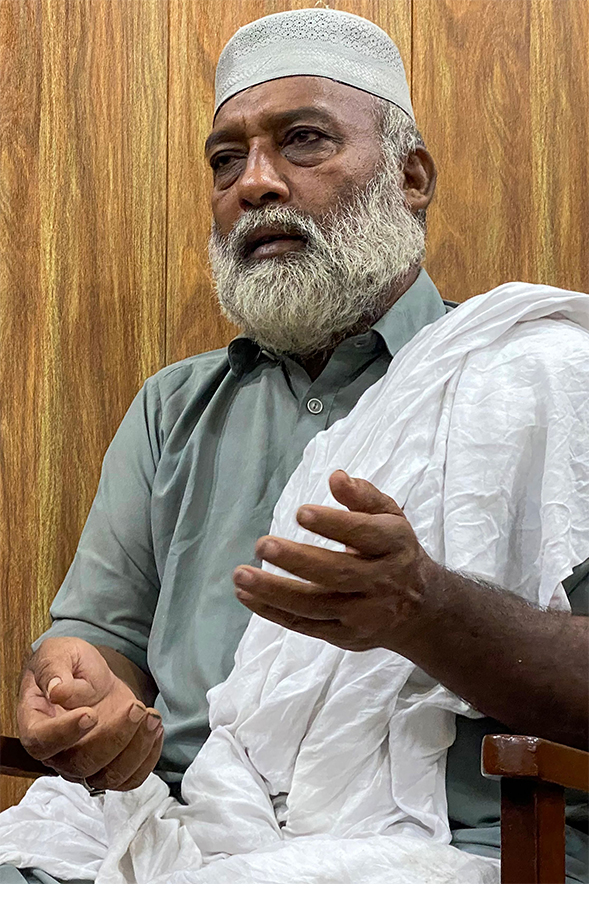
In this photograph taken on October 10, 2024, Haq Nawaz, whose adult son was abducted by bandits, speaks during an interview with AFP in Rahim Yar Khan district. (AFP)
But the gangs are increasingly online.
Some use the web to lay “honey-traps” luring kidnap victims by impersonating romantic suitors, business partners and advertising cheap sales of tractors or cars.
Some parade hostages in clips for ransom or exhibit arsenals of heavy weapons in musical TikToks.
Baloch has by far the largest online profile — irking police with a combined 200,000 followers.
Rizwan Gondal, the head police officer of Rahim Yar Khan district, says that his detectives have a dossier proving his “heinous criminal activities.”
“Police have made multiple efforts to capture him however he escapes,” he added.
“He’s a very media savvy guy. Let him say, ‘I am going to surrender before the state to prove that I am innocent’ and let the media cover it.”
In his clips Baloch protests his innocence whilst casting himself as a vigilante in a lawless land, claiming he chose to fight only after family members were slain in tribal clashes.
“We couldn’t get justice from the courts so I decided to pick up arms and started fighting with my enemies,” Baloch told AFP. “They killed our people, we killed theirs.”
But he also plays off the cycle of state neglect which breeds banditry and in turn relegates the destitute farming communities further to society’s fringes.
“The villagers here are not viewed as human but as animals,” Baloch told AFP. “If they gave us schools, electricity, government hospitals and justice, why would anyone even think of taking up arms?“
In comments sections his viewers call him “beloved brother bandit” and a “real hero.” “You have won my heart,” claims another.
“He is popular in the mainstream because he is giving the police authorities a tough time,” said former lawmaker Dhillon.
“People like that he says the things they can’t say out loud against people they can’t speak out against.”
Police have proposed countering bandits by downgrading mobile phone towers to 2G in the Katcha lands, preventing social media apps from loading.
That has not yet happened and would risk cutting communities off further still.
But more low tech solutions have had some success.
An anti-honey trap police cell cautions citizens against the gangs with the help of billboards and loudspeakers at checkpoints entering the area, preventing 531 people from falling prey since last August, according to their data.
Baloch scoffs at police. But one problem plaguing his bid for online stardom has his attention.
Copycat social media accounts pretend to be him and share duplicates of his videos — earning thousands more followers and views than his legitimate accounts.
He feels robbed. “I don’t know what they are trying to achieve,” he complains.
But for police, his Internet hero status is at odds with the toll of his crimes.
“People will idealize Shahid Lund Baloch but when they ultimately get kidnapped by him, then they will realize who Shahid Lund Baloch really is,” said senior officer Wahla.


