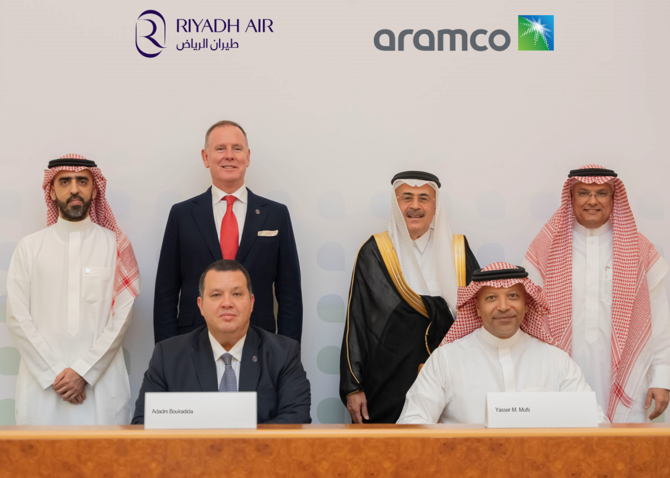
Saudi Aramco, Riyadh Air sign MoU to collaborate in low-carbon fuel supply, sustainability

Adam Boukadida, chief financial officer of Riyadh Air, and Aramco Executive Vice President of Products and Customers Yasser Mufti at the signing ceremony. Supplied
Short Url
Updated 31 October 2024
Follow

Saudi Aramco, Riyadh Air sign MoU to collaborate in low-carbon fuel supply, sustainability

RIYADH: Saudi oil giant Aramco and Riyadh Air have paved the way for potential collaboration in areas such as low-carbon fuel supply and sustainability with a new agreement. 

The two parties signed the memorandum of understanding during the eighth edition of the Future Investment Initiative taking place in Riyadh from Oct. 29 — 31 to set the stage for future partnership in those fields of common interest, according to a statement.

This falls in line with the integrated energy and chemicals company’s commitment to recognizing the urgency of addressing climate change and the fact that it has made sustainability a cornerstone of its corporate strategy. 

The firm has set ambitious goals to reduce its greenhouse gas emissions by 50 percent by 2030 and achieve net zero by 2050.

It also aligns well with one of the strategic pillars of the Public Investment Fund subsidiary, which is becoming an environmental leader by being fully committed to applying the best global sustainability and safety practices in the aviation industry. 

“We are delighted by the prospect of exploring a wide variety of opportunities for collaboration between Aramco and Riyadh Air. Both companies have expressed a desire to adopt the latest technologies, elevate experiences, and contribute to sustainability objectives,” Aramco Executive Vice President of Products and Customers Yasser Mufti said. 

“Aramco’s work to develop lower-carbon fuels, its strong focus on digitalization, and its aviation experience, among other things, provide a strong platform for potential cooperation with Riyadh Air,” Mufti added. 

On Riyadh Air’s behalf, Adam Boukadida, chief financial officer, said: “Our partnership with Aramco aligns perfectly with our ambition to become a leading global airline committed to sustainability and low-carbon fuels.”

He added: “By leveraging Aramco’s expertise, we aim to improve our operational capabilities and provide outstanding experiences for our guests. Together, we can play a significant role in advancing the Kingdom’s environmental and economic objectives.” 

During the event, Aramco agreed to work with Vietnam Oil and Gas Group, known as PetroVietnam, in storage, supply, and trading across the companies’ energy and petrochemical segments. 

As for Riyadh Air, the airline also signed an agreement during the forum to purchase 60 Airbus A321neo single-aisle aircraft, as it plans to commence its operations in 2025.

Under the theme “Infinite Horizons: Investing Today, Shaping Tomorrow,” this year’s edition of FII facilitated discussions on how investments can drive a thriving and sustainable future, pushing the boundaries of what is possible for humanity. 


Industry leaders highlight Riyadh’s Metro and infrastructure as investment catalysts

Updated 10 sec ago
Follow

Industry leaders highlight Riyadh’s Metro and infrastructure as investment catalysts

RIYADH: Saudi Arabia’s capital, Riyadh, is experiencing a transformative phase in its real estate sector, with the construction market projected to reach approximately $100 billion in 2025, accompanied by an anticipated annual growth rate of 5.4 percent through 2029.

The Kingdom is simultaneously advancing its data center capacity at an accelerated pace, with an impressive 2.7 GW currently in the pipeline. This expansion underscores the critical role of strategic land and power planning in establishing national infrastructure as a cornerstone of economic growth.

These insights were shared by leading industry experts during JLL’s recent client event in Riyadh, which focused on the city’s macroeconomic landscape and emerging trends across office, residential, retail, hospitality, and pioneering sectors, including AI infrastructure and Transit-Oriented Development.

Saud Al-Sulaimani, Country Lead and Head of Capital Markets at JLL Saudi Arabia, commented: “Riyadh is positioned at the forefront of Saudi Arabia’s Vision 2030, offering unparalleled opportunities for both investors and developers. National priorities are continuously recalibrated to ensure strategic alignment of projects and foster deeper collaboration with the private sector.”

He added: “Recent regulatory developments, including the introduction of the White Land Tax and the rent freeze, are designed to stabilize the market and are expected to drive renewed focus on delivering premium-quality assets. This dynamic environment, coupled with evolving construction cost considerations in select segments, is fundamentally reshaping the market landscape while accelerating progress toward our national objectives.”

The event further underscored the transformative impact of infrastructure initiatives. Mireille Azzam Vidjen, Head of Consulting for the Middle East and Africa at JLL, highlighted Riyadh’s transit revolution. She detailed the Riyadh Metro, a $22.5 billion investment encompassing 176 kilometers, six lines, and 84 stations, providing extensive geographic coverage, with a depth of 9.8 km per 100 sq. km. This strategic development generates significant TOD opportunities, with properties in proximity potentially commanding a 20-30 percent premium. JLL emphasized the importance of implementing climate-responsive last-mile solutions to enhance mobility and accessibility, particularly given Riyadh’s extreme temperatures.

Gaurav Mathur, Head of Data Centers at JLL, emphasized the rapid expansion of the Kingdom’s AI infrastructure, signaling a critical area for technological investment and innovation.

Focusing on the construction sector, Maroun Deeb, Head of Projects and Development Services, KSA at JLL, explained that the industry is actively navigating complexities such as skilled labor availability, material costs, and supply chain dynamics.

He highlighted the adoption of Building Information Modeling as a key driver for enhancing operational efficiency and project delivery.