

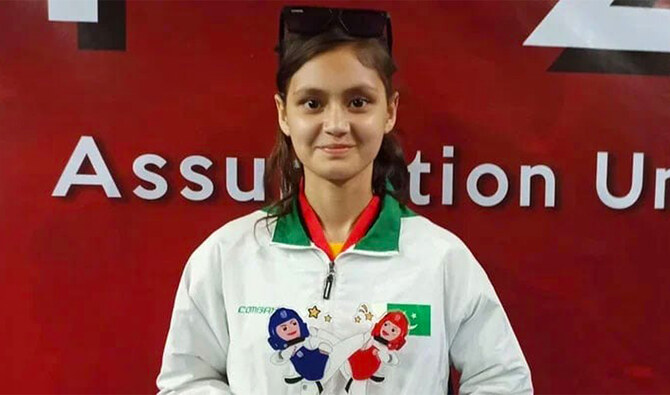
Pakistan’s youngest taekwondo champion Ayesha Ayaz represents country at Qatar championship 

The picture shared by Radio Pakistan on October 30, 2024 shows Pakistan’s youngest taekwondo champion Ayesha Ayaz. (Radio Pakistan)
Short Url
Updated 31 October 2024
Follow

Pakistan’s youngest taekwondo champion Ayesha Ayaz represents country at Qatar championship 

  • Ayaz, born in 2011 in Swat valley, started practicing martial arts at the age of 3 and made her international debut at 8
  • Around 1,440 players from 40 countries are competing in the event across four categories: cadet, juniors, youth and adults

ISLAMABAD: The Qatar International Open Taekwondo Championship will begin today, Thursday, with Pakistan’s youngest taekwondo champion Ayesha Ayaz representing her country, state broadcaster Radio Pakistan said.

Around 1,440 players from 40 countries are competing in the event across four categories: cadet, juniors, youth and adults. The tournament, featuring morning and evening sessions, will run through Saturday with daily awards for winners.

“The fourth Qatar International Taekwondo Championship will be held today at Lusail Hall,” Radio Pakistan reported. “Pakistan’s youngest Taekwondo champion Ayesha Ayaz will represent the country in this prestigious event.”

Ayaz, born in 2011 in the northwestern Swat valley, started practicing taekwondo at the age of 3 and made her international debut at 8. She is also the youngest national champion.

Ayaz’s father is the coach of Pakistan’s national taekwondo team while her mother is a double national champion. Her father also runs a martial arts training academy in Swat. She has two brothers, both of whom are taekwondo practitioners.

Ayaz was the youngest competitor to win a bronze medal for Pakistan in the 27 kg category at the Al-Fujairah Open Taekwondo Championship in Dubai in 2019. In Feb. 2020, the talented young athlete earned a gold medal in the 34 kg category at the 8th Al-Fujairah Open Taekwondo Championship in Dubai. She has also secured the title of district champion five times and been crowned a provincial champion twice.


Pakistan’s deputy PM says country seeks to convert $1 billion UAE deposit into investment

Updated 17 sec ago
Follow

Pakistan’s deputy PM says country seeks to convert $1 billion UAE deposit into investment

  • Ishaq Dar says the UAE will acquire shares in Pakistani companies using the amount, with transaction to be completed by March 31
  • The UAE’s remaining $2 billion in deposits, part of funds used to shore up Pakistan’s foreign reserves, are due for rollover in January

ISLAMABAD: Pakistan is seeking to convert part of its financial support from the United Arab Emirates into long-term investment to reduce external debt, Deputy Prime Minister Ishaq Dar said on Saturday, following talks with UAE President Sheikh Mohamed bin Zayed Al Nahyan during his visit to Islamabad.

Dar said Pakistan was engaged with the UAE on converting $1 billion in deposits into equity investment, potentially involving stakes in companies linked to the Fauji Fertilizer Group, a move that would end Pakistan’s repayment obligation on that portion of the funds.

The UAE has been one of Pakistan’s key financial backers in recent years, providing $3 billion in deposits to the central bank as part of a broader effort to stabilize the country’s external finances and unlock support from the International Monetary Fund.

Speaking at a year-end briefing, Dar said Pakistan had already begun discussions with the UAE on rolling over the first $1 billion tranche, but Islamabad now wanted to replace short-term borrowing with investment.

“They will be acquiring some shares, and this liability will end,” Dar said, adding that discussions were under way for the transaction to be completed by March 31.

Dar said the Fauji Foundation Group was taking the lead in the process, with plans for partial disinvestment by Fauji-linked and other companies to facilitate the deal.

He added that Pakistan also raised the issue of a separate $2 billion rollover due in January during talks with the UAE leadership, saying Islamabad had conveyed that converting debt into investment would be preferable to repeated rollovers.

The issue was discussed during Al Nahyan’s visit, which Dar described as cordial, adding that the UAE had expressed willingness to expand its investment footprint in Pakistan.

Pakistan has relied on repeated rollovers of deposits from friendly countries to manage its balance-of-payments pressures, a practice economists say provides short-term relief but adds to debt vulnerabilities unless replaced with foreign direct investment.

The country acquired $5 billion from Saudi Arabia and $4 billion from China, which, along with the UAE, helped shore up its foreign reserves and meet IMF conditions at a time when its external account was under severe pressure.

Dar said Pakistan was now focused on shifting from temporary financing toward longer-term capital inflows to stabilize its economy and reduce reliance on external borrowing.