

Pakistan urges US to end Cuba restrictions as UN condemns longstanding embargo

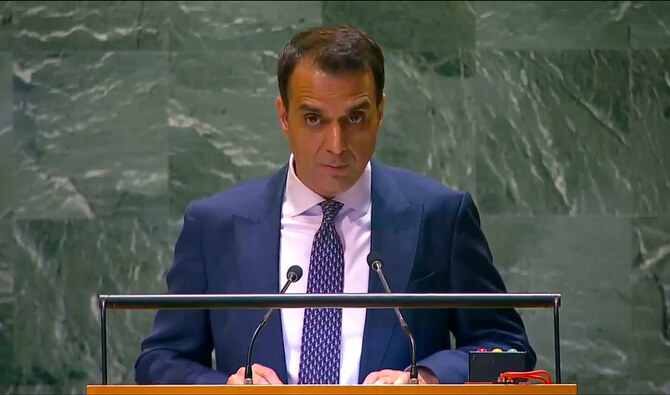
Pakistan's Deputy Permanent Representative of Pakistan to the UN, Usman Jadoon, addresses United Nations in Islamabad, Pakistan, on October 31, 2024. (@PakistanUN_NY/X)
Short Url
Updated 31 October 2024
Follow

Pakistan urges US to end Cuba restrictions as UN condemns longstanding embargo

  • UN voted 187-2 in favor of lifting the embargo, with only the US and Israel opposing the resolution
  • Pakistani diplomat says during the debate an end to embargo will improve quality of life in Cuba

ISLAMABAD: A Pakistani diplomat at the United Nations called for an end to the longstanding American economic restrictions on Cuba, emphasizing that the step would enhance quality of life in the Caribbean nation as the global body condemned the embargo for the 32nd consecutive year.

The UN General Assembly overwhelmingly voted 187-2 in favor of lifting the sanctions, with only the US and Israel opposing the resolution, alongside one abstention in the 193-member body.

Tensions between the US and Cuba escalated in the 1960s, following Fidel Castro’s revolutionary government’s decision to nationalize American-owned assets without compensation.

This led to US embargo as Washington aimed to isolate Cuba economically and politically, pressuring its government to carry out democratic reforms and curtail alignment with the former Soviet Union.

“Pakistan maintains that the imposition of unilateral economic measures is counterproductive and inconsistent with the purposes and principles of the Charter of the United Nations and international law,” an official statement quoted the deputy permanent representative of Pakistan to the UN, Ambassador Usman Jadoon, as saying during the debate.

The statement said the Pakistani diplomat highlighted the rights of the people of Cuba to their own means of subsistence, especially food and medicine, adding that “ending the embargo would be a significant step toward improving the quality of life for the Cuban people, and will help Cuba advance on the path toward sustainable development.”

Ambassador Jadoon also expressed a deep concern on the impact that the economic, financial and commercial embargo has had on Cuba and its people.

He reiterated Pakistan’s “unwavering commitment to multilateralism,” saying his country believed in the fundamental principles of sovereign equality, non-interference and non-intervention, as enshrined in the UN Charter.


Pakistan to promote mineral sector at Saudi forum this month with 13 companies

Updated 02 January 2026
Follow

Pakistan to promote mineral sector at Saudi forum this month with 13 companies

  • Delegation will take part in the Future Minerals Forum in Riyadh from Jan. 13-15
  • Petroleum minister will lead Pakistan, participate in a 90-minute country session

ISLAMABAD: Around 13 Pakistani state-owned and private companies will attend the Future Minerals Forum (FMF) in Saudi Arabia from Jan. 13 to 15, an official statement said on Friday, as the country seeks to ramp up global engagement to develop its mineral resources.

The FMF is an international conference and investment platform for the mining sector, hosted by mineral-rich countries to attract global investors, companies and governments.

Petroleum Minister Ali Pervaiz Malik confirmed Pakistan’s participation in a meeting with the Saudi envoy, Nawaf bin Said Al-Malki.

Pakistan hosts one of the world’s largest copper-gold zones. The Reko Diq mine in southwestern Balochistan, with an estimated 5.9 billion tons of ore, is partly owned by Barrick Gold, which calls it one of the world’s largest underdeveloped copper-gold deposits. Its development is expected to boost Pakistan’s struggling economy.

“Upon an invitation of the Government of the Kingdom of Saudi Arabia, the Federal Minister informed the Ambassador that Pakistan will fully participate in the upcoming Future Minerals Forum (FMF), scheduled to be held in Riyadh later this month,” Pakistan’s Press Information Department (PID) said in an official statement.

The Pakistani minister will lead his country’s delegation at the FMF and take part in a 90-minute country showcase session titled “Unleashing Potential: Accelerating Pakistan’s Mineral Revolution” along with local and foreign investors.

Pakistan will also establish a dedicated pavilion to highlight the vast potential of its rich geological landscape to the global mineral community.

The Saudi envoy welcomed Pakistan’s decision to participate in the forum and discussed enhancing bilateral cooperation in the minerals and energy sectors during the meeting.

According to the statement, he highlighted the potential for cooperation between Saudi Arabia and Pakistan in the minerals and energy sectors, expressing confidence that the FMF would provide a platform to expand collaboration.
Pakistan’s mineral sector, despite its rich reserves of salt, copper, gold and coal, contributes only 3.2 percent to the country’s GDP and just 0.1 percent to global mineral exports.

However, many countries, including the United States, have shown interest in Pakistan’s underdeveloped mineral sector, particularly in copper, gold and other critical resources.

In October, Pakistan dispatched its first-ever shipment of rare earth and critical minerals to the United States, according to a Chicago-based US public relations firm’s report.