

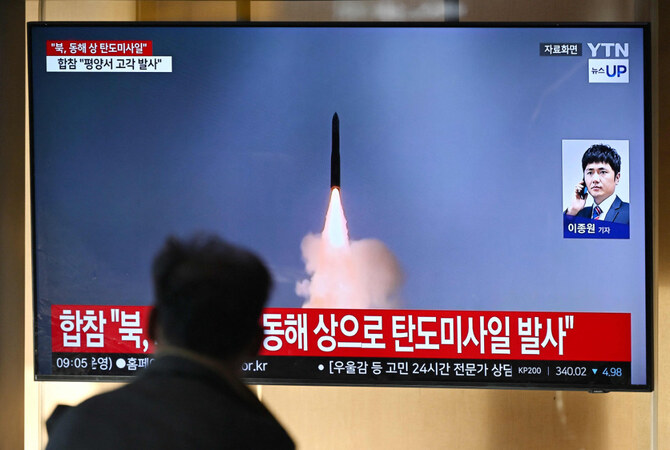

SEOUL, South Korea: North Korea launched an intercontinental ballistic missile for the first time in almost a year Thursday in a test of what may be a new, more agile weapon targeting the mainland US, its neighbors said.
The launch came as Washington warned that North Korean troops in Russian uniforms are heading toward Ukraine, likely to augment Russian forces and join the war. It also was likely meant to grab American attention days ahead of the US election Tuesday.
US National Security Council spokesperson Sean Savett called the launch “a flagrant violation” of multiple UN Security Council resolutions that he said “needlessly raises tensions and risks destabilizing the security situation in the region.” Savett said the US will take all necessary measures to ensure the security of the American homeland and South Korean and Japanese allies.
South Korea’s Joint Chiefs of Staff said North Korea could have tested a new, solid-fueled long-range ballistic missile. Missiles with built-in solid propellants are easier to move and hide and can be launched quicker than liquid-propellant weapons.
JCS spokesperson Lee Sung Joon said the launch was possibly timed to the US election in an attempt to strengthen North Korea’s bargaining power. He said the North Korean missile was launched on a high angle, apparently to avoid neighboring countries.
Japanese Defense Minister Gen Nakatani told reporters that the missile may have been a new one since its flight duration of 86 minutes and its maximum altitude of more than 7,000 kilometers (4,350 miles) exceeded corresponding data from previous North Korean missile tests.
Both South Korea and Japan condemned the North Korean launch for posing a threat to international peace and they said they’re closely coordinating with the US over the latest North Korean weapons test.
South Korea’s military intelligence agency told lawmakers Wednesday that North Korea was close to test-firing a long-range missile capable of reaching the United States and has also likely completed preparations for its seventh nuclear test.
North Korea has made strides in its missile technologies in recent years, but many foreign experts believe the country has yet to acquire a functioning nuclear-armed missile that can strike the US mainland. They say North Korea likely possesses short-range missiles that can deliver nuclear strikes across all of South Korea.

One of the technological hurdles North Korea still faces is for its weapons to be capable of surviving the harsh conditions of atmospheric reentry. South Korean officials and experts earlier said North Korea may test-launch a ICBM on a normal angle to verify that capability.
In September, North Korean state media published a photo of Kim inspecting what appeared to be a 12-axle missile launch vehicle, the largest mobile launch platform the country has disclosed so far. Observers cited the vehicle as evidence North Korea could be developing an ICBM that is bigger than its existing ones.
North Korea last test-fired an intercontinental ballistic missile in December 2023, when it launched the solid-fueled Hwasong-18.
In the past two years, Kim has used Russia’s invasion of Ukraine as a window to ramp up weapons tests and threats while also expanding military cooperation with Moscow. South Korea, the US and others have recently accused North Korea of dispatching thousands of troops to support Russia’s warfighting against Ukraine. They’ve said North Korea has already shipped artillery, missiles and other convectional arms to Russia.
North Korea’s possible participation in the Ukraine war would mark a serious escalation. South Korea, the US and their partners also worry about what North Korea could get from Russia in return for joining Russia’s war against Ukraine. Aside from his soldiers’ wages, experts say Kim Jong Un likely hopes to get high-tech Russian technology that can perfect his nuclear-capable missiles.
On Wednesday, Defense Secretary Lloyd Austin said North Korean troops wearing Russian uniforms and carrying Russian equipment are moving toward Ukraine, in what he called a dangerous and destabilizing development. Austin spoke at a news conference in Washington with South Korean Defense Minister Kim Yong-hyun.
South Korea said Wednesday that North Korea has sent more than 11,000 troops to Russia and that more than 3,000 of them have been moved close to battlefields in western Russia.


