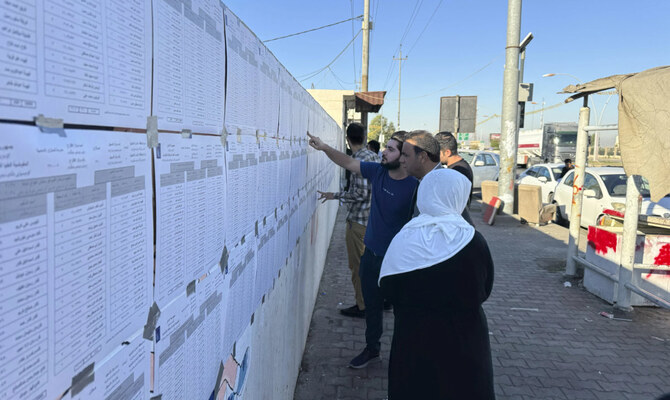
IRBIL, Iraq: Election results from the vote for the regional parliament in Iraq’s semi-autonomous northern Kurdish region show the two dominant Kurdish parties have maintained their hold while an opposition party has made inroads, officials said Wednesday.
According to the Independent High Electoral Commission, the Kurdistan Democratic Party — with its base of support in the regional capital, Irbil, and the city of in Dohuk — made the strongest showing, securing 39 seats.
The rival Patriotic Union of Kurdistan won 23 seats, continuing its influence over the city of Sulaymaniyah. In the 2018 elections, the two parties won 45 and 21 seats, respectively.
A relatively new opposition party, New Generation, won 15 seats, a significant increase from the eight seats it got in 2018, when the party was first established.
The Kurdistan Islamic Union, which came in fourth with seven seats, announced it will join the New Generation in opposition in the regional, 100-seat parliament. Other minor parties took a smattering of seats.
Despite some technical issues at the polls, voters turned out in large numbers, with 72 percent of eligible voters casting ballots.
The surge in support for the New Generation appeared to stem from growing disillusionment among younger voters, who are increasingly frustrated with the region’s ongoing economic challenges, including delays in salary payments, high unemployment, and perceived corruption within the traditional political leadership.
Economic concerns remain at the forefront — widespread dissatisfaction over delayed payments to civil servants, fluctuating oil prices, and ongoing budget disputes with the central government in Baghdad have fueled calls for reform.
Three Assyrian Christian candidates and two Turkmen candidates secured the five remaining quota seats for minorities, despite the Iraqi federal court’s controversial elimination of the reserved seats for ethnic and religious minorities earlier this year.
These seats are usually filled by candidates backed by the major political parties, leading some to say that they do not offer a genuine minority representation.
“We no longer have true representation in the parliament or the government; our voices are being silenced,” said Toma Khoshaba, an Assyrian ethnic activist.
Khoshaba argued that that these “so-called independent Assyrian representatives occupying the quota seats are largely supported by the Kurdistan Democratic Party” or by Shiite factions.
“Their loyalty lies with these dominant political groups, not with our communities,” he said.
The election outcome will also play a pivotal role in determining how Kurdish leaders handle ongoing disputes with Baghdad, particularly over oil revenue sharing and budget allocations, as well as the region’s broader economic challenges.


Dominant Kurdish parties maintain their sway in the election for the parliament in the Iraqi region
https://arab.news/cwjdp
Dominant Kurdish parties maintain their sway in the election for the parliament in the Iraqi region

- The election outcome will also play a pivotal role in determining how Kurdish leaders handle ongoing disputes with Baghdad


Israeli measures in West Bank seek to ‘assassinate Palestinian state’: Saudi UN envoy
- Kingdom ‘strongly condemns decision to convert lands to state property,’ Abdulaziz Alwasil tells Security Council
- ‘There’s no doubt that these violations undermine efforts to achieve peace and stability in the region’
NEW YORK: Saudi Arabia on Wednesday strongly condemned Israel’s “unlawful coercive measures” in the occupied West Bank, telling the UN Security Council that the actions amount to an attempt to “assassinate the Palestinian state” and undermine prospects for peace.
Speaking at a ministerial-level council meeting chaired by British Foreign Secretary Yvette Cooper, Saudi Arabia’s UN Ambassador Abdulaziz Alwasil said Riyadh rejects Israeli moves to expand settlements, seize land and alter the status of the Occupied Territories.
Israeli authorities “continue to gravely violate the rights of the Palestinian people” in the West Bank, he said.
“We meet today, more than two years after the Israeli aggression against the Gaza Strip, and at a moment where we also witness a new chapter of suffering and violations committed by the Israeli occupation,” Alwasil added.
Recent coercive measures aimed at imposing “Israeli dominance over the West Bank, expanding settlement activity, escalating settlers terrorism, practicing forced displacement against the Palestinian people and seizing their land … reflects Israel’s persistence in its attempt to assassinate the Palestinian state,” he said.
Israel’s adherence to a ceasefire agreement and halting its “illegal policies and seizure of land” have become “urgent matters that can’t be further delayed,” Alwasil added, calling for an end to “ongoing violations associated with annexation of lands belonging to unarmed Palestinians in the West Bank.”
Alwasil said 85 states have denounced the measures, and Saudi Arabia “strongly condemns the decision of the Israeli occupying authorities to convert lands in the West Bank to what it calls state property as part of schemes that aim to impose a new legal and administrative reality in the occupied West Bank.”
He added: “There’s no doubt that these violations undermine efforts to achieve peace and stability in the region.”
Alwasil reiterated that “Israel has no sovereignty” over the Occupied Territories, and expressed Riyadh’s “absolute rejection of these illegal measures which constitute a grave violation of international law, particularly Security Council resolution 2334.”
He added that “these actions are an aggression on the inherent right of the brotherly Palestinian people to establish their independent state on the June 4, 1967 borders with East Jerusalem as its capital,” and that the measures aim to “alter the demographic composition and the character and the status” of the Occupied Territories.
He cited the 2024 advisory opinion by the International Court of Justice, saying it is “clear and explicit” in affirming that “Israel’s policies and practices in the occupied Palestinian territory and its continued presence there is considered unlawful.”
He added: “It stressed that Israeli occupation must end and that it is invalid to annex occupied Palestinian territories.”
Alwasil also condemned the seizure and demolition of a compound belonging to the UN Relief and Works Agency for Palestine Refugees in the Near East in East Jerusalem and the cutting of electricity to its facilities, including schools and health centers.
“This is an unprecedented violation of international humanitarian law aimed at undermining the status of Palestinian refugees” in the Occupied Territories, he said.
With the advent of the Muslim holy month of Ramadan, he called for protecting humanitarian organizations and ensuring that they can carry out their duties “without hindrance.”
He said: “We strongly condemn practices that target humanitarian workers throughout the Palestinian territories. UNRWA isn’t a terrorist organization, and such claims are unacceptable.”
Alwasil added: “The international community must come together to provide protection for UNRWA under international humanitarian law.”
He said that in response to an invitation from US President Donald Trump, Saudi Arabia will “participate constructively and actively” in an inaugural meeting of the Board of Peace scheduled for Thursday in Washington, DC.
“We value the efforts of President Trump and his administration and the attention that they have devoted to ending the war and achieving peace in the Gaza Strip,” Alwasil added.
The Kingdom has signed the instrument of accession to the Board of Peace “in support of its efforts as a transitional body in accordance with a comprehensive plan to end the conflict in Gaza that was adopted by the Security Council by virtue of resolution 2803,” he said.
“This track aims to establish a permanent ceasefire, support the reconstruction of Gaza, and push forth a just and lasting peace based on the Palestinian people’s right to self-determination and the establishment of their independent state.”
Alwasil called for opening crossings to allow humanitarian aid into Gaza and enabling “Palestinian and international committees to administer” the enclave “with no conditions to ensure the management of the daily affairs” of its population while preserving “the institutional and geographic linkages between the West Bank and the Gaza Strip in a manner that would guarantee the unity of Palestinian land.”
Riyadh rejects “any attempt to divide or undermine the integrity of Palestinian lands,” he said. “The only path to achieving a just and comprehensive peace requires establishing a permanent ceasefire, preventing displacement and annexation, ensuring Israel’s full withdrawal from the Gaza Strip, and supporting the reconstruction.”


