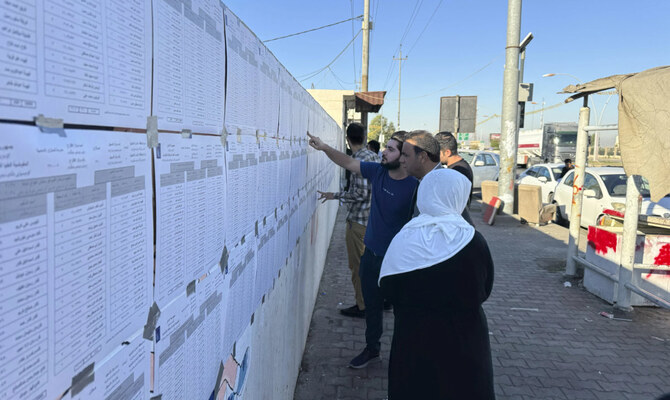
IRBIL, Iraq: Election results from the vote for the regional parliament in Iraq’s semi-autonomous northern Kurdish region show the two dominant Kurdish parties have maintained their hold while an opposition party has made inroads, officials said Wednesday.
According to the Independent High Electoral Commission, the Kurdistan Democratic Party — with its base of support in the regional capital, Irbil, and the city of in Dohuk — made the strongest showing, securing 39 seats.
The rival Patriotic Union of Kurdistan won 23 seats, continuing its influence over the city of Sulaymaniyah. In the 2018 elections, the two parties won 45 and 21 seats, respectively.
A relatively new opposition party, New Generation, won 15 seats, a significant increase from the eight seats it got in 2018, when the party was first established.
The Kurdistan Islamic Union, which came in fourth with seven seats, announced it will join the New Generation in opposition in the regional, 100-seat parliament. Other minor parties took a smattering of seats.
Despite some technical issues at the polls, voters turned out in large numbers, with 72 percent of eligible voters casting ballots.
The surge in support for the New Generation appeared to stem from growing disillusionment among younger voters, who are increasingly frustrated with the region’s ongoing economic challenges, including delays in salary payments, high unemployment, and perceived corruption within the traditional political leadership.
Economic concerns remain at the forefront — widespread dissatisfaction over delayed payments to civil servants, fluctuating oil prices, and ongoing budget disputes with the central government in Baghdad have fueled calls for reform.
Three Assyrian Christian candidates and two Turkmen candidates secured the five remaining quota seats for minorities, despite the Iraqi federal court’s controversial elimination of the reserved seats for ethnic and religious minorities earlier this year.
These seats are usually filled by candidates backed by the major political parties, leading some to say that they do not offer a genuine minority representation.
“We no longer have true representation in the parliament or the government; our voices are being silenced,” said Toma Khoshaba, an Assyrian ethnic activist.
Khoshaba argued that that these “so-called independent Assyrian representatives occupying the quota seats are largely supported by the Kurdistan Democratic Party” or by Shiite factions.
“Their loyalty lies with these dominant political groups, not with our communities,” he said.
The election outcome will also play a pivotal role in determining how Kurdish leaders handle ongoing disputes with Baghdad, particularly over oil revenue sharing and budget allocations, as well as the region’s broader economic challenges.


Dominant Kurdish parties maintain their sway in the election for the parliament in the Iraqi region
https://arab.news/cwjdp
Dominant Kurdish parties maintain their sway in the election for the parliament in the Iraqi region

- The election outcome will also play a pivotal role in determining how Kurdish leaders handle ongoing disputes with Baghdad


Family of Palestinian-American shot dead by Israeli settler demand accountability
- Relatives say Abu Siyam was among about 30 residents from the village of Mukhmas who confronted armed settlers attempting to steal goats from the community
LONDON: The family of a 19-year-old Palestinian-American man reportedly shot dead by an Israeli settler in the occupied West Bank have demanded accountability, amid mounting scrutiny over a surge in settler violence and a lack of prosecutions.
Nasrallah Abu Siyam, a US citizen born in Philadelphia, was killed near the city of Ramallah on Wednesday, becoming at least the sixth American citizen to die in incidents involving Israeli settlers or soldiers in the territory in the past two years.
Relatives say Abu Siyam was among about 30 residents from the village of Mukhmas who confronted armed settlers attempting to steal goats from the community. Witnesses said that stones were thrown by both sides before settlers opened fire, wounding at least three villagers.
Abu Siyam was struck and later died of his injuries.
Abdulhamid Siyam, the victim’s cousin, said the killing reflected a wider pattern of impunity.
“A young man of 19 shot and killed in cold blood, and no responsibility,” he told the BBC. “Impunity completely.”
The US State Department said that it was aware of the death of a US citizen and was “carefully monitoring the situation,” while the Trump administration said that it stood ready to provide consular assistance.
The Israeli embassy in Washington said the incident was under review and that an operational inquiry “must be completed as soon as possible.”
A spokesperson for the Israeli Defense Forces said troops were deployed to the scene and used “riot dispersal means to restore order,” adding that no IDF gunfire was reported.
The military confirmed that the incident remained under review and said that a continued presence would be maintained in the area to prevent further unrest.
Palestinians and human rights organizations say such reviews rarely lead to criminal accountability, arguing that Israeli authorities routinely fail to prosecute settlers accused of violence.
A US embassy spokesperson later said that Washington “condemns this violence,” as international concern continues to grow over conditions in the occupied West Bank.
Palestinians and human rights groups say Israeli authorities routinely fail to investigate or prosecute settlers accused of violence against civilians.
Those concerns were echoed this week by the UN, which warned that Israel’s actions in the occupied West Bank may amount to ethnic cleansing.
A UN human rights office report on Thursday said that Israeli settlement expansion, settler attacks and military operations have increasingly displaced Palestinian communities, with dozens of villages reportedly emptied since the start of the Gaza war.
The report also criticized Israeli military tactics in the northern West Bank, saying that they resembled warfare and led to mass displacement, while noting abuses by Palestinian security forces, including the use of unnecessary lethal force and the intimidation of critics.
Neither Israel’s foreign ministry nor the Palestinian Authority has commented on the findings.


