

North Korean troops in Russian uniforms are heading toward Ukraine, US says

1 / 2
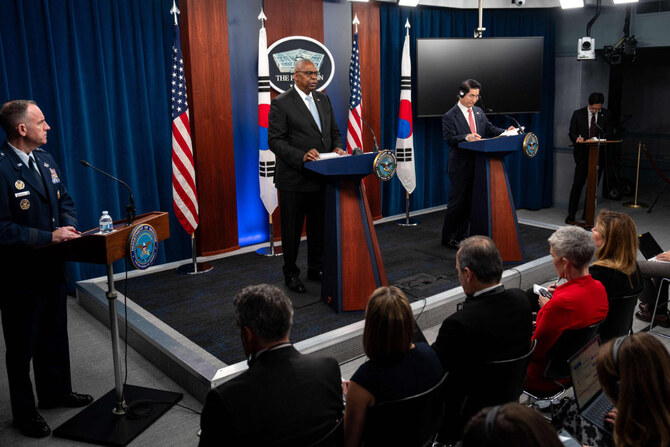
US Secretary of Defense Lloyd Austin and South Korean Defense Minister Kim Yong Hyun participate in a press briefing at The Pentagon on Oct. 30, 2024 in Arlington, Virginia. (Getty Images via AFP)
2 / 2
US Secretary of Defense Lloyd Austin and South Korean Defense Minister Kim Yong Hyun participate in a press briefing at The Pentagon on October 30, 2024 in Arlington, Virginia. (Getty Images via AFP)
Short Url
Updated 31 October 2024
Follow

North Korean troops in Russian uniforms are heading toward Ukraine, US says

  • “They’re doing this because (Russian President Vladimir) Putin has lost a lot of troops,” Defense Secretary Lloyd Austin said
  • S.Korean defense chief said the deployment “can result in the escalation of the security threats on the Korean peninsula”

WASHINGTON: Defense Secretary Lloyd Austin said Wednesday that North Korean troops wearing Russian uniforms and carrying Russian equipment are moving toward Ukraine, in what he called a dangerous and destabilizing development.
Austin was speaking at a press conference in Washington with South Korean Defense Minister Kim Yong-hyun, as concerns grow about Pyongyang’s deployment of as many as 12,000 troops to Russia.
The US and South Korea say some of the North Korean troops are heading to Russia’s Kursk region on the border with Ukraine, where the Kremlin’s forces have struggled to push back a Ukrainian incursion.
Some North Korean advance units have already arrived in the Kursk region, and Austin said “the likelihood is pretty high” that Russia will use the troops in combat.
North Korea’s move to tighten its relationship with Russia has triggered alarms across the globe, as leaders worry about how it may expand the war in Ukraine and what Russian military aid will be delivered to Pyongyang in exchange.
Ukraine’s UN Ambassador Sergiy Kyslytsya, speaking at an emergency meeting of the UN Security Council on Wednesday, said they expect as many as 4,500 North Korean troops to be at the border this week and to begin directly participating in combat operations against Ukrainian forces in November.
Austin said officials are discussing what to do about the deployment, which he said has the potential to broaden or lengthen the conflict in Ukraine. Asked if it could prompt other nations to get more directly involved in the conflict, he acknowledged that it could “encourage others to take action” but provided no details.
“This is something that we’re going to continue to watch, and we’re going to continue to work with our allies and partners to discourage Russia from employing these troops in combat,” Austin said.
Kim said he doesn’t necessarily believe the deployment will trigger war on the Korean Peninsula but could increase security threats.
There is a “high possibility” that Pyongyang would ask for higher technologies in exchange for its troops, such as receiving tactical nuclear and ballistic missile capabilities, he said through an interpreter.

Both Kim and Austin called on North Korea to withdraw its troops.
Russia has had to shift some resources to the Kursk border region to respond to Ukraine’s offensive. US leaders have suggested that the use of North Korean forces to augment Russia’s defenses indicates that Moscow’s losses during the more than two-year war have significantly degraded its military strength.
“They’re doing this because (Russian President Vladimir) Putin has lost a lot of troops,” Austin said, adding that Moscow has a choice between mobilizing more of its own forces or turning to others for help.
Already, he noted, Russia has sought military weapons from other nations. Those include North Korea and Iran.
The US has estimated there are about 10,000 North Korean troops now in Russia. But others have put the number higher. And Kyslytsya provided an array of more specific numbers and details to the UN Security Council.
The Ukrainian ambassador said up to 12,000 North Koreans were being trained at five bases in eastern Russia, including at least 500 officers and three generals from the General Staff.
In addition to wearing Russian uniforms and carrying Russian small arms, Kyslytsya said they will be provided with Russian identity documents, “notably to conceal their presence.” He said they are expected to be integrated into units manned by Russia’s ethnic Asian minorities, including Buryats.
North Korea’s UN Ambassador Kim Song defended his country’s growing military cooperation with Russia and said Pyongyang stood ready to respond if Russia’s “sovereignty and security interests” were threatened.
Earlier, a senior South Korean presidential official, who spoke on condition of anonymity during a background briefing, said that more than 3,000 of the North Korean forces are believed to have moved toward combat zones in western Russia.
A Ukrainian official told The Associated Press that North Korean troops are stationed 50 kilometers (30 miles) away from the Ukrainian border with Russia. The official, was not authorized to disclose the information publicly and spoke on condition of anonymity, did not provide any additional detail.
North Korea also has provided munitions to Russia, and earlier this month, the White House released images it said were of North Korea shipping 1,000 containers of military equipment there by rail.
A key worrisome question is what North Korea will get in return for providing the troops. But officials have yet to say specifically what Pyongyang may have requested or Moscow has offered.
In their meeting at the Pentagon, Kim and Austin agreed to continue large-scale military exercises, increase cooperation on nuclear deterrence and upgrade their abilities to deter and respond to North Korean missile launches by improving early launch warning systems, according to a fact sheet released by the Pentagon on Wednesday.
Austin and Kim are scheduled to meet Thursday with Secretary of State Antony Blinken and South Korean Foreign Minister Cho Tae-yul at the State Department.


Myanmar, Afghan hopeful scholars mourn UK study visa ban

Updated 4 sec ago
Follow

Myanmar, Afghan hopeful scholars mourn UK study visa ban

  • Myanmar, Afghanistan, Sudan and Cameroon citizens will be barred from obtaining university visas
  • Britain’s travel block is “really painful” for Afghan women hoping to escape to an education abroad, said one female

YANGON, Myanmar: Aspiring students are lamenting Britain’s ban on education visas for their war-weary countries — dashing dreams of bettering themselves and their home nations.
Myanmar, Afghanistan, Sudan and Cameroon citizens will be barred from obtaining university visas, London announced this week, saying asylum applications by visiting students had “rocketed” nearly 500 percent from 2021 to 2025.
“It’s like the country is punishing the weak, the most vulnerable people,” said one woman from Myanmar.
She was preparing for a scholarship interview for a master’s in climate change finance when her plans were upended by Downing Street’s decree on Wednesday.
“I could not focus the whole morning,” the 28-year-old told AFP from Yangon, speaking on condition of anonymity for security reasons in a country riven by civil war since a 2021 military coup.
“I can’t picture my future.”
Like in much of the developed world, immigration has become a divisive issue in Britain.
Efforts to beat back arrivals mirror the sweeping travel bans issued by US President Donald Trump which have shut out citizens of Myanmar, Sudan and Afghanistan.
Since the chaotic military withdrawal of Britain, the United States and other NATO nations in 2021, Afghanistan has been ruled by a resurgent Taliban government which has banned women over age 12 from attending school.
Britain’s travel block is “really painful” for Afghan women hoping to escape to an education abroad, said one female child social worker in Ghazni province, who asked to remain anonymous for security reasons.
She has now canceled her plans to study for a master’s in both the US and the UK.
“Now I am trying to be hopeful, but I think it would also be a mistake,” said the 27-year-old.
In the summer of 2024, Arefa Mohammadi fled to neighboring Pakistan, living in limbo as she applied to universities.
She got an offer to study public health in England but now cannot accept it.
“It was truly shocking for me,” said the 24-year-old.
“This situation put me in a place where I haven’t any goals, because all my goals and all my futures are unpredictable.”

- ‘Cruel and short-sighted’ -
In Kabul, a 39-year-old man faces similar heartbreak.
He was accepted to study specialist subjects related to water management at three universities in England and Scotland.
“When I was a child I witnessed several challenges like flash floods, water scarcity, environmental neglect, inefficient irrigation systems,” he said, asking to remain anonymous for security reasons. “To address these challenges I made my application.”
“I hoped to acquire modern knowledge. It’s impossible to acquire in Afghanistan,” he added.
Some 33 million people in the country face severe water shortages, aid agencies say, a result of compounding multi-year droughts, climate change and infrastructure battered by decades of war.
Britain’s Labour government made the decision to curb visas as the right-wing Reform UK party surges in opinion polls with its hard-line stance against immigration.
The UK Home Office said almost 135,000 asylum seekers had entered the country through legal routes since 2021.
Activist organization Burma Campaign UK called the visa ban “exceptionally cruel and shortsighted.”
“The opportunity to come to the UK to study is life-changing for the individual student but also an investment in the future of Myanmar,” said program director Zoya Phan in a statement.
One exiled Myanmar journalist has been living over the border in Thailand after escaping the military rule which has clamped down on press freedoms.
“When the military coup happened I was just 22, so I had a lot of dreams,” she said. “But over the past five years there have been a lot of struggles — I couldn’t complete my dreams.”
Every year since the junta takeover she applied for further education to buoy her spirits.
But she received an email Thursday morning canceling her place to study for a master’s at a London university.
“Everything is gone,” she said. “My UK dream is all disappeared.”