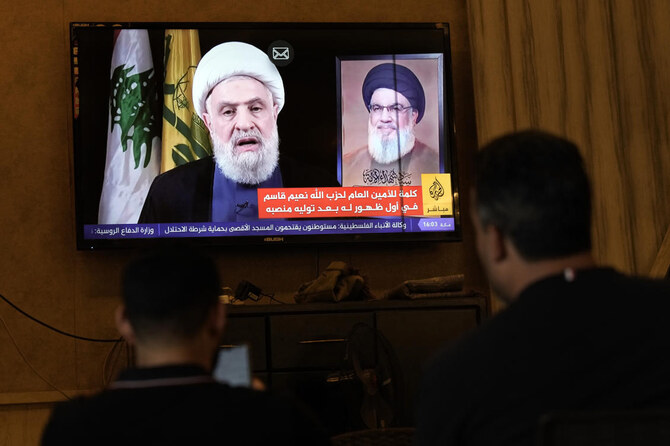
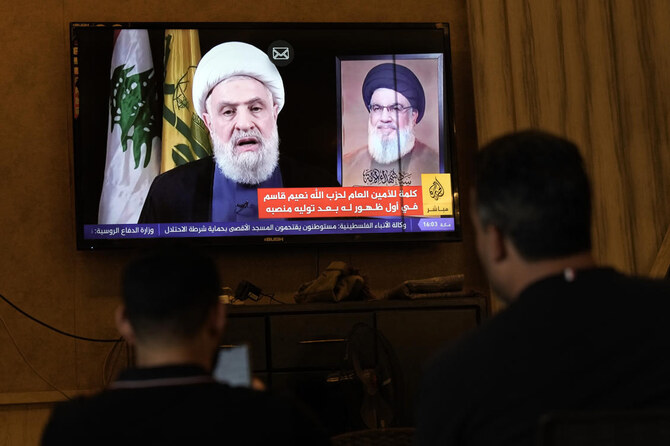
BEIRUT, Lebanon: Hezbollah’s new leader says the beleaguered Lebanese militia could agree to a ceasefire under certain terms, as Israeli forces warn civilians to flee more cities as they expand their bombardment of the group’s bastions.
His statement came as Israel’s security cabinet met to discuss a possible truce, but also as Israel attacked the eastern Lebanese city of Baalbek and said it had claimed the scalp of yet another senior Hezbollah commander.
Hezbollah leader Naim Qassem became leader of the Iran-backed armed movement on Tuesday, after the long-serving former chief Hassan Nasrallah was assassinated by Israel in a massive air strike last month.
In his first speech since taking over, Qassem insisted he would follow his slain predecessor’s “work program” and that Hezbollah could continue to resist Israel’s air and ground attacks inside Lebanon for months to come.
But he also opened the door to a negotiated truce, if presented with an Israeli offer.
“If the Israelis decide that they want to stop the aggression, we say we accept, but under the conditions that we see as appropriate and suitable,” he said.
Qassem insisted Hezbollah would not “beg for a ceasefire,” however, and warned that it had not yet received a credible proposition.
Meanwhile, in a sign of political machinations behind the scenes of the devastating military conflict, Israeli Energy Minister Eli Cohen said the country’s security cabinet was meeting to discuss what terms it might offer to secure a truce.
“There are discussions, I think it will still take time,” Cohen told Israeli public radio.
According to Israel’s Channel 12 television, Prime Minister Benjamin Netanyahu held talks with ministers on Tuesday evening on Israel’s demands in return for a 60-day truce.
These include that Hezbollah withdraw to the north of the Litani River, some 30 kilometers (20 miles) from the Israeli frontier, and that the Lebanese state’s army deploy along the border.
An international intervention mechanism would be established to enforce the truce, but Israel would demand a guarantee that it will maintain freedom of action in case of threats.
“Thanks to all the army’s operations these past months and particularly these past weeks ... Israel can come in a position of strength after the entire Hezbollah leadership was eliminated and over 2,000 Hezbollah terrorist infrastructures were hit,” said Cohen, a former intelligence minister.
According to Israeli media, US President Joe Biden’s Middle East adviser Brett McGurk and special envoy Amos Hochstein will head to the region Wednesday to meet Netanyahu and other Israeli officials to discuss conditions for a ceasefire with Hezbollah.
Their goal is to implement the deal prepared by Hochstein, which is reported to be based on UN Security Council Resolution 1701.
Under the resolution, which ended Israel’s last war with Hezbollah in 2006, only the Lebanese army and UN peacekeeping force UNIFIL would be deployed in areas south of the Litani.
On the ground explosions rocked the eastern Lebanese city of Baalbek shortly after Israel’s military warned residents it would “act forcefully against Hezbollah interests within your city and villages.”
Baalbek mayor Mustafa Al-Shall confirmed strikes hit in and around the city, while state media said “enemy warplanes launched a series of strikes on the Asira area of the city of Baalbek.”
The war in Lebanon began late last month, nearly a year after Hezbollah began low-intensity cross-border fire into Israel in support of Hamas following its October 7, 2023 attack on Israel.
The war has killed at least 1,754 people in Lebanon since September 23, according to an AFP tally of health ministry figures, although the real number is likely to be higher due to gaps in the data.
Israel’s military says it has lost 37 soldiers in Lebanon since ground operations began on September 30.
In the year-old parallel conflict between Israel and Hamas in Gaza, there were more deadly strikes on Wednesday, as international mediators prepared to propose a short-term truce to free hostages and avert a humanitarian catastrophe.
News of a potential breakthrough in truce talks came a day after an Israeli strike on a single Gaza residential block killed nearly 100 people and triggered international revulsion.
US, Qatari and Egyptian mediators have for months been trying to negotiate a truce between Israel and Hamas in Gaza to allow a prisoner swap, humanitarian access and talks on a longer-term peace.
Israel’s Mossad spy chief David Barnea, CIA director Bill Burns and Qatari Prime Minister Mohammed bin Abdulrahman bin Jassim Al-Thani held their latest round of secretive talks on Sunday and Monday in Doha.
On Wednesday, a source close to the talks told AFP on condition of anonymity that the senior officials discussed proposing to the parties a “short-term” truce of “less than a month.”
The proposal included the exchange of Israeli hostages for Palestinians held in Israeli prisons, and an increase in aid to Gaza, the source added.
“US officials believe that if a short-term deal can be reached, it could lead to a more permanent agreement,” the source said.
A Hamas official said the group would discuss any ideas for a Gaza ceasefire that included an Israeli withdrawal, but had not officially received any comprehensive proposals.
A strike Tuesday in the northern Gaza district of Beit Lahia collapsed a building and left at least 93 dead, including a large number of children, according to the territory’s civil defense agency.
The US State Department described the bombing as “a horrifying incident with a horrifying result” and a spokesman said Washington had asked Israel for an explanation.
The United Nations aid coordination agency UNOCHA said the strike was just one of at least seven mass casualty incidents over the past week in Gaza.
“Only two... out of 20 health service points and two hospitals, Kamal Adwan and Al Awda, remain functional, although partially, hampering the delivery of life-saving health services,” UNOCHA said.
“Across the Gaza Strip, October has seen very limited food distribution due to severe supply shortages,” it warned, adding that 1.7 million people, 80 percent of the population, did not receive rations.
Israel launched a renewed offensive against Palestinian fighters in northern Gaza in recent weeks, one year after the October 7, 2023 cross-border Hamas attack that left 1,206 Israelis dead.
Israel’s response has led to the deaths of 43,163 Palestinians in Gaza, most of them civilians, according to the Hamas-run territory’s health ministry, figures which the United Nations consider reliable.


![]()

New Hezbollah chief open to truce with Israel if offer is made
Short Url
https://arab.news/pmxng
New Hezbollah chief open to truce with Israel if offer is made
- Naim Qassem: ‘If the Israelis decide that they want to stop the aggression, we say we accept, but under the conditions that we see as appropriate and suitable’
- Qassem insisted Hezbollah would not ‘beg for a ceasefire,’ however, and warned that it had not yet received a credible proposition


Hamas official says group in final stage of choosing new chief
CAIRO: A senior Hamas official told AFP on Sunday that the Palestinian movement was in the final phase of selecting a new leader, with two prominent figures competing for the position.
Hamas recently completed the formation of a new Shoura Council, a consultative body largely composed of religious scholars, as well as a new political bureau.
Members of the council are elected every four years by representatives from Hamas’s three branches: the Gaza Strip, the occupied West Bank and the movement’s external leadership.
Hamas prisoners in Israeli jails are also eligible to vote.
The council subsequently elects the political bureau, which in turn selects the head of the movement.
“The movement has completed its internal elections in the three regions and has reached the final stage of selecting the head of the political bureau,” the official said, speaking on condition of anonymity as he was not authorized to speak publicly.
He added that the race for the group’s leadership is now between Khaled Meshaal and Khalil Al-Hayya.
A second Hamas source confirmed the development within the organization, which fought a devastating war with Israel following its October 7, 2023 attack.
Hayya, 65, a Gaza native and Hamas’s chief negotiator in ceasefire talks, has held senior roles since at least 2006, according to the US-based NGO the Counter Extremism Project (CEP).
Meshaal, who led the political bureau from 2004 to 2017, has never lived in Gaza. He was born in the West Bank in 1956.
He joined Hamas in Kuwait and later lived in Jordan, Syria and Qatar. The CEP says he oversaw Hamas’s evolution into a political-military hybrid.
He currently heads the movement’s diaspora office.
Last month, a Hamas source told AFP that Hayya enjoys backing from the group’s armed wing, the Ezzedine Al-Qassem Brigades.
After Israel killed former Hamas leader Ismail Haniyeh in Tehran in July 2024, the group chose its then-Gaza chief Yahya Sinwar as his successor.
Israel accused Sinwar of masterminding the October 7 attack.
He too was killed by Israeli forces in the southern Gaza city of Rafah, three months after Haniyeh’s assassination.
Hamas then opted for an interim five-member leadership committee based in Qatar, postponing the appointment of a single leader until elections, given the risk of the new chief being targeted by Israel.
Hamas recently completed the formation of a new Shoura Council, a consultative body largely composed of religious scholars, as well as a new political bureau.
Members of the council are elected every four years by representatives from Hamas’s three branches: the Gaza Strip, the occupied West Bank and the movement’s external leadership.
Hamas prisoners in Israeli jails are also eligible to vote.
The council subsequently elects the political bureau, which in turn selects the head of the movement.
“The movement has completed its internal elections in the three regions and has reached the final stage of selecting the head of the political bureau,” the official said, speaking on condition of anonymity as he was not authorized to speak publicly.
He added that the race for the group’s leadership is now between Khaled Meshaal and Khalil Al-Hayya.
A second Hamas source confirmed the development within the organization, which fought a devastating war with Israel following its October 7, 2023 attack.
Hayya, 65, a Gaza native and Hamas’s chief negotiator in ceasefire talks, has held senior roles since at least 2006, according to the US-based NGO the Counter Extremism Project (CEP).
Meshaal, who led the political bureau from 2004 to 2017, has never lived in Gaza. He was born in the West Bank in 1956.
He joined Hamas in Kuwait and later lived in Jordan, Syria and Qatar. The CEP says he oversaw Hamas’s evolution into a political-military hybrid.
He currently heads the movement’s diaspora office.
Last month, a Hamas source told AFP that Hayya enjoys backing from the group’s armed wing, the Ezzedine Al-Qassem Brigades.
After Israel killed former Hamas leader Ismail Haniyeh in Tehran in July 2024, the group chose its then-Gaza chief Yahya Sinwar as his successor.
Israel accused Sinwar of masterminding the October 7 attack.
He too was killed by Israeli forces in the southern Gaza city of Rafah, three months after Haniyeh’s assassination.
Hamas then opted for an interim five-member leadership committee based in Qatar, postponing the appointment of a single leader until elections, given the risk of the new chief being targeted by Israel.
Latest updates


© 2026 SAUDI RESEARCH & PUBLISHING COMPANY, All Rights Reserved And subject to Terms of Use Agreement.