

Riyadh Air orders 60 next-generation Airbus A321 aircraft

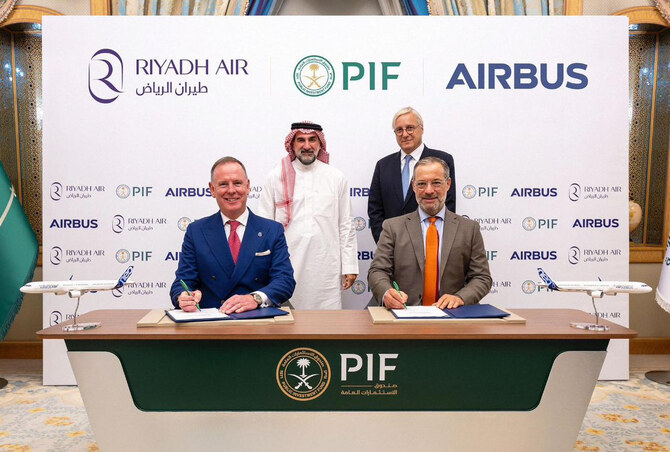
The deal was signed by Tony Douglas, CEO of Riyadh Air, and Christian Scherer, CEO Commercial Aircraft of Airbus, at the 8th Future Investment Initiative in the Kingdom’s capital city. Supplied
Short Url
Updated 30 October 2024
Follow

Riyadh Air orders 60 next-generation Airbus A321 aircraft

  • Strengthening the operations of Riyadh Air is crucial for Saudi Arabia as the Kingdom is evolving itself as a global tourism destination
  • New order will also support the airline’s long-term goal of creating 200,000 jobs and delivering enhanced connectivity

RIYADH: Saudi Arabia’s Riyadh Air, a subsidiary of the Public Investment Fund, has signed an agreement to purchase 60 Airbus A321neo single-aisle aircraft, as it plans to commence its operations in 2025. 

According to a press statement, the deal was signed by Tony Douglas, CEO of Riyadh Air, and Christian Scherer, CEO of Commercial Aircraft of Airbus, at the 8th Future Investment Initiative in the Kingdom’s capital city.  

Strengthening the operations of Riyadh Air is crucial for Saudi Arabia as the Kingdom is evolving as a global tourism destination, aligned with the economic diversification goals outlined in the Vision 2030 program. 

In September, the airline launched its first non-commercial flight from Riyadh’s King Khalid International Airport as part of the certification process.

Last year, the airlines had ordered 39 Boeing 787 Dreamliners with options for 33 more, thus bringing the estimated fleet capacity to 132.


The Airbus A321neo airliner is widely considered the most sustainable and efficient aircraft in the aviation industry. AN/Abdulrahman bin Shalhuob

“We are pleased to embark on another key milestone in Riyadh Air’s journey with the carrier’s second major fleet order, this time in partnership with Airbus,” said Yasir Al-Rumayyan, governor of PIF and chairman of Riyadh Air. 

He added: “This deal underlines the airline’s ambitious intentions in advance of next year’s launch as it builds a comprehensive international network and establishes Riyadh as a major strategic global aviation hub.”

The Airbus A321neo airliner is widely considered the most sustainable and efficient aircraft in the aviation industry, and it is expected to fulfill Riyadh Air’s ambition to cover 100 destinations worldwide by the end of this decade, the press statement said. 

Riyadh Air added that the new order will also support the airline’s long-term goal of creating 200,000 jobs and delivering enhanced connectivity to Riyadh to the world. 

“This order will not only enable us to support economic growth in the aviation industry, it will also ensure Riyadh Air operates one of the most sustainable fleets in the industry and be instrumental in helping Saudi Arabia achieve its net-zero emissions goals,” said the CEO of Riyadh Air. 

Douglas added: “This deal strongly reinforces the positive economic impact of Saudi Arabia’s newest airline on both a global and local scale and helps facilitate the fast-growing local aviation ecosystem.” 

The chief of Commercial Aircraft at Airbus said that the latest generation A321neo aircraft will bring exceptional efficiency to Riyadh Air’s operations and comfort to its passengers. 

“We look forward to working together to support the incredible growth of Saudi aviation,” added Scherer. 


Saudi tourism employment surpasses 1m as hospitality sector expands 

Updated 08 January 2026
Follow

Saudi tourism employment surpasses 1m as hospitality sector expands 

RIYADH: Saudi Arabia’s tourism workforce surpassed 1 million in the third quarter of 2025, underscoring the sector’s rapid expansion as the Kingdom continues to develop its hospitality infrastructure and visitor economy. 

According to the latest Tourism Establishments Statistics report released by the General Authority for Statistics, the total number of employees in tourism activities reached approximately 1,009,691 in the third quarter of 2025, marking a 6.4 percent increase compared to the same period in 2024, when employment stood at 948,629. 

The growth in employment comes alongside a significant rise in the number of licensed tourism hospitality facilities, which increased by 40.6 percent year on year to reach 5,622 in the third quarter. Of these, serviced apartments and other hospitality facilities accounted for 52.6 percent, while hotels represented 47.4 percent. 

The robust growth reflected in the latest tourism statistics aligns directly with the goals of Vision 2030, as the Kingdom aims to double tourism’s gross domestic product contribution to 10 percent. The sector is also seeking to create 1.6 million jobs, and attract 150 million visitors annually by 2030.

The report showed that non-Saudi employees made up the majority of the tourism workforce, numbering 764,520 and accounting for 75.7 percent of the total. Saudi nationals employed in the sector reached 245,171, representing 24.3 percent of all tourism workers. 

In terms of gender distribution, male employees dominated the sector with 875,658 workers, while female employees totaled 134,033, making up just 13.3 percent of the workforce. 

Hotel performance showed positive momentum, with the average room occupancy rate rising to 49.1 percent during the quarter, an increase of 2.9 percentage points from 46.1 percent in the same period a year earlier. 

In contrast, serviced apartments and other hospitality facilities experienced a slight dip in occupancy, recording 57.4 percent compared to 58 percent in the same quarter of 2024. 

The average daily room rate in hotels decreased by 3.6 percent to SR341 ($90.9), down from SR354 in the third quarter of 2024. Meanwhile, serviced apartments and similar facilities saw their average daily rate rise by 4.1 percent to SR208, up from SR200 a year earlier. 

The average length of stay in hotels was 4.1 nights, down 1 percent from 4.2 nights in the third quarter of 2024. For serviced apartments and other hospitality facilities, the average stay was 2.1 nights, reflecting a marginal decrease of 0.2 percent year-on-year. 

The statistics draw on administrative records, surveys and secondary data to capture activity across the Kingdom’s tourism sector, GASTAT said.