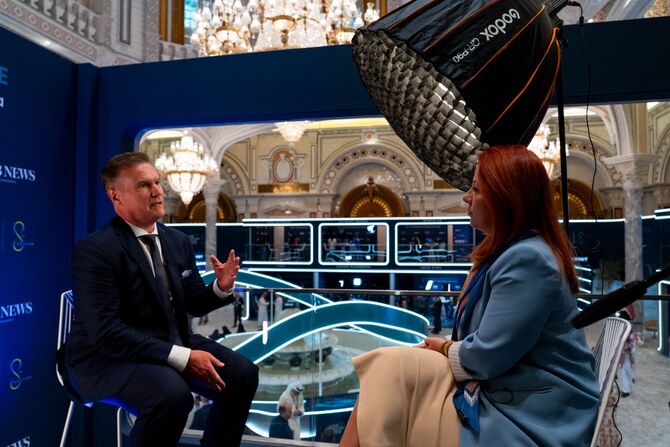

RIYADH: Saudi Arabia’s TASARU is boosting German-based premium chauffeur services company Blacklane’s entry into the Kingdom through a strategic investment, says the CEO.
In an interview with Arab News during the Future Investment Initiative in Riyadh, Michael Mueller – head of the Public Investment Fund subsidiary – emphasized the alignment between Blacklane’s mission and Saudi Arabia’s Vision 2030, which includes objectives for a sustainable and localized premium transportation sector.
“Blacklane is a ride-hailing company that finally focuses on premium chauffeur services and they want to establish a business here in Saudi Arabia and this is finally where we found a very good match into the strategy 2030 of KSA to have a sustainable, premium chauffeur service that finally wants to localize and establish their business here,” he said.
In addition to providing chauffeur services, Blacklane plans to establish a training academy in the Kingdom, which Mueller highlighted as a unique differentiator in the market.

“What makes them different is their chauffeur service in Saudi Arabia is already existing and established, of course, but, if you look into what they want to build up, and this is, for example, a training academy, so, it’s something also that comes along with higher safety,” he said.
According to Mueller, the investment in Blacklane provides the Kingdom with an experienced international partner to advance sustainable mobility in the region.
“And we have an international company that is already experienced in that business, and that’s what we want to bring to the Kingdom now with our investment and yesterday we did the signing and we are very happy finally that they will start establishing this business,” he added, following the signing of the agreement at FII8.
TASARU’s investment in Blacklane is part of a broader strategy to develop an ecosystem that supports the growth of key automotive players in the Kingdom, including Ceer, Lucid, and Hyundai.
“Our priorities right now are, of course, focus also on supporting Ceer, Lucid, Hyundai, and looking into the supplier business, because that’s also very essential as these companies will go live within the next two to three years,” Mueller explained.

“That’s definitely something we are carefully observing right now. Which suppliers are necessary to establish this ecosystem around the OEMs (original equipment manufacturers) themselves,” he added.
In the longer term, TASARU is exploring opportunities to strengthen Saudi Arabia’s automotive logistics infrastructure, a move that could further support the sector’s growth.
“Then we look into each and every opportunity. There might come something in the logistics area that finally also supports to uplift logistics services around automotive. That might be something that is potentially coming a little bit later,” Mueller said.
Reflecting on TASARU’s milestones achieved within its first year, Mueller pointed to investments in autonomous technology and ride-hailing services as indicators of the company’s commitment to building a sustainable mobility ecosystem in Saudi Arabia.
“I think you can already see after just one year of operations, we established something in King Abdullah Economic City. We went into autonomous technology investments as now with Blacklane also in ride-hailing services,” he said.

Mueller added that the company is heavily investing in everything that supports the broader vision of boosting the automotive and mobility industry in the Kingdom.
“Ride-hailing is one part of it. But we also go more into bringing new technologies to Saudi Arabia, everything that is supporting the overall idea to establish automotive and mobility services in Saudi Arabia,” he said.
Blacklane is currently in its foundation phase in the Kingdom, Mueller explained, adding that the company’s main hub is in Riyadh and the next step will be to bring their training facilities and academy.
“After Riyadh, they will focus on Jeddah and there will be three or four cities coming more or less in the Kingdom,” he added.

Mueller explained that the process of developing the mobility ecosystem comes in a step-by-step model.
He added that Saudi Arabia has already started to establish facilities like Lucid and Ceer, but what comes next is finding the right suppliers to build the foundation.
He added that exploring next-generation vehicles and technologies, along with strengthening regulations for these innovations, will play a significant role in the future.
Mueller also hinted that TASARU is in the early phases of several big announcements that have yet to be revealed.