

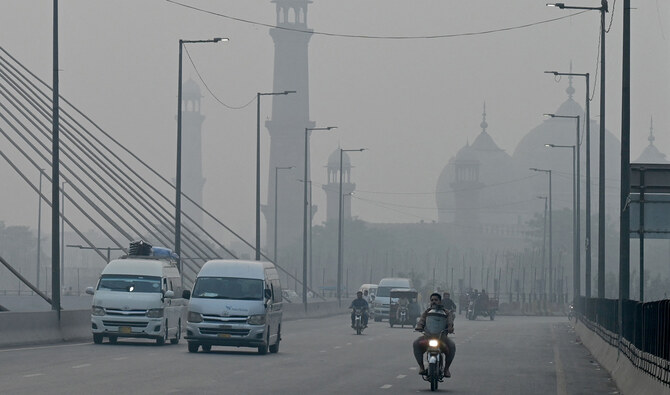

ISLAMABAD: The chief minister of Pakistan’s most populous Punjab province on Wednesday called for diplomacy with neighbor and arch-rival India to combat smog as both nations grapple with hazardous levels of air pollution ahead of the winter months.
Rated the world’s most polluted capital by Swiss group IQAir for four years in a row, Indian capital New Delhi was the world’s second most polluted city on Wednesday, the group’s live rankings showed, followed by Lahore in neighboring Pakistan. Baghdad in Iraq was ranked number one on the list.
When cooler temperatures take hold, pollution spirals and air quality deteriorates as temperature inversion traps pollution closer to the ground, packing hospital wards in Lahore and New Delhi with patients with respiratory problems.
Rising air pollution can cut life expectancy by more than five years per person in South Asia, one of the world’s most polluted regions, according to a report published last year which flagged the growing burden of hazardous air on health.
Addressing a ceremony to mark the Hindu cultural festival of Diwali on Wednesday, the Punjab CM Maryam Nawaz Sharif said Pakistan and India needed to coordinate actions to temper toxic smog, which winds carry across the border.
“There is an issue of smog in Pakistan’s Punjab, especially in Lahore. So, we must do this diplomacy with India,” Sharif said. “For the health of people there [Indian Punjab], for their betterment and the betterment of our side of the border, for our health, for the health of our people, until both Punjabs take joint measures, we won’t be able to fight smog.”
The annual practice of burning crop stubble left after harvesting paddy to clear fields for wheat planting is widely blamed for toxic pollution in the region before winter, causing disruptions such as school closures and construction curbs.
But people often also flout New Delhi’s ban on smoke-emitting firecrackers, usually burnt in celebration of the Diwali festival which runs from Wednesday to Friday this year, worsening pollution.
Sharif said she was contemplating writing a letter to her Indian counterpart, Bhagwant Mann, on the issue of combating smog.
“This is not a political issue, it’s a human issue, on which if we [Pakistan] are taking steps, then the Indian side should have a matching response, the same measures should be taken there because the winds don’t know that there is a boundary in between,” Sharif added.
Relations between India and Pakistan have gone through periods of thaw but have been largely frozen since they downgraded diplomatic ties in tit-for-tat moves in 2019.
SMOG PRECAUTIONARY MEASURES
In Pakistan’s Punjab, authorities have enforced new measures to combat hazardous smog, including making mask-wearing mandatory across the city of Lahore. New, shorter school timings have also been announced in the city while student assemblies will be conducted in classrooms rather than outdoor spaces. All outdoor activities at schools have been temporarily suspended. A ban has also been imposed on fireworks in Lahore until Jan. 31, 2025.
“Till the Lahore residents don’t announce war against smog, the government can’t do anything,” Senior Punjab Minister Marriyum Aurangzeb said while speaking to Geo News om Wednesday. “We need cooperation from Lahore’s people to make this a smog-free city.”
The minister said the smog helpline number 1373 had been launched so citizens could report activities leading to air pollution, urging residents to check that their cars were not expelling toxic fumes and requesting farmers to halt stubble burning.
Speaking about Punjab CM’s vision to convert all vehicles in Lahore to electric, she said at least 200-250 electric buses were required in Lahore.
“Cameras to detect vehicles emitting smoke are being installed and the smoke-emitting vehicle will be stopped after three warnings,” she added.
Separately, the World Wild Fund (WWF) Pakistan published a report based on air quality data from 2013-2024 that showed that Lahore’s air quality had “degraded” due to vehicular emissions, crop residue burning, industrial processes and coal combustion while air pollution levels remained the same.
The report recommended promoting electric vehicles, enhancing sustainable development models, segregating industrial zones, expanding mass transit networks and switching to renewable energy sources.
The WWF report also recommended the widespread use of low-cost sensor-based monitoring systems that can measure pollutants, mandatory vehicular emission testing, integrated traffic management, crop residue management and minimizing the construction sector’s dust.
Breathing toxic air has catastrophic health consequences, with the World Health Organization saying strokes, heart disease, lung cancer and respiratory diseases can be triggered due to prolonged exposure.
According to the United Nations Children’s Fund, nearly 600 million children in South Asia are exposed to high levels of air pollution.


