

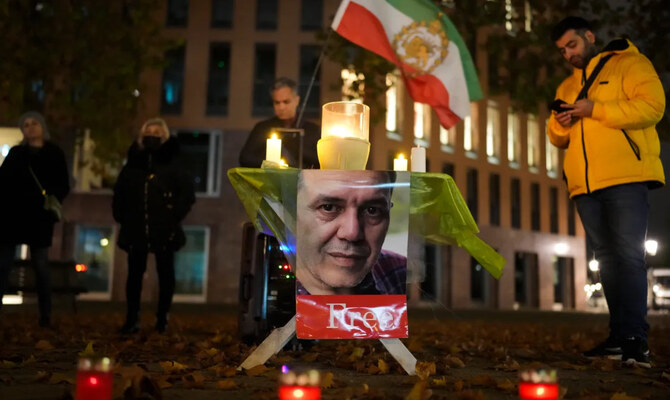
Germany recalls envoy to Iran over execution of dual national

People commemorate Iranian-German Jamshid Sharmahd during a protest following his execution in Iran, near the Foreign Ministry in Berlin, Germany, Oct. 28, 2024. (AP)
Short Url
Updated 29 October 2024
Follow

Germany recalls envoy to Iran over execution of dual national

  • Sharmahd, who also holds US residency, was sentenced to death in 2023 on charges of “corruption on earth,” a capital offense under Iran’s Islamic laws

BERLIN: Germany has recalled its ambassador to Iran over the execution of German Iranian national Jamshid Sharmahd and summoned the Iranian charge d’affaires to voice Berlin’s protest, the German foreign office said on Tuesday.

“We have sent our strongest protest against the actions of the Iranian regime & reserve the right to take further action,” the Foreign Ministry said in a post on X.

Germany’s ambassador in Tehran protested in the strongest possible terms against the killing of Sharmahd, the post said, adding that German Foreign Minister Annalena Baerbock had recalled the ambassador to Berlin for consultations. Iranian state media said on Monday Sharmahd was put to death after he was convicted of carrying out terrorist attacks. “No terrorist enjoys impunity in Iran. Even if supported by Germany,” Iran’s Foreign Minister Abbas Araqchi said on X.

“Iranian national Jamshid Sharmahd openly and unashamedly led a terrorist attack on a mosque that killed 14 innocent people.”

Iranian state media reported on Tuesday that the German ambassador was summoned by the Foreign Ministry over “interventionist comments” made by German officials against the Iranian judiciary’s decision.

“Support for Sharmahd contradicts the German government’s claims in regards to the rule of law, the protection of human rights, and the fight against terrorism,” the Foreign Ministry said according to state media.

Sharmahd, who also holds US residency, was sentenced to death in 2023 on charges of “corruption on earth,” a capital offense under Iran’s Islamic laws.

He was accused by Iran of heading a pro-monarchist group accused of a deadly 2008 bombing and planning other attacks.

His daughter Gazelle Sharmahd, also on X, demanded proof of his execution and called for the immediate return of her father.


Slovak parliament passes law to abolish whistleblower protection office

Updated 4 sec ago
Follow

Slovak parliament passes law to abolish whistleblower protection office

  • The new law abolishes the office in charge of protecting whistleblowers and creates another body
  • Fico has faced a series of protests over his curbing of rights in the country

BRATISLAVA: Slovakia’s parliament on Tuesday approved a law that critics say will curb protections for whistleblowers, the latest move drawing rule-of-law concerns since nationalist Prime Minister Robert Fico’s return to power in 2023.
It comes after parliament last year adopted controversial penal code reforms, including easing the penalties for corruption and economic offenses in the European Union and NATO member.
Since his return to power, Fico has faced a series of protests over his curbing of rights in the country of 5.4 million people.
Parliament passed the new law, which abolishes the office in charge of protecting whistleblowers and creates another body that will be placed under government authority, with 78 votes in favor and 57 against.
The law, which foresees that the government will nominate the chair of the new body, will take effect from January 1, 2026.
Parliament will be tasked with electing the chair.
The law states that “protections granted so far may be retroactively withdrawn... from whistleblowers,” adding that protections may also “be permanently re?evaluated, including at the initiative of the employer.”
Jan Horecky, a lawmaker from the Christian Democratic KDH party, denounced the abolition of the “last... independent institution dedicated to fighting corruption” in the country.
In recent weeks, Slovak NGOs have protested against the government plans to abolish the office, with a few hundred people rallying in front of the parliament building after lawmakers passed the law in the first reading.
The opposition SaS party has called a new protest for Thursday.
Transparency International Slovakia in late November accused Fico of “dismantling even the little he himself offered in the fight against corruption,” while the NGO Stop Corruption said whistleblower protection risks being turned into “a scrap of paper that will protect no one.”
Slovakia’s rank in Transparency International’s annual corruption perceptions index dropped several places last year, with the country ranking among the most corrupt in the EU last year.
Critics say about 100 people who have blown the whistle on corruption stand to lose protection.
Fico has drawn a series of protests, including over tightening his grip on public broadcaster RTVS and media outlets he deems “hostile” and replacing leading figures in the country’s cultural institutions.
Brussels launched legal action against Slovakia over changes to the country’s constitution that see national law take precedence over EU law.