

Pakistani PM discusses bilateral ties, economic plans with Saudi crown prince in Riyadh 

1 / 2
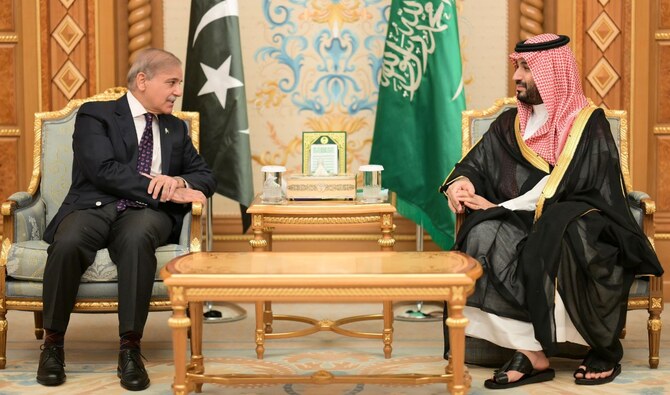
Prime Minister Shehbaz Sharif meets with Saudi Crown Prince Mohammed bin Salman on the sidelines of the Future Investment Initiative summit in Riyadh on October 29, 2024. (PMO)
2 / 2
Prime Minister Shehbaz Sharif speaking at the Future Investment Initiative (FII) summit in the Saudi capital of Riyadh on October 29, 2024. (Photo courtesy: Shehbaz Sharif/ X)
Short Url
Updated 30 October 2024
Follow

Pakistani PM discusses bilateral ties, economic plans with Saudi crown prince in Riyadh 

  • Shehbaz Sharif arrived in Riyadh on Tuesday, weeks after Pakistan signed $2 billion deals with Saudi businesses
  • Saudi crown prince this year reaffirmed commitment to expediting $5 billion investment package for cash-strapped Pakistan

ISLAMABAD: Pakistani Prime Minister Shehbaz Sharif on Tuesday met Saudi Crown Prince Mohammed bin Salman in Riyadh and discussed ongoing bilateral engagements and Pakistan’s future economic plans, Sharif’s office said in a statement. 

The meeting took place on the sidelines of the eighth edition of the two-day Future Investment Initiative (FII) summit for which global business, technology and financial leaders have converged in the Saudi capital, looking for opportunities to forge relations with some of Saudi Arabia’s biggest companies and its $925 billion sovereign wealth fund.

Sharif arrived in Riyadh on Tuesday for a visit that comes after one to Islamabad by Saudi Investment Minister Khalid bin Abdulaziz Al-Falih, during which over $2 billion in agreements and memorandums of understanding (MoUs) were signed between Saudi and Pakistani businesses. 

“The two leaders took stock of the ongoing bilateral engagements, especially in follow up to the decisions taken in previous high-level meetings held in Makkah and Riyadh in April 2024,” Sharif’s office said in a statement after his meeting with the Saudi crown prince. 

In April this year, after PM Sharif met the crown prince in Makkah Al-Mukarramah, Saudi Arabia reaffirmed its commitment to expedite a $5 billion investment package for Pakistan.

At Tuesday’s meeting, Sharif apprised the crown prince of Pakistan’s economic, institutional and policy reforms agenda, saying that the Kingdom had a “central role” to play in Pakistan’s “future economic plans.” He also appreciated the Kingdom’s efforts to promote regional peace and stability in the Middle East and reiterated Pakistan’s commitment to stand by Saudi Arabia in such efforts.

“The two leaders exchanged views on regional developments and agreed to closely coordinate positions on regional issues,” Sharif’s office said.

’PARTNERSHIPS IN AI, EDUCATION, HEALTH’

Prior to his meeting with the Saudi top leader, Sharif attended the FII summit in Riyadh where he said his government was looking to form partnerships with Saudi and other global companies in the realms of artificial intelligence (AI), education and health.

“Pakistan is laying the foundation for a knowledge-based economy driven by innovation in three pivotal domains, artificial intelligence, education and health, in which we look forward to forging useful partnerships,” Sharif said during his address at the summit, which is focusing on global investments in AI, robotics, education, energy, space, finance, health care and sustainability. 

“Our mission is clear, and it is to encourage young minds to redefine the boundaries of AI, training skilled engineers and data scientists as the backbone of Pakistan’s AI growth and equipping our workforce to harness the power of AI across industries.”

The prime minister said Pakistan had more than 275,000 registered doctors, with the country’s youth pioneering new health tech solutions. 

“With advancements in health care standards, we envision a future where our doctors and scientists collaborate across borders for a healthier tomorrow,” Sharif added as he invited participating nations to invest in Pakistan and bring their expertise to the South Asian country as it built a future “rooted in resilience and shared prosperity.”

“Pakistan stands ready to join those countries who dare to dream big,” Sharif said. 

The Pakistani PM’s visit takes place at a time when Islamabad is seeking to strengthen trade and investment ties with friendly nations, particularly the Kingdom, which has promised a $5 billion investment package that cash-strapped Pakistan desperately needs to shore up its dwindling foreign reserves and fight a chronic balance of payment crisis.



Islamabad hits back after Indian minister blames Pakistan army for ‘ideological hostility’

Updated 10 sec ago
Follow

Islamabad hits back after Indian minister blames Pakistan army for ‘ideological hostility’

  • Jaishankar tells a public forum most of India’s problems with Islamabad stem from Pakistan’s military establishment
  • Pakistan condemns the remarks, accusing India of waging a propaganda drive to deflect from its destabilizing actions

ISLAMABAD: Pakistan accused India on Sunday of running a propaganda campaign to malign its state institutions, a day after Indian External Affairs Minister Subrahmanyam Jaishankar attributed what he described as Pakistan’s “ideological hostility” toward New Delhi to the country’s powerful army.

Addressing a public forum in New Delhi, Jaishankar said most of India’s problems with Pakistan stemmed from its military establishment, which he argued had cultivated and sustained an entrenched animosity toward India.

His remarks came months after a brief but intense military confrontation between the nuclear-armed neighbors, during which both sides exchanged artillery and missile fire and deployed drones and fighter jets.

Responding to the comments, Pakistan’s Foreign Office spokesperson Tahir Andrabi called them “highly inflammatory, baseless and irresponsible.”

“Pakistan is a responsible state and its all institutions, including armed forces, are a pillar of national security, dedicated to safeguarding the sovereignty and territorial integrity of the country,” Andrabi said in a statement. “The May 2025 conflict vividly demonstrated Pakistan armed forces’ professionalism as well as their resolve to defend the motherland and the people of Pakistan against any Indian aggression in a befitting, effective yet responsible manner.”

“The attempts by Indian leadership to defame Pakistan’s state institutions and its leadership are a part of a propaganda campaign designed to distract attention from India’s destabilising actions in the region and beyond as well as state-sponsored terrorism in Pakistan,” he said, adding that such “incendiary rhetoric” showed the extent of India’s disregard for regional peace and stability.

Andrabi said that rather than making “misleading remarks about the armed forces of Pakistan,” India should confront the “fascist and revisionist Hindutva ideology that has unleashed a reign of mob justice, lynchings, arbitrary detentions and demolition of properties and places of worship.”

He warned that the Indian state and its leadership had become hostage to “this terror in the name of religion.”

India and Pakistan have fought three wars since independence in 1947. They have also engaged in countless border skirmishes and major military standoffs, including the 1999 Kargil conflict.

The four-day conflict in May 2025 ended with a US-brokered ceasefire, after Washington said both sides had expressed willingness to pursue dialogue.

Pakistan said it was ready to discuss all outstanding issues, but India declined talks.


-End