ISLAMABAD: Pakistani and Russian officials discussed trade, investment and military cooperation between the two countries during high-level meetings held in Islamabad on Tuesday, Pakistani state media reported, with Prime Minister Shehbaz Sharif saying the two countries had “wide potential” to benefit from in various fields.
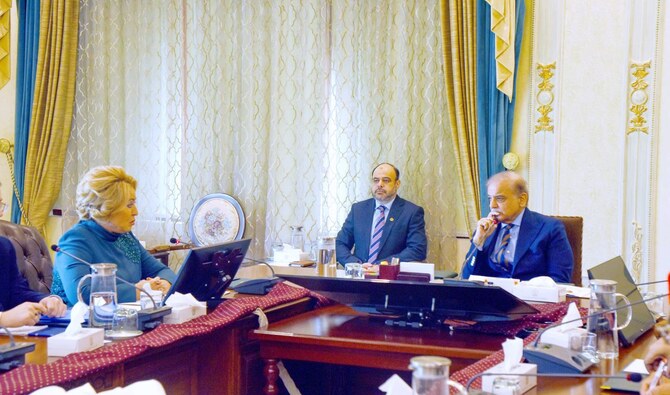
The statement came after a meeting of a Russian parliamentary delegation, led by Russian Federation Council Speaker Valentina Matvienko, with the Pakistan prime minister.
Sharif said recent visits by the Russian leadership to Pakistan were a positive sign for bilateral relations and both countries benefit from their potential in different fields, the Radio Pakistan broadcaster reported.
“Shehbaz Sharif expressed the confidence that Pakistan-Russia Joint Commission meeting to be held in December will prove to be an important opportunity to expand cooperation between the two countries,” the report read.
“The two sides discussed strengthening of banking channels for promotion of trade and investment as well as the creation of a comprehensive road map for economy, trade and investment between Pakistan and Russia.”
Established in 2008, the Pakistan-Russia Inter-Governmental Commission focuses on promoting trade, economic, scientific, technological and culture cooperation between the two countries.
The commission, co-chaired by a high-level representative from each country and comprising several working groups, meets regularly to discuss and implement agreements in various fields.
Separately, Russian Deputy Defense Minister Col. General Aleksandr V. Fomin, along with a high-level delegation, held meetings with Pakistan Air Force and Pakistan Navy chiefs.
The meeting with PAF chief, Air Chief Marshal Zaheer Ahmed Baber Sidhu, remained focused on bolstering military cooperation and industrial collaboration between the two sides, while exploring new avenues to fortify existing ties through joint military exercises and technical support for PAF equipment, according to the Inter-Services Public Relations, the Pakistani military’s media wing.
“[Pakistan] Air Chief emphasized on strengthening military ties with Russia, focusing on collaborative training programs, joint military drills and industrial collaboration,” the ISPR said in a statement.
In his meeting with Pakistan Navy chief, Admiral Naveed Ashraf, the Russian deputy defense minister discussed bilateral collaboration and regional maritime security, according to the Pakistan Navy’s Directorate General of Public Relations (DGPR). Various avenues, including bilateral training, exchange of visits and conduct of bilateral naval exercises, also came under discussion.
“Pakistan greatly values its relations with the Russian Federation and desires to forge a long-term, multi-dimensional partnership with Russia,” the naval chief was quoted as saying by the DGPR.
The visiting dignitary appreciated Pakistan Navy’s efforts to support collaborative maritime security.
“Both leaders agreed to further strengthen and diversify the scope of existing bilateral defense relationship particularly in maritime domain and naval technologies,” the DGPR added.
Pakistan and Russia, once Cold War rivals, have warmed up to each other in recent years through regular business and trade interactions. Islamabad’s ties with Russia also significantly improved in 2023 after Pakistan started purchasing Russian crude oil at a discount rate.
On Monday, Pakistan’s President Asif Ali Zardari sought Russia’s support to join the inter-governmental BRICS organization during his meeting with Russian Federation Council Speaker Matvienko, Pakistani state media reported.
In 2006, Brazil, Russia, India and China created the “BRIC” group before South Africa joined the alliance in 2010, making it BRICS. The bloc was founded as an informal club to provide a platform for its members to challenge a world order dominated by the United States and its Western allies.
Countries like Pakistan who want to join BRICS see it as an alternative to global bodies viewed as dominated by the traditional Western powers and hope membership will unlock benefits including development finance, and increased trade and investment. Pakistan had last year applied to become a member of BRICS.


Pakistan, Russia discuss trade, investment, military cooperation in high-level Islamabad meetings
https://arab.news/8qp2q
Pakistan, Russia discuss trade, investment, military cooperation in high-level Islamabad meetings

- Russian delegation currently visiting Pakistan, meets PM Shehbaz Sharif, services chiefs
- Former Cold War rivals Pakistan and Russia have warmed up to each other in recent years

Pakistan’s Mahnoor Omer named among TIME’s ‘Women of the Year’ for 2026
- Omer moved a Pakistani court against the so-called ‘period tax’ in Sept. 2025 which has since sparked a national debate
- Taxes on sanitary pads in Pakistan can add up to 40 percent to retail price, UNICEF says only around 12 percent women use such products
ISLAMABAD: Pakistani women’s rights activist Mahnoor Omer, who fought against taxes on menstrual products, has been named among the TIME magazine’s ‘Women of the Year’ for 2026.
Omer’s efforts have been recognized alongside 16 activists, artists, athletes and businesswomen in the TIME’s Women of the Year 2026 list, including Olympic gold medalist Sydney McLaughlin-Levrone and Oscar-nominated filmmaker Chloe Zhao.
Dissatisfied with the efforts to educate Pakistani girls about sexual violence, Omer founded the Noor Foundation at the age of 14 and held her own workshops with village girls about everything from climate change to menstruation, according to the TIME magazine.
Two years later, a conversation with a domestic worker about the price of pads made her realize that not everyone could afford these essentials. She moved a court against the so-called “period tax” in Sept. 2025 and the case has sparked a national debate on the subject, considered a taboo by many in Pakistan, since its first hearing late last year.
“A decade and one law degree after her interest in activism was sparked, Omer, now 25, is putting her passion and expertise to work in the name of gender equity,” TIME wrote about Omer on its website.
Taxes imposed on sanitary products in Pakistan can add up to 40 percent to the retail price. UNICEF estimates just 12 percent of women in the country use commercially produced pads or tampons. The alternative, using cloth, risks health impacts including rashes and infections, and can make it impossible for girls to attend school while menstruating.
Omer’s suit, which awaits the government response, has sparked a national discussion. She says she spoke about menstruation to her father and male cousins, who thanked her for standing up for their daughters.
The 25-year-old, who is currently enrolled in a master’s degree in gender, peace, and security at the London School of Economics, sees this case as just the first of many.
“I’m not free until every woman is free,” she was quoted as saying by TIME. “I want to leave no stones unturned in terms of what I can do with the next few decades, as a lawyer for the women in my country and gender minorities in general.”


