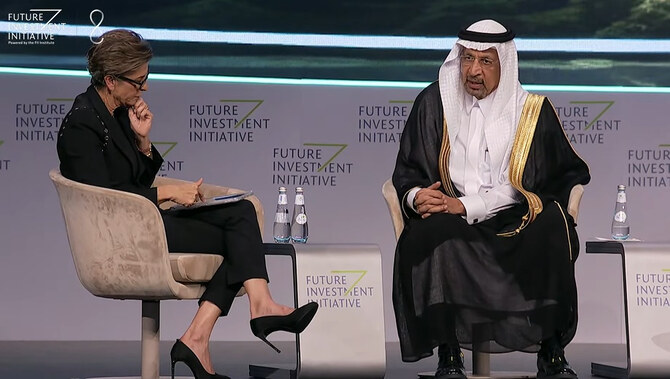

RIYADH: Saudi Arabia attracted 540 international companies to establish their regional headquarters in Riyadh, ahead of a 2030 target of 500, according to Khalid Al-Falih, the Kingdom’s minister of investment.
Speaking at the eighth Future Investment Initiative summit in Riyadh on Oct. 29, Al-Falih said that Saudi Arabia’s economic growth and investment landscape continues to remain resilient amid geopolitical tensions in the region.
“Investors are not only coming to Saudi Arabia for our vibrant market. They are coming to the Kingdom to explore the broader region. We have initiated a program aimed at targeting 500 regional headquarters by 2030. And I am glad to announce that we have reached 540 companies,” said Al-Falih.
Through the regional HQ program, Saudi Arabia introduced new tax incentives for multinational companies moving their regional headquarters to the Kingdom. These incentives include a 30-year exemption on corporate income tax and withholding tax related to headquarters activities, alongside discounts and support services.
Al-Falih added: “Our economy is in the middle of the Middle East. We are the center of the Middle East and we feel the pain that is happening at the human level. The economy of Saudi Arabia under Vision 2030 is navigating these geopolitical tensions, macroeconomic and global challenges including trade tensions and political conflicts extremely well.”
According to the minister, Saudi Arabia’s gross domestic product has grown by 70 percent since the launch of Vision 2030, a program aimed at diversifying the Kingdom’s economy by reducing its dependence on oil.
Affirming the progress of economic diversification, the investment minister said that Saudi Arabia’s non-oil economy has been growing at 4 percent to 5 percent consistently since 2016, when Vision 2030 was launched.
The comments by Al-Falih come just a few days after the International Monetary Fund projected the Kingdom’s economy to grow by 1.5 percent in 2024 and 4.6 percent next year. According to IMF, the Kingdom’s projected growth for 2025 is the second highest among countries in the Gulf Cooperation Council.
Earlier this month, the World Bank also projected the Saudi gross domestic product to grow by 1.6 percent this year and later accelerating to 4.9 percent in 2025.
In September, another report by credit rating agency S&P Global said that Saudi Arabia’s economic growth will be driven by its diversification strategy aimed at strengthening the non-oil private sector and reducing dependence on crude revenues.
The investment minister also added that Saudi Arabia is targeting $3.3 trillion of gross capital formation by 2030, and it is currently growing at a pace of 10 percent year on year.
He added that the Saudi Arabia progressing in every sectors including tourism, with the Kingdom attracting more than 100 million tourists last year.
Al-Falih said that economic conditions are getting stabilized globally, with inflation moderating and interest rates declining.
“Inflation has now been crushed, and it is now back to target levels; 2.6 percent in developed countries. Interest rates have declined, and in many countries have started reducing interest rates and quantitative easing. There has been no massive recession in most G20 economies,” said Al-Falih.
He added: “Investor confidence is 15 percent high compared to three years ago, as measured by IPSOS. Tourism is back to where it was before the pandemic.”
Geopolitical tensions
Al-Falih expressed his concerns about the growing geopolitical tensions in the Middle East, and said that Saudi Arabia is committed to bring peace and stability in the region.
“Geopolitical situation is concerning. The human aspect of it is truly tragic, look at the region, look at Europe. What is happening should be not underestimated, and the Kingdom is doing all it can to bring peace and prosperity,” said the investment minister.
Turkish Finance Minister Mehmet Şimşek said his country’s economy, with its diversified nature, is well equipped to combat the effects of tensions in the region.
“We are concerned about the risk of escalation of the ongoing conflicts, even though I think the risk is small, but it is not completely ignorable. Typically that would be the worst case scenario because Turkiye is a highly diversified economy. We are more resilient,” said Şimşek.
He added: “The good news is that we have free trade countries with 54 countries around the world, and that covers about 60 percent of our trade.”
During the same panel discussion, UK’s Minister of State for Trade Douglas Alexander said that politics is making a come back to the business sector, which is creating challenges to the future of economy.
“In the first 40 years of globalization, CEOs and capital allocators did not have to give much consideration to geopolitics, and they instead focussing on ensuring flows of capital, services and goods. However, in recent years, we are seeing politics making a comeback, politics domestically, and geopolitics internationally,” said Alexander.
Technological shift
During the discussion, Al-Falih said that advanced technologies like artificial intelligence are expected to fuel optimism in the minds of investors, thus strengthening market conditions.
“AI, by itself, is fueling not only capital markets, but it is fueling optimism. It is creating an opportunity for rebalancing global competitiveness, among companies, among countries, and even among families and people, who think technological infrastructure will create a greater future,” said the Saudi minister.
Echoing similar view, Şimşek said that prolonged economic growth demands green transition and digital transformation.
Al-Falih further added that Saudi Arabia is doing everything to ensure security and safety of data as AI takes the center stage.
“What we are doing in Saudi Arabia is having a balanced framework on data privacy, data sovereignty and data security when it comes to AI,” said Al-Falih.
He added: “AI has a huge demand here. Saudi Arabia is going to be the disruptor, it is going to be the maker of a different ecosystem for actually incubating AI, algorithms and data centers that will have everything.”