


AITO: Dany Alwan stood shaking as rescue workers pulled remains from piles of rubble where his brother’s building once stood.
An Israeli airstrike destroyed the three-story residential building in the quiet Christian village of Aito a day before. His brother, Elie, had rented out its apartments to a friend who’d fled here with relatives from their hometown in southern Lebanon under Israeli bombardment.
Things were fine for a few weeks. But that day, minutes after visitors arrived and entered the building, it was struck. Almost two dozen people were killed, half of them women and children. Israel said it targeted a Hezbollah official, as it has insisted in other strikes with high civilian death tolls.
This strike - in northern Lebanon, deep in Christian heartland - was particularly unusual. Israel has concentrated its bombardment mostly in the country’s south and east and in Beirut’s southern suburbs -Shiite-majority areas where the Hezbollah militant group has a strong presence.
Strikes in the traditionally “safe” areas where many displaced families have fled are raising fears among local residents. Many feel they have to choose between helping compatriots and protecting themselves.
“We can’t welcome people anymore,” Alwan said as rescue teams combed through the rubble in Aito. “The situation is very critical in the village, and this is the first time something like this has happened to us.”
Aito is in the Zgharta province, which is split between Christian factions who are supporters and critics of Hezbollah.
Some Christian legislators critical of Hezbollah have warned of the security risks that could come with hosting displaced people, mostly from the Shia Muslim community. They worry that many may have familial and social ties to Hezbollah, which in addition to its armed wing has civilian services across southern and eastern Lebanon.
Some also worry that long-term displacement could create demographic changes and weaken the Christian share in Lebanon’s fragile sectarian power-sharing system. The tiny country has a troubled history of sectarian strife and violence, most notably in a 15-year civil war that ended in 1990.
Lebanon for decades has struggled to navigate tensions and political gridlock within its sectarian power-sharing government system. Parliament is deeply divided among factions that back and oppose Hezbollah and has been without a president for almost two years.
When Hezbollah fired rockets at northern Israel in solidarity with Palestinian ally Hamas in the war-torn Gaza Strip, the move was met with mixed feelings. Critics say it was a miscalculation that has brought the widespread devastation of Gaza here.
After nearly a year of low-level fighting, the Israeli military escalated its attacks against Hezbollah a month ago, launching daily aerial bombardments and a ground invasion. Most of Lebanon’s estimated 1.2 million displaced people fled over the past month.
In late September, traffic jams stretching for miles clogged streets leading to Beirut as people left, some with nothing but the clothes on their backs.
For many, the violence has moved them to help their fellow residents, cutting across sectarian lines.
Michella Sfeir, who was safe in the north, said she wanted to take action after seeing a picture of a driver pouring water from his bottle into a nearby driver’s empty one.
“The first thing you can think of is: How can I help immediately?” she said.
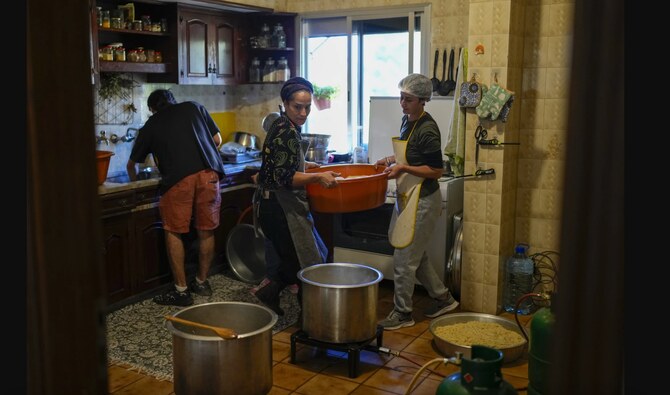
She now helps prepare meals at a women’s art center that’s become a community kitchen and donation dropoff center for blankets, clothes, and supplies in Aqaibe, a seaside town just north of Beirut. Displaced women who found shelter in surrounding neighborhoods regularly visit, while some people involved in other initiatives help deliver the hot meals to shelters around dinnertime.
“We get lots of questions like, ‘When you go to give the help, is there a member of Hezbollah waiting for you at the door?’” Sfeir said, citing blowback in the community from people who perceive the displaced as Hezbollah members, supporters and relatives.
“Some people ... would ask us ‘Why are you helping them? They don’t deserve it; this is because of them.’”
Though northern coastal cities such as Byblos and Batroun with pristine beaches and ancient ruins have not felt the direct pain of the conflict, anxiety is rising in surrounding areas.
On one coastal road - the busy Jounieh highway - an Israeli drone struck a car earlier this month, killing a man and his wife.
Such rare but increasing Israeli strikes have rattled residents in the north. Many feel torn: Should they risk their security by hosting displaced people, or compromise their morals and turn them away?
Zeinab Rihan fled north with family and relatives from the southern Nabatiyeh province when they couldn’t bear the airstrikes approaching closer to their homes.
But, Rihan said, they found many landlords quoting outlandish rent figures in an apparent attempt to turn them away.
Some might have been acting out of personal prejudice, Rihan said, but it’s likely most were simply afraid.
“They were scared that they might rent their place to someone who turns out to be targeted,” Rihan said. “But this is our current reality, what can we do?”
A resident of one northern town near the coast said the local government didn’t want to welcome displaced people, but many residents pressured the municipality to change course.
He cited the town’s common sympathy and sense of duty to help others, despite the security risks. He spoke to The Associated Press on condition of anonymity for fear of stirring tension among residents.
Elsewhere, in the hilly village of Ebrine, a stone’s throw away from Batroun, residents have been regularly visiting dozens of displaced families sheltering in two modest schools. This month, an Israeli strike hit a village a short drive away, but that hasn’t stopped some residents from hiring the displaced - for some, to work in olive groves during the harvest season.
Back in Aqaibe, some displaced women from nearby areas have joined Sfeir and others volunteering at the kitchen: chopping vegetables, cooking rice in vats, packaging meals in plastic containers, and having coffee together on the balcony.
“Just because we’re in an area that doesn’t have direct conflict or direct war doesn’t mean that we’re not worried about Beirut or the south,” said Flavia Bechara, who founded the center, as she took a break from chopping onions and potatoes. “We all used to eat the olives and olive oil of the south, and we used to go there to get fruits and vegetables.”
Bechara and several women finished packing dozens of meals for the day, and a group of women came to pick up winter clothes for their kids. Bechara said she isn’t phased by the criticism or questions she gets from some of her neighbors.
“There’s always anxiety,” said Bechara, who just recently could hear strikes a short drive away, in Maisra. “There’s always (the fear) that what is happening there can happen here at any moment.”


