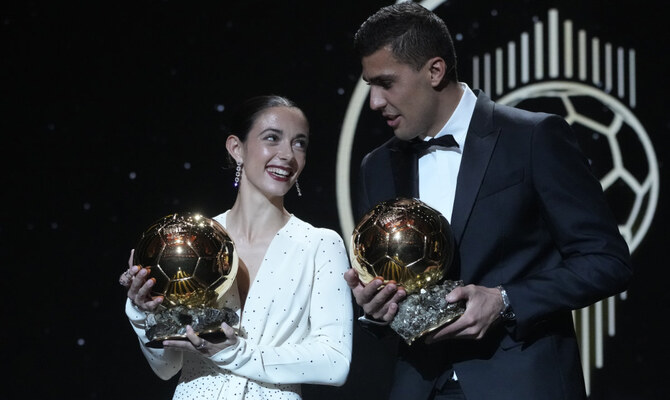
PARIS: Spanish midfielders Rodri and Aitana Bonmatí won the men’s and women’s Ballon d’Or award for the world’s best soccer player on Monday.
The 28-year-old Rodri won the prestigious award for the first time after helping Manchester City win the Premier League and being a key player in Spain’s European Championship triumph. He succeeded eight-time winner Lionel Messi of Argentina.
Rodri put his hands over his face when his name was read out by former winner George Weah.
“Incredible night for me,” said Rodri, who is out for the season after injuring his ACL last month and arrived on crutches to the ceremony. “One of my key things is I always try to improve every game.”
The 26-year-old Bonmatí retained her award after helping Barcelona win the Spanish league, the Spanish cup and the Champions League. Bonmatí joined Barca teammate Alexia Putellas in winning two titles since the women’s trophy was first awarded in 2018. She beat her teammates Caroline Graham Hansen of Norway and Salma Paralluelo of Spain as Barcelona completed a 1-2-3.
“It’s a pleasure to be here again,” said Bonmatí, who received the award from Oscar winner Natalie Portman. “Thanks to my teammates and the clubs who make me a better football player every year.”
Vinícius Júnior was among the four men’s finalists with his Real Madrid teammates Jude Bellingham and Dani Carvajal. But no one from Madrid attended the gala in central Paris, even though Carlo Ancelotti won the coach of the year award.
Vinícius had been seen as one of the favorites for the award until making the decision not to travel to Paris for the ceremony. The decision was made by Madrid, according to a person who works with Vinícius and spoke to The Associated Press on condition of anonymity because he wasn’t authorized to speak about the player’s whereabouts publicly.
Vinícius finished second in the voting, with Bellingham third.
Neither Messi nor Cristiano Ronaldo — winners of the prestigious individual award a combined 13 times — were in the running for this year’s prize — the first time that’s happened since 2003.
While Rodri is not a flamboyant player or a prolific scorer like Messi and Ronaldo, he had a huge influence on City’s team with his ability to protect the defense and distribute passes cleanly from the back.
“I try to be a leader and try to improve every day from the best,” Rodri said.
City looked unbeatable at times with him in the side, while his excellent technical ability enabled him to slot smoothly into the quick-passing style made so effective by Spain at Euro 2024.
Bonmatí scored 19 goals for the second straight season for Barca and this year has netted five in five games for Spain, taking her international tally to 26.
The Ballon d’Or was created by France Football magazine and has been awarded since 1956 for the men, and since 2018 for the women. It is voted for by journalists from the top 100 countries in the FIFA rankings.
Each journalist, one per country, selects 10 players in ranked order, with points attributed to each position. The winner is the player who receives the most points. Unlike FIFA’s awards for the best players each year, fans aren’t part of the voting system.
Yamal’s trophy and other awards
On a good night for Spain and Barca players, teen prodigy Lamine Yamal — the youngest-ever scorer at a European Championship — won the Kopa award for best Under-21 player and Barca won the best women’s team award.
Real Madrid was voted the best men’s team.
Former PSG forward Kylian Mbappé and Bayern Munich striker Harry Kane shared the Gerd Mueller award for most club and country goals last season with 52. Mbappé joined Madrid during the offseason.
Argentina’s penalty-saving specialist Emiliano Martínez retained the Lev Yashin award for best goalkeeper.
Ancelotti and Olympic-winning coach Emma Hayes won the Johan Cruyff award for best men’s and women’s coach.
Spain forward Jenni Hermoso, who has fought sexism in Spanish soccer after she was kissed on the lips at last year’s Women’s World Cup final by former federation president Luis Rubiales, collected the Socrates award for humanitarian work.
A special award was given by France Football to the wife and son of late Germany great Franz Beckenbauer.

Spaniards Rodri and Bonmatí win Ballon d’Or award for best men’s and women’s players in world soccer
https://arab.news/jqwh5
Spaniards Rodri and Bonmatí win Ballon d’Or award for best men’s and women’s players in world soccer
- While Rodri is not a flamboyant player or a prolific scorer like Messi and Ronaldo, he had a huge influence on City’s team with his ability to protect the defense and distribute passes cleanly from the back
- The 26-year-old Bonmatí retained her award after helping Barcelona win the Spanish league, the Spanish cup and the Champions League
From the Red Sea to the deep desert: inside the new route for Dakar 2026
- The seventh consecutive edition to take place in Saudi Arabia will run from Jan. 3-17
RIYADH: The Dakar Rally returns to Saudi Arabia for the seventh consecutive edition from Jan. 3-17, bringing with it one of the most demanding and wide-ranging routes since the first such event in the Kingdom.
Held under the supervision of the ministry of sport, organised by the Saudi Automobile and Motorcycle Federation, and promoted by the Saudi Motorsport Company, this year the race elevates the rally’s challenges, drawing competitors into a course through some of the country’s most iconic and challenging landscapes.
With a total distance of 7,999 kilometres, including 4,845 kilometres of timed special stages, the 2026 route almost matches the longest competitive distance of the rally’s Saudi era. It takes competitors through some of the Kingdom’s most varied landscapes, from the Red Sea coast to the deep desert and back again.
Fewer bivouacs mean teams arrive to better-rested support crews, while redesigned marathon stages help shape the rhythm of the event. Intense days are balanced with recovery opportunities around the rest day, creating a course defined by challenge and deliberate pacing.
Yanbu: Start and finish point on the Red Sea coast
Yanbu bookends the 2026 Dakar Rally, hosting the Prologue, Stages 1 and 2, and the final Stage 13. Set between the Red Sea and a stretch of inland hills, the region offers a mix of gravel plains, rocky corridors, and light sandy terrain that shifts subtly in color and tone throughout the day. The blend of coastal calm and rugged interior landscapes gives competitors an early sense of the rally’s character and provides a familiar backdrop when they return to the finish on the Red Sea coast.
AlUla: Distinctive desert scenery and marathon conditions
Arriving from the opening stages in Yanbu, AlUla brings competitors into one of the rally’s most distinctive settings, where sandy tracks run through wide open spaces and weave around ancient rock formations. The region’s limited landmarks and expanding network of tracks place added weight on navigation, while the mix of plains, hills, and rocky stretches requires regular changes in pace.
As part of the marathon phase, teams face simple desert camps and minimal support, keeping the focus on careful vehicle management in one of the rally’s most visually striking regions.
Hail: Key region with deep rally roots and the longest stage
Hail adds a familiar rhythm to Dakar 2026, taking competitors through a region deeply connected to Saudi Arabia’s rally heritage. The stage, the longest of Dakar 2026, unfolds toward the Qassim area, where the dunes that local off-road communities have navigated for generations rise and fall as far as the eye can see. The day is spent almost entirely on sand, moving between rolling dune lines and broad valleys that offer little change in surface but plenty of shifts in momentum. It is a long, demanding stretch that rewards comfort in deep sand before the field makes a lengthy journey toward Riyadh and a well-earned rest day.
Riyadh: Central transition marked by steady race rhythm
Riyadh is a reset point in the rally, where competitors return to the course after the rest day with renewed focus.
The stage that follows calls for a measured approach: confidence from the first week can be helpful, but overconfidence can be costly. Sandy, fast tracks dominate the route, with occasional dense bushes along the edges where the terrain itself presents few major hazards beyond the temptation to push too hard. With the day’s combined distance approaching 900km, sustained concentration is essential, even during the long sections leading in and out of the capital.
Wadi Al-Dawasir: Extensive dunes and classic desert driving
Wadi Al-Dawasir brings the rally back into classic desert territory as competitors leave Riyadh and enter one of Saudi Arabia’s largest dune regions. The landscape offers one of the most complete terrain mixes of the rally, with long dune lines, broad valleys, and clear horizons that create a steady but demanding pace. Navigation is straightforward but unforgiving, as even small mistakes can lead teams off course, especially with this part of the route forming the core of the event’s second marathon phase. The area’s size and consistency test endurance and focus, offering a full return to deep-desert driving in a region closely tied to Dakar’s sand heritage.
Bisha: Fast terrain with demanding navigation
Bisha introduces a different type of challenge to Dakar 2026, where the main difficulty comes from navigation rather than the terrain itself.
The tracks in this region often allow for a fast pace, but the abundance of intersections, forks, and junctions can quickly create a maze-like environment. Staying focused is essential, especially with the long overall distance adding to the day’s fatigue. Competitors who manage their pace and maintain clarity through the shifting network of routes will be best positioned as the rally moves toward Al-Henakiyah.
Al-Henakiyah: Mixed terrain requiring precise control
Al-Henakiyah offers one of the final opportunities for competitors to influence the standings, with a route that shifts quickly between different types of terrain. Fast tracks give way to narrower, more winding sections, and parts of the day run through riverbeds where conditions can change without warning.
The stage ends with a series of small dunes that may look modest but still demand attention and control. It is a varied and active day on the course, where a strong, well-rounded performance can still make a meaningful difference before the rally returns to Yanbu.
With 812 competitors representing 69 countries, the 2026 route promises a challenge worthy of the Dakar name. Each region presents its own rhythm and demands, rewarding those who can adapt and stay focused across two intense weeks. As the rally unfolds, the diversity of the terrain and the scale of competition reflect the enduring spirit of Dakar and the growing role of Saudi Arabia as a defining stage for the world’s toughest rally.


