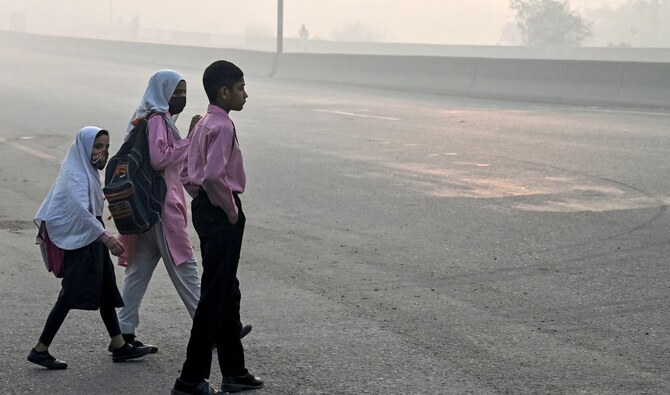
ISLAMABAD: Authorities in the eastern Pakistani province of Punjab have altered timings for all public and private schools as prevailing smog continues to threaten lives in the country’s most populous province.
The Punjab Environmental Protection Authority (PEPA) this week issued a notification, detailing the adjusted timings and additional precautionary measures.
Effective from Oct. 28 till Jan. 31, schools in the province will begin at 8:45am, while morning assemblies will be held indoors to reduce students’ exposure to hazardous air.
The decision to alter school timings and suspend outdoor activities aims to minimize exposure to hazardous air quality, according to the provincial authorities.
“In the morning, the smog is more intense. Keeping this in mind, the government has wisely taken measures to prioritize children’s health by rescheduling school timings” Sarah Ather, principal of SAINT ANDREWS CHURCH CATHEDRAL SCHOOL SYSTEM, told Reuters.
“This is a good initiative by the government to provide safer facilities for children.”
Smog is particularly bad in winter as a result of low-grade fuel from factories and vehicles in the low-lying megacity of 14 million, where denser cold air traps emissions at ground level. Seasonal crop burn-off by farmers on the outskirts of Lahore is also a major contributing factor.
Lahore, the provincial capital, topped the global pollution charts on Monday, earning the dire distinction of the world’s most polluted city, when the air quality index (AQI) hit 507 at around 10am local time (0500 GMT), with the Switzerland-based air quality watchdog IQAir categorizing the air quality as “hazardous.”
But some parents say the change in school hours won’t reduce smog and they will have to readjust their schedules for transportation of children.
“The change in school hours hasn’t reduced the smog. It remains a constant issue,” said Mohammad Shahbaz.
“The revised timing has only caused disturbance in public schedules. Earlier, schools ran from 8:00 am to 1:00 pm, but now children return home at 3:00 pm, creating logistical challenges for parents.”
Breathing the toxic air has catastrophic health consequences, with the World Health Organization saying strokes, heart disease, lung cancer and respiratory diseases could be triggered due to prolonged exposure.
According to the United Nations Children’s Fund (UNICEF), nearly 600 million children in South Asia are exposed to high levels of air pollution.


Pakistan’s Punjab alters school hours as severe smog threatens health of students

https://arab.news/5cmdu
Pakistan’s Punjab alters school hours as severe smog threatens health of students
- The provincial capital of Lahore near the border with India regularly registers among world’s most polluted cities
- Smog is particularly bad in winter due to low-grade fuel from factories, vehicles in the low-lying city of 14 million

Pakistan’s president defends ongoing strikes in Afghanistan, urges Kabul to dismantle militants
- Afghanistan on Thursday launched attacks in retaliation for Pakistani airstrikes the previous Sunday
- Pakistan’s military says it is only targeting Afghan military installations to avoid civilian casualties
ISLAMABAD: Pakistan’s president on Monday defended his country’s ongoing military strikes in neighboring Afghanistan, saying Islamabad tried all forms of diplomacy before targeting militants operating from Afghan territory, and called on the Taliban government in Kabul to disarm groups responsible for attacks in Pakistan.
Pakistan earlier said it is in “open war” with Afghanistan, alarming the international community. The border area remains a stronghold for militant organizations including Al-Qaeda and the Daesh (Islamic State) group.
“(The Afghan Taliban) must choose to dismantle the terror groups that survive on conflict and its war economy,” Asif Ali Zardari said during a speech to lawmakers, adding that “no state accepts serial attacks on its soil.”
Afghanistan on Thursday launched attacks in retaliation for Pakistani airstrikes the previous Sunday. Since then, Pakistan has carried out operations along the border, with Information Minister Attaullah Tarar claiming the killing of 435 Afghan forces and the capture of 31 Afghan positions.
Kabul has denied such claims.
In Afghanistan, the deputy government spokesman Hamdullah Fitrat said Pakistan’s military fired mortar shells at a refugee camp in eastern Kunar province, killing three children and injuring three others.
Afghanistan’s defense ministry said Afghan forces carried out strikes targeting a Pakistani military facility near Paktia province, causing “substantial losses and heavy casualties.”
Pakistan’s military did not respond to questions. It has said Pakistan is only targeting Afghan military installations to avoid civilian casualties.
Pakistan has witnessed a surge of violence in recent months and blames it on the outlawed Pakistani Taliban, known as Tehreek-e-Taliban Pakistan or TTP. It operates both inside Pakistan and from Afghan territory.
Islamabad accuses Afghanistan’s Taliban government of providing safe havens for the TTP, which Kabul denies.
The latest cross-border fighting ended a ceasefire brokered by Qatar and Turkiye in October. The two sides failed to reach a permanent agreement during talks in Istanbul.
Zardari reiterated Pakistan’s call for talks, saying, “We have never walked away from dialogue.”
The Pakistani leader again accused Afghanistan of acting as a proxy for India by sheltering militant groups.
“Stop being used by another country as a battlefield for their ambitions,” he said.
Zardari cited a recent report from the United Nations Security Council’s monitoring team that described the presence of militant groups in Afghanistan as an extra-regional threat.


