

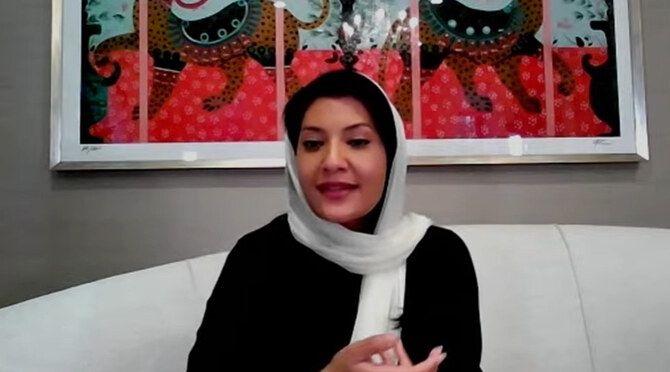
Vision 2030 reshaping women’s lives in Saudi Arabia, says Princess Reema

Speaking at a panel discussion in the inaugural edition of the HERizon Summit, on the sidelines of the eighth Future Investment Initiative, Princess Reema bint Bandar said that the right policies should be implemented to accelerate the progress of females in the business and entrepreneurial landscape. 
Short Url
Updated 28 October 2024
Follow

Vision 2030 reshaping women’s lives in Saudi Arabia, says Princess Reema

RIYADH: Saudi Vision 2030 has reshaped women’s lives in the Kingdom, as regulatory reforms help females pursue more opportunities in the public and private sectors, according to Riyadh’s ambassador to the US. 

Speaking at a panel discussion in the inaugural edition of the HERizon Summit, on the sidelines of the eighth Future Investment Initiative, Princess Reema bint Bandar said that the right policies should be implemented to accelerate the progress of females in the business and entrepreneurial landscape. 

Launched under the theme “Invest in Women,” the event aims to bridge the gender gap and empower females to become a formidable force in the global workforce.

A report released by the World Bank earlier this month affirmed Saudi Arabia’s progress in ensuring gender parity and highlighted that the Kingdom successfully raised female labor participation from 22 percent in 2016 to 34 percent by the end of 2023.

“The Kingdom’s progress since Vision 2030 is quite astounding. The biggest change has been made is the regulatory frameworks and the laws that have been implemented, which allowed not just the government to push forward on the inclusion of women, but it also created a framework for the private sector to understand their responsibilities,” said Princess Reema. 

She added: “When we talk about the accelerators for the inclusion of women, more policies and investments have to be made. It is not just the policy on paper; it is all about the implementation, the follow through, and the creation of a space where the woman herself understands what proportion of resources she needs.” 

According to the top diplomat, mentorship, internship, and investment in training and education could help women in the Kingdom explore unique job opportunities in new sectors. 

“Our women do need the exposure to help them level up. The more we engage with women from other countries and men from other countries and learn and expose ourselves, these Saudi women will be women who can work anywhere in the world. That’s the goal,” added Princess Reema. 

She emphasized placing the right woman in the proper role to fully leverage their expertise and achieve the best results.

“I would really employ the due diligence to hire ‘the’ right women, not just ’a woman’. ‘The’ woman that you are looking for does exist. You just need a little time to look for them and find them,” she said. 

She added: “The women in the Kingdom of Saudi Arabia, we are not tokens, we are not a box to tick. We are women who are dedicated to the development, not just about the country, but about families, nations, and our neighborhood.” 

During the event’s opening ceremony, Richard Attias, CEO of FII Institute, said that the first edition of the HERizon Summit is a gathering dedicated to highlighting the limitless potential of women worldwide. 

He added that the event aims to discuss transforming women’s lives and igniting that change.

“We must acknowledge that the past has not been easy for women, where too many voices remained unheard. Today, we are here to break down those barriers. We should envision a world where opportunities are boundless and equal for all. This is a movement toward inclusion, innovation, and unity,” said Attias. 

He added that the summit will work to ensure that women will get equal opportunities like men in all sectors, breaking the barriers of borders and therefore allowing females to reach their highest potential. 

The FII CEO added: “We believe that when women rise, a nation prospers. When women lead, society is transformed, and when women’s voices are amplified, our shared future becomes brighter and stronger. We believe in that.” 

In the panel discussion, Cecilia Attias, founder and president of Cecilia Attias Foundation for Women said that females should be given specific quotas in the board of companies to ensure gender parity. 

“I am surprised we still have a panel for women. We should be part of the other panels. We are in the 21st century. We should have the same opportunities like men,” said Cecilia. 

Jenny Johnson, president and CEO of Franklin Templeton said that women are more talented than men in handling venture capital funds, despite the less support they receive. 

“In the US, less than 2 percent of venture capital have been given to women entrepreneurs, yet they have twice the returns of the average venture capital funds,” said Johnson. 


Global brands shut Middle East stores as conflict causes chaos

Updated 03 March 2026
Follow

Global brands shut Middle East stores as conflict causes chaos

  • Luxury brands and retailers close stores in Middle East
  • Conflict threatens the region that has ‌been luxury’s fastest growing
  • Mass-market retailers monitor situation, adjust operations in region

PARIS: In Dubai and other major Middle Eastern shopping hubs, many stores are closed or operating with a skeleton staff as the escalating conflict in the ​region causes chaos for businesses and travel.

The US-Israeli air war against Iran expanded on Monday with no end in sight, with Tehran firing missiles and drones at Gulf states as it retaliates for a weekend of bombing that killed Iran’s supreme leader and reportedly killed scores of Iranian civilians, including a strike on a girls’ primary school.

Chalhoub Group, which runs 900 stores for brands from Versace and Jimmy Choo to Sephora across the region, said its stores in Bahrain were closed, while other markets, including the UAE, Saudi Arabia, and Jordan remained open though staff attendance was “voluntary.”

“We operate with a lean team formed of members who volunteered and feel comfortable to come to the store,” Chalhoub’s Vice President of Communications Lynn al ‌Khatib told Reuters, adding ‌that the company’s leadership team personally visited Dubai Mall and Mall of the Emirates ​on ‌Monday ⁠morning to check ​in ⁠with workers.

E-commerce giant Amazon closed its fulfillment center operations in Abu Dhabi, suspended deliveries across the region and instructed its employees in Saudi Arabia and Jordan to remain indoors, Business Insider reported on Monday, citing an internal memo.

Gucci-owner Kering said its stores were temporarily closed in the UAE, Kuwait, Bahrain and Qatar and it has suspended travel to the Middle East.

Luxury growth engine under threat

Shares in luxury groups LVMH, Hermes, and Cartier-owner Richemont were down 4 percent to 5.7 percent on Monday afternoon as investors digested the knock-on impacts of the conflict.

The Middle East still accounts for a small share of global spending on luxury — between 5 percent and 10 percent, according ⁠to RBC analyst Piral Dadhania. But the region was “luxury’s brightest performer” last year, according to consultancy ‌Bain, while sales of expensive handbags have stalled in the rest of the ‌world.

Now, shuttered airports have put an abrupt stop to tourism flows into ​the region and missile strikes — including one that damaged Dubai’s ‌five-star Fairmont Palm hotel — are likely to dissuade travelers, particularly if the conflict drags on.

“If you assume that it’s ‌a $5 billion to $6 billion (travel retail) market and let’s say it’s going to be shut down for a month, we are talking about hundreds of millions of dollars that are definitely at risk,” said Victor Dijon, senior partner at consultancy Kearney.

If Middle Eastern shoppers cannot travel to Paris or Milan, that could also hurt luxury sales in Europe, he added.

Luxury brands have been investing in lavish new stores and exclusive events ‌across the region. Cartier unveiled a “high-jewelry” exhibition in Dubai’s Keturah Park just days before the conflict started.

Cartier and Richemont did not reply to requests for comment.

Luxury conglomerate LVMH ⁠has also bet big on ⁠the region. Last month, its flagship brand Louis Vuitton staged an exhibition at the Jumeirah Marsa Al Arab hotel, and beauty retailer Sephora launched its first Saudi beauty brand.

LVMH does not report specific figures for the region, but in January Chief Financial Officer Cecile Cabanis said the Middle East has been “displaying significant growth.” LVMH did not reply to a request for comment on how its business may be impacted by the conflict.

The Middle East has also attracted new investment from mass-market players. Budget fashion retailer Primark said in January that it plans to open three stores in Dubai in March, April and May, followed by stores in Bahrain and Qatar by the end of the year.

“Primark is set to open its first store in Dubai at the end of March but clearly this is a fast-moving situation which we are monitoring closely,” a spokesperson for Primark-owner Associated British Foods said.

Apple stores in Dubai will remain closed until Thursday morning, the company’s website showed, while Swedish fast-fashion retailer ​H&M said its stores in Bahrain and Israel are ​closed.

Consumer goods group Reckitt has told all employees in the Middle East to work from home, temporarily closed its Bahrain manufacturing site and suspended all business travel to the region until further notice.