

Modi, Spanish PM launch India’s first private military aircraft plant in Gujarat

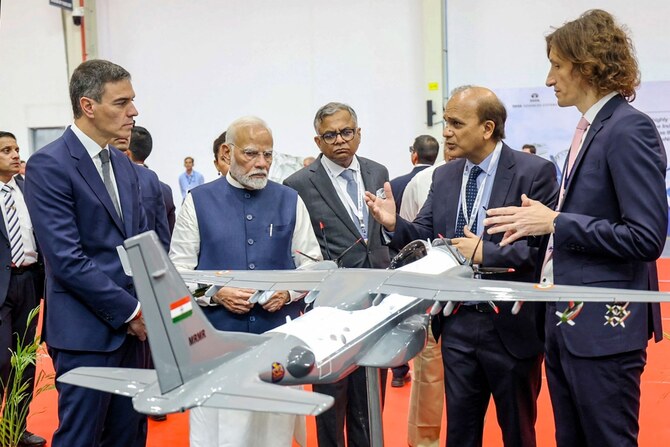
Spanish Prime Minister Pedro Sanchez and Indian Prime Minister Narendra Modi attends an exhibition during the joint inauguration of TATA Aircraft Complex in Vadodara, Gujarat on Oct. 28, 2024. (Indian Press Information Bureau)
Short Url
Updated 28 October 2024
Follow

Modi, Spanish PM launch India’s first private military aircraft plant in Gujarat

  • The first C-295 aircraft made in India will be rolled out by Vadodara plant in 2026
  • Modi launched ‘Make in India’ initiative in 2014 to promote country as a global manufacturing hub

NEW DELHI: Indian Prime Minister Narendra Modi and his Spanish counterpart Pedro Sanchez inaugurated India’s first private military aircraft plant on Monday, boosting the country’s ambitions of becoming a global manufacturing hub. 

In Gujarat state’s Vadodara city, the two premiers launched the Tata Aircraft Complex, the manufacturing hub that will produce the Airbus C-295 transport military aircraft in collaboration with Airbus Spain and to be deployed by the Indian Air Force.

“In India, the defense manufacturing ecosystem is touching a new height. Had we not taken a firm step 10 years ago we would not have reached this feat today. Back then no one could have imagined that India could be involved in defense manufacturing on such a scale,” Modi said at the launching ceremony. 

The Indian premier vowed to turn India into a global manufacturing hub when he came to power in 2014 with his “Make in India” initiative, including in infrastructure, pharmaceuticals and the defense sector. 

“That time our priority and identity were of importer. But we decided to tread a new path, we fixed a new target for us and today we are witnessing the result,” he said.

Under a $2.5 billion deal signed in 2021, India and Spain agreed to procure 56 C-295 transport aircraft to replace the aging Avro-748 planes of the Indian Air Force. 

Airbus will deliver the first 16 of the aircraft from its final assembly line in Seville, Spain — six of which have so far been delivered. The remaining 40 will be manufactured and assembled by Tata Advanced Systems in India, as part of an industrial partnership between the two companies. 

“The factory will not only strengthen India and Spain’s relationship but also consolidate Make in India and Make for the World Mission,” Modi said. 

The plant in Vadodara is expected to roll out the first C-295 aircraft made in India in 2026. The plane can transport up to 71 troops or 50 paratroopers, will be able to access remote locations and be used for medical evacuations and aid in disaster response and maritime patrol duties.

“This project brings together the best of two worlds,” Sanchez said. 

“This project strengthens our industrial ties while underlying our country's deep commitment as a reliable and strategic partner. This plant will be a symbol of industrial excellence, an engine of growth and a testament to the close and growing friendship.”

Sanchez was on a three-day visit to India, the first such trip by a Spanish leader to the South Asian nation in 18 years.

As part of his visit, Sanchez will also travel to India’s financial capital of Mumbai on Tuesday, where he is expected to meet with trade and industry leaders, as well as visit film studios in an effort to boost entertainment industry collaboration between the two countries. 

As the world’s largest arms importer, accounting for almost 10 percent of total global arms import between 2019 and 2023, the plant in Vadodara marks a new chapter in India’s defense industry development.  

“To maintain strategic autonomy, it is imperative to substantially reduce dependence on foreign suppliers. Hence, India is focusing on maximizing its domestic production of advanced defense systems,” Delhi-based defense analyst Ranjit Kumar told Arab News. 

India has been encouraging the private sector to make investment in weapons production to increase its self-dependency in the defense sector. New Delhi is also in talks with German and Spanish submarine makers to produce next-generation diesel submarines in India, he added. 

“India is thus leveraging its huge defense market to successfully negotiate with leading international defense firms to produce their weapon systems in India for supplying not only Indian armed forces but also use the facility in India for the international market.” 


Germany’s Merz visits India to push defense industry ties ahead of EU trade deal

Updated 12 sec ago
Follow

Germany’s Merz visits India to push defense industry ties ahead of EU trade deal

  • India, Germany make joint declarations on cooperation in defense, critical minerals, energy
  • Merz is accompanied by CEOs of top German companies such as Thyssen, Siemens, Bosch

NEW DELHI: German Chancellor Friedrich Merz met Indian Prime Minister Narendra Modi on Monday to push for defense industry cooperation ahead of India’s awaited free trade agreement with the EU.

Merz’s two-day trip is his first since taking office in May and he is accompanied by German business leaders.

The visit started in Ahmedabad in Gujarat, Modi’s home state, where they held a press conference after a delegation-level meeting and a series of joint declarations, including on strengthening bilateral cooperation in the defense industry, critical minerals, semiconductors, and energy.

“The growing cooperation in defense and security is a symbol of our mutual trust and shared vision,” Modi said, as he thanked Merz for “simplifying the processes” related to defense trade.

“We will also work on a roadmap to enhance cooperation between our defense industries, which will open up new opportunities for co-development and co-production.”

The roadmap would promote long-term industry-level collaboration, including technology partnerships, co-development and co-production of defense platforms and equipment, according to Prof. Ummu Salma Bava, chairperson of the Special Centre for National Security Studies at Jawaharlal Nehru University.

“This defense cooperation marks a transformational shift in the bilateral relations that had till now focused on economic cooperation, and inaugurates a new chapter on a scaled-up defense engagement,” she told Arab News.

“PM Modi indicated that both countries are entering the ‘limitless’ phase in expanding economic cooperation in strategic sectors.”

Germany is India’s most important trading partner in Europe and one of its top partners worldwide, with bilateral trade in goods and services estimated by the Indian Ministry of External Affairs at $50 billion.

In Merz’s delegation are 25 CEOs and industry leaders, including from Thyssen Krupp Maritime Systems, Siemens, DHL Group, Infineon Technologies, Uniper, Airbus Defence and Space.

German media reported that one of the key focuses of the visit is finalizing the details of an $8 billion deal to jointly build submarines in India.

The visit comes as India and the EU — of which Germany is the largest economy — are working on a free trade agreement. It also takes place ahead of an EU-India summit in New Delhi on Jan. 27, where parts of the pact are expected to be finalized.

“The visit of the large business delegation with 25 German CEOs is to tap into the growing economic potential and also further strengthen the bilateral economic relations,” Bava said.

“The signing of the India-EU FTA will further expand trade between India and Germany. Germany is the largest economy in the EU and has a strong base in automobiles, engineering, advanced manufacturing, chemicals and defense industry.”