

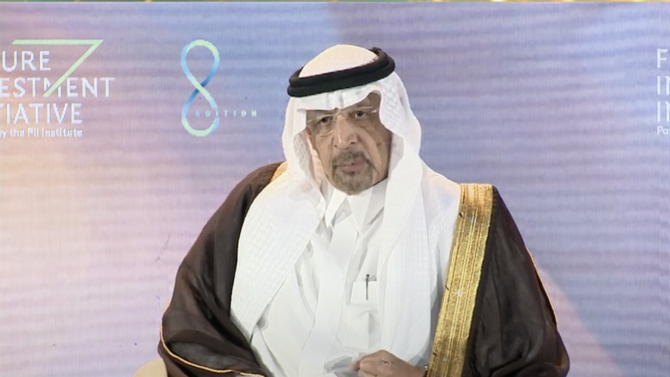

RIYADH: Africa’s economic vitality has a profound impact on global stability, Saudi Arabia’s Minister of Investment Khalid bin Abdulaziz Al-Falih emphasized during a forum ahead of the Future Investment Initiative event.
Speaking at the FII New Africa Summit in Riyadh, global leaders gathered to discuss the opportunities and challenges facing the continent under the event’s theme, “Infinite Horizons: Investing Today, Shaping Tomorrow.”
Addressing the audience, Al-Falih emphasized the importance of recognizing Africa’s growing global role, while advocating for collaborative partnerships to unlock the continent’s vast resources and economic potential.
“When Africa sneezes, indeed, the rest of the world catches a cold,” he said, underscoring the ripple effect of the continent’s economic health on global stability.
He emphasized Africa’s demographic advantage, noting that 18 percent of the world’s population resides on the continent. “Is that a problem, or is that a dividend that Africa should, and the rest of the world indeed, harness, as the world goes through aging and human resources become scarce?” he asked, advocating for a shift in perspective regarding Africa’s growing youth population.
Highlighting the contient’s rich agricultural potential, Al-Falih pointed to Africa as a “breadbasket and food basket for the rest of the world,” particularly for regions like the Arabian Peninsula and the broader Gulf Cooperation Council, which see immense strategic value in its resources.
“We need to work together to mobilize finance,” he urged, calling for targeted investment to drive sustainable development across the continent.
Al-Falih noted that investment in the region should be a partnership rather than an aid-based relationship. “We don’t want to help Africa,” he said, “we want to work with Africa to create opportunity for investors.”
He also underscored the need for nations on the continent to strengthen governance, transparency, and regulatory frameworks to attract investors and drive long-term growth. “Africa needs to first help itself,” he added, stressing that sound public policy and regulatory environments are key for sustainable development.
Also speaking on Africa’s economic potential, Amadou Hott, former minister of Economy, Planning, and Cooperation of Senegal, emphasized the importance of internal resource mobilization to ensure sustainable growth.
“It is extremely important to have sound public finances and make sure we are mobilizing more resources domestically,” Hott said, pointing to the need for fiscal prudence and proactive policy measures.
Infrastructure emerged as a focal point during the discussions, as Adebayo Ogunlesi, CEO of Global Infrastructure Partners, highlighted Africa’s energy deficit, with “40 percent of the African continent [lacking] access to electricity.”
He also cited Nigeria’s limited electricity generation, which trails behind the output of a mid-sized American city, as an example of the infrastructure gap that constrains economic potential.
Tidjane Thiam, president of Cote d’Ivoire’s Democratic Party, argued that a well-managed domestic economy is the foundation for attracting foreign capital.
“Foreign investment is a reward that will come as a result of you managing properly your domestic economy,” Thiam said.
He highlighted solar power as a transformative opportunity for Africa, describing it as “the cheapest and cleanest form of energy” and a powerful solution for the continent’s needs.
Further showcasing Africa’s renewable energy potential, Samaila Zubairu, president and CEO of the Africa Finance Corp., pointed to the continent’s hydroelectric resources, with “350 gigawatts of hydroelectricity, with less than 10 percent of that developed.”
He detailed ongoing efforts with the government of the Democratic Republic of the Congo to rehabilitate a major hydroelectric dam, underscoring the value of partnerships in scaling Africa’s renewable energy infrastructure.
“Africa has abundant energy systems that can be used both for Africa and for the rest of the world,” he added.
Building on this message of collaborative growth, Zubairu mentioned partnerships with Saudi entities, including memoranda of understanding with the Saudi Fund for Development and Saudi Exim Bank, to bolster financing and support African infrastructure projects.
This commitment reflects Al-Falih’s belief that “the world needs Africa as much as Africa needs the world,” a sentiment that resonated throughout the panel discussion.


